

VIDEO: British army vets work with Afghan farmers
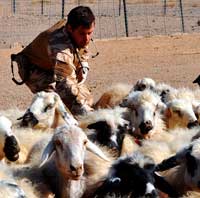
Captain Miles Malone is fast becoming known as the “Herriot of Helmand” for his work with Afghan farmers.
The 28-year-old, halfway through a seven-month deployment at the British forces hub of Camp Bastion, is spearheading a pioneering veterinary clinic.
Miles’ main role in the Army is to provide preventative healthcare and emergency care to the dogs used to search out IEDs and guard camps where troops are based, but he’s become the force behind a new project to improve local Afghans’ standard of living.
His monthly vet clinic invites farmers from the villages dotted to the northwest of Camp Bastion – away from the Green Zone where most fighting has occurred – to bring their livestock for a free check-up and dose of preventative healthcare.
It’s a dangerous business. Under the watchful eye of Kalashnikov-armed Afghan Army guards, perched on top of four-wheel drive Ranger vehicles as security look outs, the veterinary officer carries a pistol at his waist. This is, after all, Taliban country: unpredictable and dangerous.
Scroll down to watch a video of Captain Malone in action
“Here come the first customers of the day,” announces Miles as he spots movement several kilometres away.
A turbaned Afghan farmer moves slowly across the sandscape on his motor scooter, with his three young sons riding pillion and another boy herding a flock of about 100 sheep towards the makeshift wire pen of the vet clinic.
“Livestock forms the lifeblood of these local communities,” he says, “so by improving the health of the herd, we can have a positive impact on the health, wealth and general wellbeing of the population.”
“If we reduce the disease state of the animals, the effect will be improved meat and milk production. This increases the value of the animals at market and increases the amount of protein in the locals’ diet. If the meat doesn’t contain worms or diseases which can be transmitted to humans, the local population’s health improves.”
Click here for more pictures of the “Herriot of Helmand” |
|---|
Giving assistance to the population also serves a useful purpose for British forces. “By helping the locals with a project like this, we build up good relations with them and they repay us with information about the surrounding area and Taliban activity.”
In this remote and desolate area, semi-nomadic families eke out a living by growing a few crops – usually poppy with its ready-made market to the Taliban – and farming livestock. The goats, sheep, cows and donkeys are prized and valuable possessions (so much so that the womenfolk make colourful beaded necklaces to adorn the cattle’s necks).
Sergeant Major Greg Reeve from Wiltshire explains: “If an Afghan man owns an animal, it will be more prized to him than any other possession, apart from his sons.
“Apart from the family compound, the cows, sheep and goats are a farmer’s most valuable commodity. Female children and wives come low down in the pecking order. Everything in Afghanistan has a price, but you cannot compare local values to Western values.
“A farmer may well be more concerned about an animal dying than he would his child or one of his wives. It sounds harsh, but life is harsh here,” adds Greg. “If a farmer’s herd is in poor health, his family’s income will be reduced and all the family members will suffer. Once you start to understand the way Afghan society works and the crucial dependence on animals for existence, you can see why a project like this could really benefit the local population.”
Click here for more pictures of the “Herriot of Helmand” |
|---|
Despite the value they place on their livestock, Greg says the largely illiterate populace know little about how to care for their beasts.
“There is near total ignorance about causes and spread of disease, breeding cycles and how milk is produced. If a goat stops milking, it is said to be Allah’s will rather than the fact that it has not bred for 18 months and therefore has no anatomical reason to produce milk.”
As such, the natural health of herds is poor, with cattle usually underweight and riddled with worms, mites and other parasites. They also frequently carry diseases which can spread to humans. Brucellosis is common and causes abortion and premature births in both cattle and humans. The intestinal worms carried by sheep and goats also spread to humans via the food chain.
Miles, who has now held three vet camps, points out that the priority is firstly to de-worm and de-louse. Once the animals have achieved a baseline of health, he then vaccinates.
“From a slightly geeky veterinary perspective, these herds are fascinating because the goats and sheep are extremely ancient breeds. They have not been engineered by breeding programmes and are as they would have appeared in biblical times. Because they have not been exposed to drugs and have built up no resistance, they respond extremely well and quickly to the products I give them.”
Already he is seeing the same farmers returning with their herds for treatment. “The improvement in herd health is marked, even in such a short space of time.”
To immunise and worm each animal costs around £1.70 in medication, rising to £4 per head if antibiotics are needed. This needs to be sustainable, so the drugs are sourced from local suppliers and, in the future, the plan is to train Afghans in basic veterinary skills so they can carry out treatments themselves. The hope is that this project will leave a “lasting and beneficial legacy”.
Click here for more pictures of the “Herriot of Helmand” |
|---|
After his livestock have been treated, the Afghan farmer shakes hands with the vet, mounts his motor scooter and heads off, accompanied by his children and animals.
He is, by Afghan standards, wealthy and therefore influential and the British serviceman know if they can get him on side, he’ll spread the word about the veterinary programme.
The next day several more locals farmers arrive at the clinic together with about 500 sheep, goats and a couple of donkeys. Miles once again goes to work…