Air tour gives a glimpse of disease pressures
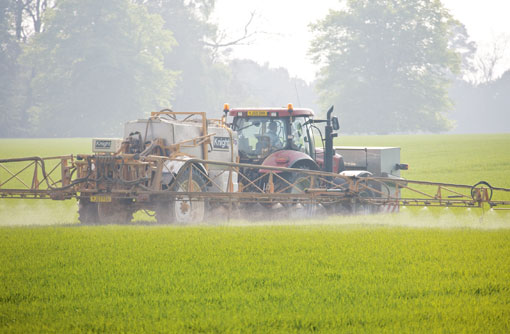
After the 700-mile whistle-stop Crop Doctor helicopter tour of the country to find out the disease pressures in wheat crops, Adam Clarke reports on the findings
Septoria tritici is rampant across the UK on all varieties, with growers urged to plan a robust T1 fungicide to suppress the disease.
While a dry spring has not been conducive to the spread of the disease, heavy morning dews have allowed septoria to establish in new growth.
Other diseases such as rust, mildew, eyespot and fusarium were more variable across the regions, with varietal resistance and local conditions dictating disease threat.
Farmers Weekly teamed up with Bayer CropScience on the Crop Doctor tour to identify the disease risks in winter wheat on four trial sites, and discuss control strategies.
Cawood, Yorkshire
The trial site at Stockbridge Technology Centre is on very free draining, light soils that are ideal for growing vegetable crops, but cereal yields can be compromised in dry years.
“Early drilling and varietal choices are vital and crops tend to mature early,” said Sean MacGill, commercial technical manager at Bayer CropScience. “T0 and T1 timing is vital in the area,” he said.
Concerns at Cawood included septoria, yellow rust and mildew, which was of particular concern to Mr MacGill despite the disease not being active.
“Where it has been so dry recently, the mildew has dried out, but the black dots that can be found in the leaf lesions will explode into life once the rain comes back.
“On this light land mildew can be a serious problem, and in a crop of untreated Solstice last year we saw a yield reduction of nearly 2t/ha.
“In a commercial situation a specific mildewicide at T0 would be vital in keeping the disease in check until the T1 timing, where the broad-spectrum products will take over,” he said.
Yellow rust could be found in susceptible varieties such as Oakley but also Solstice, Santiago and Viscount. Crops were about to receive a T0 treatment to hold septoria and control the rust.
“Crops will receive a half rate of Folicur with chlorothalonil, but in susceptible varieties such as Oakley, where yellow rust infection can be found, it may be worth upping rates,” said Mr MacGill.
Local AICC agronomist Julian Thirsk had applied an early spray in some susceptible varieties, which will result in a five spray programme.
“Yellow rust is now sweeping through those varieties and where we had backward crops after roots sat at growth stage 24, they have received a pre-T0 of a low dose Centaur to hold the disease.
“The T0 sprays are going on now, and where yellow rust was a particular concern the spray was bought forward to get on top of the disease,” said Mr Thirsk.
Callow, Herefordshire
Situated just south of Hereford, the local cropping area is predominately feed wheat. Poultry producer Sun Valley Foods is situated nearby, providing growers with a market, and influencing varietal choice and crop management.
Heavy clay loam soils retain moisture and provide high yield potential, with the site achieving an average yield in excess of 10t/ha.
The main focus at Callow is Septoria tritici, which is the biggest threat to the high yields achieved at the site, but eyespot can provide a concern and was present in the trial plots.
“We have had no rain in the last couple of weeks, but we have had some very heavy dews which have really got the septoria going,” said Gareth Bubb, commercial technical manager at Bayer CropScience.
“You can see septoria present in nearly every plant in some plots, so it will be a challenge to keep levels down,” added Mr Bubb.
The site has been sprayed with a T0, which has chlorothalonil included to keep septoria under control until T1.
Crops at the site and in the local area have promising yield potential, according to local independent agronomist David Lines, and this has prompted him to plan to use an SDHI fungicide at T1.
“With cereal prices as they are, and the yield potential there, I will invest in Aviator at T1 and in less promising situations the T1 will be based on Firefly.
“I don’t think there is much between the three new SDHIs, and I will also try the other products this year to get a further comparison,” said Mr Lines.
Long Sutton, Lincolnshire
Long Sutton is situated on fertile silt loams, which have excellent yield potential.
Typically a high yellow rust risk site, minimal levels were present in the trial plots, even in susceptible varieties such as Oakley.
“There was significant yellow rust infection carried through the winter here,” said Andrew Flind, fungicide development manager at Bayer CropScience.
“But the severe frosts that resulted from the cold snap during February really held the disease back, even on susceptible varieties.
“Growers should not be complacent though, and the issue should still be addressed at T0.
“It buys time until T1, and allows you to concentrate on the disease that really saps yield, which is septoria,” said Mr Flind.
The eastern side of the country has had two very dry springs, cutting yield potential and disease incidence, but Mr Flind believed it was a very risky game to cut back on fungicides.
“If you do get a major rain event after a prolonged dry spell, you can get disease jumping from the base of the plant to the flag leaf, like we saw last year.
“I think it’s advisable for growers to stick to the plan where possible, and particularly where SDHI chemistry is concerned,” said Mr Flind.
“Where you are on the edge of droughty conditions, Aviator Xpro can give you real benefits, protecting grain sites and producing extra yield.”
Rates must also be kept up with the new products, as growers would not see the physiological benefits at lower rates, while resistance management was also a further reason to maintain a robust programme, Mr Flind added.
Fusarium could also be found at the Long Sutton site, and while the traditional T3 control timing is at GS61-65, where conditions are favourable it is something that is beneficial to control early.
“We have independent evidence from research at Harper Adams and FERA that an application of Proline, at both T1 and T2, helps stop the spread of inoculum up the stem and relieve the pressure on your T3,” Mr Flind said.
Petersfield, Hampshire
Situated in the South Downs, soils vary from free draining chalk on higher ground, to heavy clay in the bottom of the valleys.
The close proximity to ports has resulted in the area predominantly growing milling and biscuit wheats for export.
Mild winters usually result in high disease pressure from septoria, rusts and mildew.
Soil types in the area dictate early drilling and are, therefore, conducive to stem based disease such as eyespot.
Fusarium was less of a concern in the area, except when the crop was established after maize, said Richard Cromie, local agronomist with Crop Management Partners, based in Petersfield.
“That problem is easily solved by not growing milling varieties after maize,” he explained. “But where fusarium is present, Proline at T1 is the best option and should get on top of the disease.”
“Our T0s have all been applied, based on Cherokee, however, where eyespot and mildew were a concern we used Ceando,” said Mr Cromie.
Brown rust had been present at the site, but Mr Cromie was encouraged by the results of the earliest T0 applications.
“The treatments look to have done a fantastic job and have cleaned out any active inoculum,” he said.
But at T1 Mr Cromie will be recommending Tracker where the disease is a concern.
“It is the best product in a curative situation, with Proline being slightly weaker on brown rust,” said Mr Cromie.
Second wheats will receive a Proline or Firefly, if there is a need for a strobilurin, mixed with Bravo.
“If the weather cools down conditions will become more conducive to yellow rust and that will take priority, with Proline being the stronger product,” he added.
The decision on whether to use an SDHI fungicide this season is clear, with crops looking well on the heavier land.
“Crops would have to go backwards rapidly for us not to use one, as the potential is there.
“We will invest in Aviator as I am concerned with the lower rate of triazole in the Adexar formulation,” said Mr Cromie. “If rust is a problem at the flag leaf stage I would add a strobilurin into the mix too.”
“My preference of using Tracker at T1 is also a good reason for using Aviator, as you are then rotating your two main triazoles at T1/T2,” he added.