

Pneumonia Hit Squad: calf-rearing advice from experts
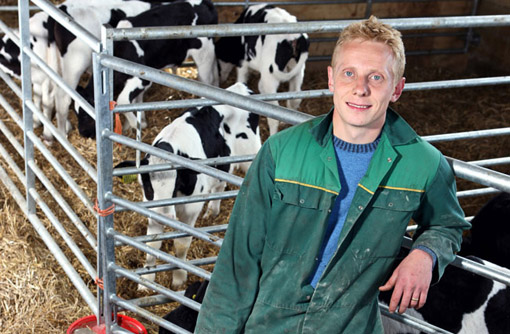
As a follow-up from Farmers Weekly’s Youngstock: Stop the Loss campaign, a group of specialist advisors teamed up to form the Pneumonia Hit Squad and visited three producers to troubleshoot their calf-rearing systems.
The Hit Squad’s recommendations prove you don’t have to have a big, new set-up to get the best from your calves – it’s about making the most of the buildings you have.
Aly Balsom reports from Ben (pictured) and John Prior’s Combe Farm in Castle Combe, Wiltshire.
How Ben and John Prior’s rearing system is set up
- 150-cow herd, year-round calving, organic system
- Try to give a 2-litre bag of colostrum at birth and ensure calf sucks cow or teat bar – calves stay with dam for 12 hours
- Some colostrum frozen, but quality not tested
- Calves fed 2.5-3 litres of waste milk twice a day (cost of organic milk powder, at about 49p/litre, makes it unworkable)
- Calves on milk for 12 weeks to fit with organic requirements
- Calves supplied with home-mixed blend
- Bulls and heifers mixed until four to five months old
- Quarterly bulk milk testing for top five diseases
- Calves generally moved at weaning
- Three main housing steps – high-roofed baby calf house next to parlour, mono-pitch brick shed for weaned calves, dutch barn for calves from four to five months old
Issues identified by Ben and John Prior
- Poor housing and labour are among the main challenges
- Five to six calves a year up to 12 months of age lost to pneumonia – most losses seen post-weaning
- Arable business means calf management can suffer during harvest
- Shared responsibility for calves among staff and poor communication
- Increasing cow numbers have added to challenge of calf rearing
- Aim is to bag calves with 2 litres of colostrum at birth, but sometimes this can slip at the weekends
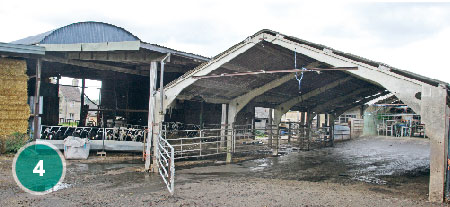
- Main issues with calf health when animals moved into a dutch barn at four to five months old – this barn is attached to the collecting yard, with fresh calvers housed in an attached barn in the same air space
- Calves seem to do well at the weaned stage when housed in the mono-pitch shed, however damp bedding is a problem throughout the year
- A drip-feed of calves coming in makes it difficult to have batches going out
Building use and ventilation
You may be seeing problems in the dutch barn, but is this really where the problems are happening, asked Mr Williams.
“Calves may not be getting a good start and then the problem could be manifesting itself later. For example, lungs may have been weakened early on and then when they are exposed to other animals in the dutch barn, that’s when problems develop.”
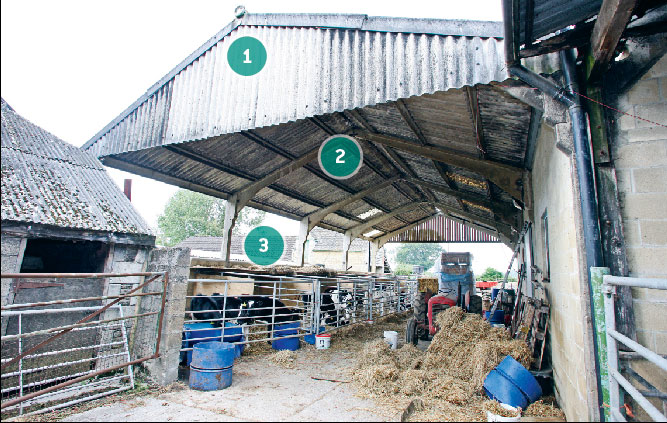
The height of the building currently used to house baby calves was identified as one of the main areas for attention.
The small calves housed in this building are never going to create enough heat to drive air movement in here, said Mr Potter.
Consequently the Hit Squad advised changing the order in which calves move through the system so that building size reflected the size of stock housed.
“I would suggest moving the older, weaned calves into the building currently used for young baby calves. These older calves would be more able to drive ventilation,” Mr Potter said.
However, the central ridge would need to be opened to allow air to exit, and machinery relocated to provide more space. Space boarding with gaps of no more than an inch should also be installed.
The young calves could then be housed in the smaller, mono-pitch buildings, allowing the farm to manage the same group sizes as before. Calves could be kept here for the first six weeks on milk and then moved.
The Hit Squad stressed that drainage would need to be improved in these sheds to house younger stock and advised partitioning off the bedding area from the milk feeding area.
Mr Williams commented: “I would suggest splitting bulls and heifers out when they move from the mono-pitch shed. You can then use the best buildings for the future of the herd.”
Mr Willliams suggested putting bulls in the dutch barn and heifers in the high-roofed building next to the parlour. This would help deal with stock congestion – particularly considering the farm’s intention to grow the herd to 200 cows.
Colostrum
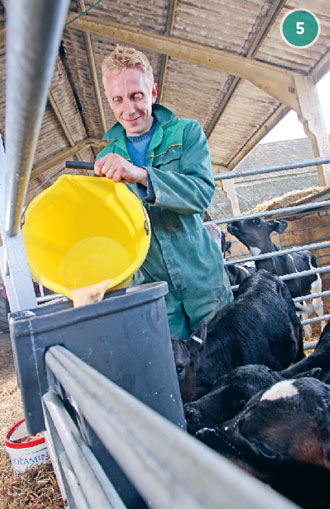
Mr Williams advised undertaking blood immunoglobulin testing to establish whether calves were receiving enough colostrum.
“My concern is not what you are giving them, but the fact you don’t know what the calves think of it,” he said.
“You are stuck with yields, so it’s the quantity that needs addressing. You may not be able to improve quality, but blood test results will tell you if you need to give more.”
Mr Potter said a colostrum meter could come into play as a means of quality control when freezing supplies. This would ensure only the best colostrum was frozen.
Regarding pneumonia control, Mr Williams stressed that colostrum management was the first port of call, rather than vaccination.
“Colostrum makes a bigger improvement on the scale than vaccination. You can manage the pneumonia challenge down by looking at building design and improve resistance through colostrum management.”
Team management
Owing to the fact that a number of people are working with the calves, it would be useful to write down some team protocols, said Mr Potter.
“I would suggest putting up a whiteboard or blackboard next to the calves so things can be ticked off when they’ve been done, rather than relying on texting people.”
|
1. Roof too high for baby calves to ventilate – move weaned calves into this building. 2. Open ridge to improve air outlet. 3. Install space boarding. |
|---|
| 4. Dutch barn not ideal as shared air space with mixed ages. Split stock so older bull calves here and heifers prioritised elsewhere. |
| 5.Blood test calves to see if colostrum feeding is adequate. |
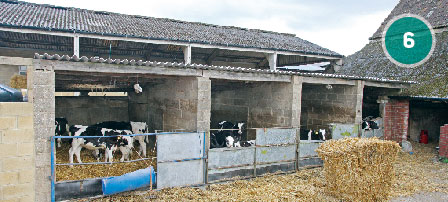
| 6. Move young calves into smaller, mono-pitch building. Improve drainage and partition off bedding and feeding area. |
1. Think about the stocking rate of baby calves – don’t put up buildings that are too big and too high.
- There is the general belief that big, open spaces are good for ventilation, but you need enough animals to create heat to drive air flow, as well as adequate inlet and outlet.
- It’s worse to understock baby calves than to overstock, as they will be unable to drive ventilation.
- The problem with large, open buildings come on a still day.
- An adult dairy cow will generate 12 times as much energy as a calf.
2. Buildings need both an inlet and outlet
- Anything above the eaves is an outlet, anything below the eaves is an inlet.
- If you improve air inlet, you must also improve outlet at the same time.
- The greater the height between the ridge and the eaves, the less inlet and outlet you need.
- Have no more than an inch gap between space boards in sheds for baby calves.
- Mono-pitch buildings are less easily ventilated as stagnant air can gather at the back.
3. Assess colostrum quality and quantity early on
- If you don’t give calves a solid grounding in immunity you will hit problems later on. You could treat calves well from three weeks of age, but if you haven’t got it right from the beginning, you’re fighting a losing battle. Blood immunoglobulin testing at seven to 10 days old can give an idea of whether you’re giving enough good-quality colostrum and if you are giving it adequately.
4. Ideally buildings should be built for a specific purpose
- Before putting up a new shed, decide what it is going to be used for – is it a shed for calves on milk or weaned calves? This will change how you set up drainage and other facilities.
5. Roofing material will effect how a building is ventilated
- Tin roof temperature will vary considerably with ambient temperature – the effect can be like that of a boiling kettle on a mirror, with condensation gathering and potentially dripping on to the beds below. “Tiger stripes” on the roof can be an indication of this problem.
- Thermo-cement is a more stable roofing material than tin.
A building containing animals on a still day ventilates by a phenomenom known as the “stack effect”. The animals drive this with the heat they produce.
This hot air rises within the building and tries to escape through a high-level outlet. This creates a negative pressure within the building, sucking clean, dry, cooler air into the building through inlets. Outlets are above eaves height and inlets are below eaves height.
Think of the movement of air in a livestock building in a similar way to the movement of air/smoke in a fireplace. The animals have a similar role to that played by the fire – enough animals are needed to create enough heat to push air up and out of the building outlet (chimney).
Both inlets and outlets are needed to allow air to be pushed up and out of the building and new fresh air to be drawn in. It’s essential you have both. The most common finding in buildings is a lack of high-level outlet.
See the Hit Squad in action on farm in this video, and read about our other case studies at Boycott Farm in Yockleton, Shropshire, and Ridgend Farm, Worcestershire.