You've
probably heard the phrase "planning prevents poor performance" or something
similar!Nitrogen planning should be
complete and in accordance with NVZ regulations N max calculations and
demonstration of compliance should be documented before any field applications
are made.Fungicide prices are beginning
to firm and prudent growers will have considered programmes based on price and
products that provide the chosen actives at best value.
The weatherman
promises warmer conditions at the beginning of March.As soon as it starts to warm up rapeseed
crops will be ready for their first nitrogen application (usually including
sulphur). Followed by first dressings on barley, second, subsequent, later and
then earlier drilled wheats. So have the spreader poised for action.
As I write this I am looking out on yet another covering of snow with weather forecast not looking too optimistic this weather combined with uncertainty in markets is not helping optimism on farms. However on the whole crops when they are not covered in snow are looking reasonably well.
Oilseed Rape in our area is giving good ground cover and a combination of residual herbicide activity and the winter is meaning that crops are looking clean and very few will be needing a Galera tidy up.
Only about 50-60% of these received the important Light Leaf Spot fungicide so in cases where this wasnt applied more robust rates of Flusilazole or Prothioconazole will be applied at stem extension and depending on growth a decision needs to be made wither to include a metconazole for growth regulation.
As soon as ground conditions allow we will be aiming to get our first Nitrogen/Sulphur on to these crops to waken them up. Winter Barley still is an important crop in our area for rotational
benefits some on lighter ground seems to be suffering a bit of frost
heave and showing up classic manganese deficiency which will need
correcting when ground conditions allow.
My last Crop Watch report at the end of November 2009 said that nobody had turned a wheel in the previous three weeks. We're now at the end of February and, apart from a week or so before the snow came before Christmas, nobody has had much opportunity to do much since then either.
Consequently the biggest subject of discussion at the moment is outstanding autumn spray recommendations. Whilst every individual situation has its own criteria, there are some general rules I go by:
Crystal - latest label timing 31st December
Pendimethalin - not much use post - em on grassweeds -if they've emerged better switching to something else
Atlantis - forget it until things warm up
Contact graminicides - much the same
OSR Fungicides - if they've not already gone on I can't see much point putting them on now until stem extension
Fox/Galera recommendations - who knows? Never put them on before this late this cold
Propyzamide - missed the boat
Carbetamide probably missed the boat
DFF/ Chlortoluron -varies depending on rate or product but most still valid.
Following temperatures as low as -17C in January the rape crops in the area have a much reduced GAI compared to before Christmas, when some crops would have had a GAI of nearly 2. Those same crops are now supporting GAIs of between 0.6 and 0.8. This will have a profound effect on the top dressing regime with the canopies having to be re-built and the nitrogen that was tied up in the canopy largely lost to the present crop.
Nitrogen and sulphur applications will take place to most rape crops as soon as ground conditions allow. Total amounts of nitrogen for the rape crop are going to be significantly higher than we might have assumed just a few weeks ago, with many crops now needing between 200Kg/Ha and 230Kg/Ha instead of the 120Kg/Ha to 150Kg/Ha they would have received if canopies had been maintained.
Cereal crops have survived the freeze extremely well with the exception of a few barley crops where manganese deficiency has lead to a lack of winter hardiness and quite a bit of winter kill. Cereal growth stages are quite varied with early drilled crops now supporting a surplus tiller number. These crops will not be receiving any early N as to encourage further surplus tiller production can only be counter productive.
Field conditions are still very soggy and the drains are running well. Oilseed rape has much better establishment and growth than last year,
but pigeons are starting to be a problem. It's too late for Kerb
(propyzamide) so you need to move to carbetamex for weed control.
A lot of crops were not sprayed for phoma - consequently the disease is
rife and needs controlling. Flusilazole applied at up to 0.5-0.6l/ha
should give good control. Light leaf spot isn't really a problem in
this area, but it is a disease that likes the cold so it needs looking
out for.
First nitrogen applications are high up the agenda once the crop starts
growing and most will be putting on nitrogen and sulphur. We'll be
carrying out SMN testing before making the first nitrogen application
and at stem extension we will look at plant growth regulator fungicide
options. Metconazole is good where there is excessive growth.
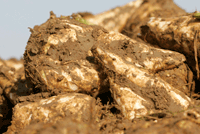
Although the weather during 2010 has not been conducive to spraying, more recently opportunities have been taken to drill spring beans and to continue lifting sugar beet. Despite the freezing conditions during January most beet crops in the ground suffered very little root damage especially where canopy cover remained to provide some protection.
I have not seen any significant damage from the cold weather and the snow on wheat or rape. Rape canopies have shrunk somewhat since the late autumn so to get an accurate picture of crop nitrogen content we are weighing and sampling for dry matter and nitrogen content.
Soil mineral nitrogen sampling has been hampered by weather and travelling conditions but early indications are that results are as low or lower than last season (0-90cm sampling depth). This is to be expected given that winter precipitation has been higher than average and with soil temperatures around 3c the nitrogen cycle has shut down.
SMN sampling wheat after OSR is showing some particularly low levels which may be explained by higher than average rape yields in 2009. At least we have had time to catch up on paperwork and draft nitrogen planners and check all NVZ requirements are in place.
We are just beginning to see some signs of life in OSR crops. New root growth can be found and leaf growth will respond to any rise in temperature. Pigeon damage is mainly confined to the earlier areas where the snow was first to retreat however vigliance is required since there are more relatively small crops than usual.
Harvest 09 was a slow affair and much of the rape area was established towards the middle of September. Most of those crops have a GAI of less than 0.5 but have good root growth so still have good potential but they can't stand any further set back from pigeon damage. Most weed control was Metazachlor based and has done a satisfactory job.
Where cleavers still exist we will use Galera when conditions warm up later in March. Volunteer cereals and wild oats will be moped up with a graminicide again when warmer conditions prevail. Any early spraying will be for light leaf spot where the autumn application failed to go on. Where brome or blackgrass have not yet been treated the only treatment available from now will be a full rate graminicide when growth begins.
Night frosts continue but with little rainfall in the past two and a half weeks there is a good opportunity for preparing spring seed-beds and applying P&K fertilisers.
Spring beans are being planted this week but it is probably a little early for barley to go into such cold soil. Remember if, planting beans, to apply a pre-emergence herbicide as there are few choices for post-emergence treatment.
Most cereal crops have come through the winter very well. Those that were drilled in September have tillered adequately, particularly winter barley. Later drilled wheat crops however have not tillered and will benefit from 40kg/ha of nitrogen in late February/early March.
As usual at this time of year, there are high levels of septoria tritici in wheat and rhynchosporium in barley but it is far too early to consider treatments.
There is a lot of talk in the press about the high risk of yellow rust in many wheat varieties but none is apparent at present.
Cold or wet conditions have limited spraying opporunities, prevented applications of P&K fertiliser etc..... Ploughing/cultivations for spring crops has been possible on light chalks, but most other soils remain too wet to work.
The un-exciting prospects for spring crops mean fallow will be used in the occasional field which has particular weed issues.
Winter cereal crops have come through the cold and snow relatively unscathed, and any untreated crops will no longer need an aphicide. Some frost lift has been seen, but levels do not appear too damaging.
Although we had the best of intentions to apply Atlantis in the autumn to small black-grass plants, this was in many cases not possible. Black-grass is now well tillered, and it is vital to take every step possible to maximise product efficacy.
At last the cold snap and hopefully the main of the winter is over. It is the worst I have known for the last 30 years with snow covered fields and roads like ice rinks. I ventured out one day back in January but after an hour on the road I hastily retreated back home.
All crops except the middle of October late-drilled crops of Oilseed rape have come through the weather pretty well. Once these smaller crops have started to grow and the temperature is above 8C then it would be advisable to apply some early nitrogen to encourage leaf growth and root development. There is a large amount of phoma present on the untreated crops of rape and variable amounts can also be seen on the new growth in some of the autumn treated crops.
These crops will need urgent treatment with a robust rate of a fungicide such as Capitan (flusilasole) as soon as weather conditions allow. Also, look out for light leaf spot, which is at level higher than I have ever seen in my 34 years of experience in the field. Where light leaf spot is noticed then use Proline (prothioconazole) or add carbendazim to the Capitan.
Crops generally look well and it is pleasing to see less field ponding this winter, a sign that soil structure problems were corrected last autumn. With limited opportunities to apply the autumn spray programmes it is now a case of readjusting plans where products were not able to be applied as intended.
Blackgrass control appears good where pre-ems followed by Atlantis mixes were applied pre-christmas. However, I estimate only around 25% of intended Atlantis was applied. As a result there are some well tillered blackgrass populations to control this spring, and with wet soils and low soil temperatures, it will be a while before conditions are suitable for spring Atlantis. The same is true for brome control as many of the sulphonylurea herbicides require warmer conditions than we have now.
Annual broad-leaved weeds and meadowgrasses have been well controlled by autumn residual herbicide mixes. Where fields have not been treated it will be a case of moving towards products with more contact activity.
Snow in January covered crops, and allowed management plans to be completed. Now the snow has gone and crops are visible.
Last week saw an opportunity for the last few outstanding propyzamide and carbetamide applications on oilseed rape to take place. Rape crops appear to have come through the winter so far unscathed, but it is early days and it will be interesting to see if the extremely low temperatures will have effected some of the large canopy crops internally.
Residual herbicides applied to rape prior to Christmas appear to be working extremely well. The hard frosts seem to have taken care of any charlock, hopefully removing the need to use Fox (Bifenox) . The root structure on most crops I have looked at look are good. Crops going into winter with large canopies, will allow us to use lower rates of nitrogen, and this may be the first year when fungicides with growth regulator effects will be used on a larger percentages of the crop.
We finally had green fields last week and ground conditions were just getting to the point where we could travel. But, Friday afternoon saw snow flurries and about an inch fell. we then had sub zero temperatures over the weekend and yet more snow fell on Sunday, so now we're back to square one.
Winter OSR: Some crawler was applied last week (fortunately there is no Kerb on farm to apply). Rape crops generally seem to have come through the cold snap intact and have opened up well, so as long as conditions allow we should be able to get the crawler to the target. Where there is no pigeon control the crops are being severely grazed, even where control options are in place it is a struggle but will pay off in the long run.
A new year, but not a lot has happened on the crops as yet, apart from, that is, the weather.
In this part of the world we have had quite a lot of snow which has been a blessing as far as the very forward crops of rape are concerned. Several years ago we had not only severe cold temperatures, but a lot more snow than this year. However, the severe cold had weakened the forward crops so much that the rape collapsed and suffered from snow rot.
This year however, the snow came before the severe cold and acted as an insulating layer so no collapsing rape. In fact, most crops at the moment look very well.
For the second year running we have had a proper spell of winter weather.
Most crops have come through this well, and in complete contrast to last year, winter linseed has suffered no visible symptoms of frost lift yet.
Defy (prosulfocarb) pre emergence, applied under a Specific Off Label Approval (SOLA) has done a good job of containing blackgrass, and a very good job of broadleaved weed control. However, I have two farms where only part of the acreage was treated with Defy and untreated fields are much more vigorous. Time will tell if this translates into yield and if Defy is really safe on Linseed.
Unfortunately, the inclement weather has left last autumn's spray programme in tatters. Quite a bit of rape has not received a phoma spray or grass weed control.
One of the best parts of being an agronomist is the continual variation that the seasons throw at you - no two are quite the same.
However, there are certain incidences that return like clockwork - manganese deficiency and my friends the pigeons.
Having spent the best part of a month covered with snow the crops emerged blinking into daylight. Overall, everything looked well and as the temperature rose, the first signs of manganese deficient crops could be seen.
This is the time of year when my preferred recommendation is industrial strength manganese. It is also the time when the spray operators hide as mixing the powdered manganese can be a real pain and getting a window to apply the product is also difficult.