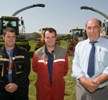
Did you happen to notice in some of the Sunday papers today an advertisement for Danepak the bacon company? The company has had problems in the UK recently culminating in the laying off of staff at the Thetford packing station in Norfolk. Clearly they are trying to build up their business again and the ad campaign must be one of the measures being taken.
I don't know who dreams up their advertising themes but this one is brilliant. Whoever it was decided to cash in on the renewed interest in the UK in local foods and traceability. A bit difficult, you might think for products originating abroad. Well, yes, but they have overcome that obvious problem by emphasising the family farm angle.
It is ridiculously simple really. They simply took a photograph of a typical (if rather large) extended farming family - they look genuine anyway whether they are or not - and labelled each with their role in the business as if they were part of a major company.
Continue reading "LETS LEARN FROM THE DANES" »
NFU President Peter Kendall was on the Radio 4 programme "BH" this morning welcoming Tesco's decison to increase the price of milk. He said it was encouraging that a major retailer had recognised the need to pay more to help save the dairy industry. And he added that he hoped UK consumers would now accept the benefits of home production and buy locally. I may not have used his exact words - I was in the shower at the time and its difficult to make notes.
But when asked if he claimed UK food (specifically organic, I think) was more environmentally friendly than that which is imported he hesitated and said no he didn't think that. He just asked people to remember that UK food was subject to rigorous inspection. He seemed reluctant to remind listeners about food miles. Indeed he was clearly at pains not to be perceived to be complaining by telling it how flying produce around the world must add to global warming, never mind doubts over the provenance of some imports.
Minutes later a listener sent in a text message asking why consumers should believe such stories from the industry that gave us Foot & Mouth disease. By which time it was too late for Peter to respond as his link to the Cambridge studio had ended. I ask, not for the first time, if the farming message might have been more effective if the NFU had been a bit more agressive and told the whole story - not just the most palatable bits.
Yesterday morning Meurig Raymond was on the Radio 4 farming programme talking about government plans to share the costs of infectious diseases. He too seemed almost hesitant to mention that F&M was imported, not generated in Britrain.
Continue reading "IF YOU DON'T COMPLAIN YOU WON'T GAIN" »
As readers of my FW column may be aware, one of our diversifications is a horse livery. The other day we were checking on the welfare of some of our charges and commented to the owner of a grey mare that had been with us for eight or nine months that we thought she was over feeding her. I'm not, she replied. I have a job to get her to eat enough. In that case she must be pregnant, we said, half joking.
But the seeds of doubt had been sown. The horse had been bought from a dealer who owned a stallion just before it came to us and it set our client wondering. A couple of day's later when the vet was visiting our client asked him to do an internal examination to make sure.
Oh yes, he said, as he took off his rubber glove after the examination. I reckon she'll foal in two to four weeks.
Having bought the mare as empty the present owner was not best pleased. That evening she phoned to tell the vendor what had happened. To which the vendor said "Oh". She then went on to tell how the mare had, indeed, been covered, three times, by a very good stallion but that it had not been thought she was pregnant. Moreover, she had asked the vet (by coincidence the same one that we use) to do a scan and he had assured her the mare was empty. That was why she had been sold empty.
Continue reading "FOAL FOOLS OWNER - FATHER NOT AMUSED" »
The Norfolk Showground has today been ringing with the sound of happy childrens voices. Most of the adults with them seemed pretty satisfied as well. It was the annual Spring Fling, arranged by the Show specifically to provide rural activity opportunities for children between 4 and 14 during the Easter Hoilidays. This year almost 4,500 attended - which is almost certainly a record.
I won't try to tell of all the things the children could do - there were so many. But the theme, as usual, was interactivity allowing the young people to do things on every stall. The John Innes Institute, for instance, invited visitors to identify different trees by sniffing the fruits they bear. The Young Farmers did a taste test of flavoured baked crisps made from potatoes and lentils and asked the tasters to vote for which they preferred.
A local cheese maker showed how cheese was made and offered pieces to taste. A dairy farmer - part of an East Anglian group of producers whose milk is labelled as such - had brought Friesian, Jersey and Ayrshire cows and were giving away cartons to drink. Pig producers were cooking sausages for visitors; bee keepers showed how bee's made honey and so on.
Continue reading "SPRING FLING RINGS BELL AGAIN" »
On Saturday I shall be flying to China with a party of FW readers. We start, almost inevitably, in Beijing but after doing a few touristy things there we will be concentrating on more rural area's to try to assess what effect the countrys' so called economic miracle has had on farming. We already know that some 750million of the 1.3billion chinese still are in villages and have to make a living from rural activities. I suspect there have been few changes in the countryside despite what is happening in the towns and cities but we will see. I shall also be looking for evidence of China's contribution to greenhouse gases. I gather it will not be hard to find.
If I can make my laptop work from such places I intend to report some of what we learn while we are there and give a fuller account in FW when I get back.
Continue reading "TRAVELLERS TALES" »
The combination of rising world population, increasing demand from some developing countries and global warming will lead to food shortages and sharp increases in its cost to consumers. Now where have I read that before? Oh, I remember. I wrote it myself about ten years ago and many other commentators have said something similar in the meantime.
But this week Prof. Bill McKelvey of the Scottish Agricultural College has said it again and suddenly the BBC and others have begun to take notice. It's not that he said anything very different and I do not intend that in any cynical way. But as an academic he is considered as impartial - unlike people like me. Even more relevant is that the public mood has changed, especially towards global warming, and suddenly the popular media is taking it seriously.
Pronouncements by other world renowned academics have helped. Jeffery Sachs, Director of the Earth Institute at Columbia University, USA, for instance.
Continue reading "EXPERT BACKING FOR POPULAR PREDICTION" »
At the British Embassy in Beijing the other day the Farmers Weekly party heard how Britain is trying to help China achieve its objective of 95% food sufficiency in the long term. The priority is to transfer UK agricultural technology to enhance yields and improve sustainability, we were told.
But we wondered if such concepts were realistic. First, farm technology is already ahead of the UK in some respects. At a vegetable exhibition attended yesterday we were told that at least half the varieties already grown (and we were told some 2000 different types were grown in this Qingdao area) were genetically modified. Many other crops grown in the country are also GM we were told.
Second, the growth of prosperity in the urban areas we have visited is so fast that it is difficult to imagine how any system could keep up with increasing demand. And when you consider that only 15% of the country is able to be cultivated and the population will rise from its current 1.3billion to 1.5billion within the next ten years, it looks even more unlikely.
Continue reading "DO NUMBERS ON CHINESE POLITICAL MENU ADD UP?" »
What you have to remember, said the man who had lived and worked in China for the last seven years, is that the Chinese have a sense of history that is much longer than we have in the west. Most of the people here believe that the last sixty years of Communism was only a brief interruption in the dominant position in the world which China should hold and indeed used to hold a few thousand years ago when it was a leading civilisation.
Whether they agreed with that assessment or not, members of the Farmers Weekly Farm Study Tour of the country could only wonder at the speed of industrial and infrastructure development that had happened in China over the last ten years and is clearly still going on.
We have been through literally beautiful new airports, travelled smooth and wonderful new six and eight lane highways and marvelled at forests of prestige office buildings that leave London standing.
Here is real wealth exemplified, perhaps most eloquently, in the City of Chongqing. Twenty years ago it was a "small city" of only 8 million people. Today that City has more than 31 million and it is the second biggest in China, after Shanghai. We drove through the centre of Chongqing after dark and it was lit up with neon lights like Disneyland.
Continue reading "CHINA: CENTRE OF THE WORLD!" »
A few kilometers from the massive new dam, claimed to be the worlds biggest civil engineering project and due to create a 660 kilometer reservoir along the Yangtse River, the farming remains substantially the same as it was 30, 50, or perhaps 100 years ago. The dam is scheduled to be completed in 2009 and will then, it is said, provide water for areas to the north where there is a shortage, generate huge amounts of electricity and remove the threat of flooding downstream.
The scale of the scheme is mind boggling and will be life changing for many Chinese. But the farmers around the town of Yichang where the dam is sited will notice hardly any difference.
The Farmers Weekly Study Tour has just spent the day looking at the almost completed dam and at the farming nearby. The contrast is difficult to take in.
On the one hand a US$25billion investment over 30 years. On the other narrow rows of wheat and barley inter-sown with cotton plants. Sometimes they inter-plant with rice or water melons but the width of the grain strips remain the same at less than a metre - because that is the size of the cutter bar on their tiny combine harvester.
Continue reading "RURAL CHINA LITTLE CHANGED" »