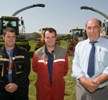
The area close to Hangzhou in Eastern China was full of the typical tiny farms the Farmers Weekly Tour Group had seen elsewhere in the country. Small plots featured vegetables, asparagus, lettuces and so on and many of those who grew them were out hoeing and watering despite the fact that this week is a public holiday in China.
How could a 1,200 cow dairy exist in such a district we wondered? Suddenly there in front of us were long open sided cattle sheds together with barns full of hay and bags of fodder. What we had not expected was that the entire milking operation would be set on just 7.5ha and that all the 5,000 tonnes of feed required would be brought in from outside.
Questioned on this the manager admitted that the transport costs of bringing hay and corn 3,000 km from northern China was as much as the value of the feed. He also admitted that the value of the milk produced at the equivalent of 15p to 16p per litre was barely enough to leave a profit. But the owners of the intensive dairy farm were the same Chinese people that owned a bottling plant a few miles away and they had set it up three years ago with the intention of serving the growing needs of the prosperous Hangzhou region comprising some six million consumers. Presumably the retail operation made up for modest returns from producing milk. Although the members of the party were intrigued to learn that the ex farm price was so low because of over-production. We thought that sounded familiar.
Continue reading "PROGRESSIVE CHINESE FARMERS CONNECT TO SUCCESSFUL CONSUMERS" »
Shanghai must be one of the most exciting cities in the world if you are urban based, into industrial development and want to make lots of money. Let us ignore global warming air pollution and labour exploitation, for the moment, for the purposes of this blog.
It was, anyway, somewhat surprising for the Farmers Weekly Farm Study Tour to be told they were to see one of China's most forward looking horticultural facilities in the city's northern suburbs. But there, among sprawling industrial estates, we found the Sun Qiao Modern Agricultural Development Area.
Extending to only a handful of hectares it seemed to be a cross between a research centre, a demonstration unit and a commercial operation. But it was, as it said on the label, one of the most modern agri/horti/enterprises we had seen in two weeks of touring the country. There were modern greenhouses with automated atmosphere control, hydroponic production and advanced plant cloning techniques. We could almost have been in Holland or Japan. Moreover, the centre regularly attracts experts from those countries to guide them in their research and techniques.
Continue reading "THE WESTERNISATION OF CHINESE HORTICULTURE" »
Since I got back from China last weekend some 9mm of rain has fallen on this farm. We had 4mm on Monday and a further 5mm last night. There is no doubt that the crops look better for it if only that they show up better against dark, moist soil than they do against the dust left by almost seven weeks without rain. But in truth all that has happened is that plants have been freshened up. Drag your boot across the soil and you soon find the moisture has only penetrated an inch or so into the topsoil. We still need a couple of inches or more of steady rain to deal with the deficit.
Even if that happens over the next few days, and there seems little likelihood of it for this area of the country according to the weather forecasts I have seen, irreparable damage has already been done. Spring drillings on heavy land are worst affected. The land was too wet to carry a tractor in early March so could not be drilled until the end of the month or early April and it has dried out ever since. In some cases sugar beet have not even germinated. Light land, drilled into moist seedbeds in March did germinate and emerged and benefited from the warm April. Such crops look well at present. But if we get the hot summer we are promised they will suffer later.
Continue reading "SHOWERS AND LIGHT RAIN FAIL TO BREAK DROUGHT" »
My sincere congratulations to American writer Bill Bryson on being nominated as President of the CPRE. I was a fan of his travel and other books long before he moved to South Norfolk. Since he has lived here I have had a number of opportunities to talk to him about his love of the English countryside and there is no doubt it is genuine. Moreover, he has chosen to live in this country rather than the USA because he enjoys it so much. What saddens him, however, is that too many native Brit's fail to appreciate the beauty around them and are all to ready to abuse it.
Accordingly, the CPRE President Elect has declared that his main focus will be fly tipping in the countryside. It may be that part of his motivation for this has been the filth and rubbish he has seen tipped on our gateways and roadside banks - rubbish that at busy times we sometimes struggle to clear. That the local district council also often fails to clear that element of the mess that it should deal with helps not at all.
I have told Bill Bryson that I will support his proposed campaign wholeheartedly. I have also told him that success will not be easy. Unfortunately, the people who indulge in fly tipping are probably not readers of his books nor do they share his love of the countryside. If they did they would surely stop doing it.
Continue reading "BRYSON TO TACKLE BLIGHT ON THE COUNTRYSIDE" »
It's amost a week since I posted anything. If you've missed me I apologise. If you haven't that just proves I have yet to make an impact in this new media. Either way I should explain my absence.
Last Monday evening my broadband connection failed. It 's happened before so I gave up trying to re-establish it by re-booting the computer, unplugging at the wall socket and so on. On Tuesday I tried again but no joy. So I phoned my server and asked for advice. We went through all the things I had already done and a few more cable checks but still it would not connect. Leave it with me, the adviser said, I will ask BT to check the telephone exchange and the line.
On Wednesday I had to go to London so very little happened. But there was still no connection on Thursday. BT obviously don't have the same sense of urgency as individual users.
The trouble is you get to rely on these wretched gadgets and when they don't work you feel bereft. The paper work builds up too.
Friday dawned and I knew I needed to send a column to FW (the magazine). By the time I had written it BT had still not called and the broadband connection failed again - several times! In desparation I called the local library and booked a terminal. The only computer available was one in a tight corner at which you had to stand and type, so I had no alternative but to take it. I copied the column onto a memory stick, headed for town and eventually took my turn standing in a corner at the console from which I successfully sent next weeks column to FW.
Continue reading "APOLOGIES FOR ABSENCE" »
It is with sadness that I record the passing of Perry McClean, a passionate farmer and distiguished scientist and researcher. For thirteen years from 1978 to his retirement he was the Director of Norfolk Agricultural Station (since merged into The Arable Group - TAG) a job he did with flair and distinction.
He did not come from a farming family. His interest in agriculture began when he worked on farms in Essex as a boy. He studied at Wye College and then joined MAFF from which he was seconded to Norfolk Agricultural Station.
His Ministry career later took him around the country including a spell in London. But he was always happiest on farms and when offered the job of Director of MAFF's light land experimental farm at Gleadthorpe in Nottinghamshire he jumped at the chance. Nine years later, when the farmer owned Norfolk Agricultural Station was looking for a new Director, committee members remembered the young man who had worked in the county years before and head hunted Perry for that job.
He was very much a square peg in a square hole and was a success from the start. The Station, had always been well known but Perry raised its profile even further. And Norfolk farmers, as well as many further afield, used what he did on the commercial part of the experimental farm as a template for what they did on their own holdings.
Continue reading "MINISTRY MAN WHO BECAME FARMERS FRIEND" »
The BBC's Today programme on Radio 4 came live from a tent at the Hay Literary Festival this morning. Like farming, the festival was being affected by the Bank Holiday weather with participants apparently having to wear rubber boots, although the rain will have been more welcome on most farms, I suspect.
But that was not the only parallel between the book business and farming. During the programme a book boffin complained that one UK independent book shop was being forced out of business every week because of price cutting by multiple retailers. Even best selling books, like those in the Harry Potter series, did not make money for small shops because readers could get them cheaper where they bought their groceries. Bulk buying and discounting is destroying large chunks of the book business and with it a vital element in the community, listeners were told. There was an urgent need to protect local booksellers from the ruthless activities of the big stores.
Continue reading "BOOK BUSINESS AND FARMING SUBJECT TO SIMILAR PRESSURES" »
There was a green theme running through the 176th Suffolk Show which I visited today. Together with the County Council the Show Association launched a campaign to make Suffolk the greenest county. And there was a stand explaining all the little things people can do that could, collectively, bring this about.
Closer to farmers pocket books was a major exhibition promoting local food and urging consumers to consider the food miles involved in imported foods. The stand contained nuggets of information that might persuade them to change their buying habits.
For instance, it was stated that according to DEFRA the distance UK food travelled increased by 15% between 1992 and 2002 with obvious implications for the emission of greenhouse gases and global warming. Information on the stand also explained how the food trade gap between what we import and what we export had more than doubled in ten years as British farmers contribution to the national diet had declined.
Consumers were urged to look more closely at country of origin labels and choose what to buy accordingly. They were advised to eat home grown food in season; to use farmers own shops and markets; to look up local food producers on the internet.
Continue reading "SUFFOLK SHOW SUPPORTS FOOD MILES CAMPAIGN" »