« June 2007 | Main | August 2007 »

July 2007 Archives

July 2, 2007

DUTCH BEET BEAT BRITISH

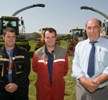
This very nice Dutch farmer happened to be staying at the same farmhouse B&B as I was during the Royal Show. His arable farm was in the south of the country close to Belgium and on it he grows wheat, onions and sugar beet. Onions were clearly his top crop for profit and he said he had had a very good year in 2006. He had sold his wheat at better prices too, that was why he was able to afford to bring his wife and two children to the Royal.
But the sugar beet won't have contributed much to your profits, I volunteered. Oh yes they did, he replied. We had a very high yield last year. But what about CAP reform and the reduced price, I continued. Well, it wasn't too serious, he said, only 3% less than the year before.
But British beet growers have had a cut of 37% I said and there's more to come. Sugar beet are beginning to look very questionable in this country,especially with the threat of more quota cuts.
My Dutch friend could not understand why our price cut was so severe. My beet go to our co-operative, he told me, and they have diversified into a variety of other sugar based products. They in turn make good profits and the co-op shares those with growers so that we do not suffer too much.
Naively, I had thought that all sugar beet growers across the EU were similarly affected by the sugar reform package. Not so, apparently. It set me wondering whether British Sugar with its famed efficiency were profiting more than growers know from alternate income. And it made me regret, once again, that growers did not take over the processor twenty five years ago when we had the chance. Meanwhile my eyes probably went a pale shade of green as I wished my new Dutch friend well and hoped he would have a good Royal Show.

July 3, 2007

HELMUT HARVESTS GOLD MEDAL

helmet.JPG

One of the few really satisfying moments during a very unsatisfactory Royal Show was the presentation to Dr Helmut Claas of a rarely awarded Gold Medal.

The Medal is reserved for people who have made "outstanding and sustained contributions to our industry" and few deserve it more than Dr Claas.

He is, of course, German by birth but an Englishman by adoption. Indeed he is a Suffolk farmer.

Furthermore his combine harvesters are now estimated to gather in more than half of UK grain each year. And that takes no account of the grass and silage machinery in which his company is world leader, the balers and now the Claas tractors that are being seen on British farms in ever increasing numbers.

If I sound like a fan, that is an accurate assessment. I have used Claas equipment since I began farming. And, like many other UK farmers, I count myself a privileged friend of Helmut Claas as well as a customer.

A few weeks ago during the FW study tour of Germany I took the party to look round the main production factory at Harsewinkel. After we had seen the amazing technology in what is now probably the most modern farm machinery factory in the world we went to the nearby farm where it is possible to test drive some of the models made by Claas. A little later Helmut and his wife Erika joined us. First, they shook hands with all of us in the British party. Then they did the same with the Claas staff members there to look after us.

By such respect for their workers the Claas family - and it is still a family owned business - earn the loyalty of their workers and that is just one of the reasons, together with Helmut engineering genius, why they produce world beating machines.

Thankyou Helmut for all you have done for UK agriculture. And congratulations.

July 4, 2007

TRAGIC ROYAL WASHED AWAY

It saddens me to say it because it has been an enjoyable annual event in my life for over forty years but the Royal Show was doomed long before heavy rain knocked the final nail in its coffin.

Who or what should take the blame?

The truth is that there have been a combination of factors. The state of the industry hasn't helped, although signs of an upturn are beginning to appear; inexperience management, with no senior members of staff who had ever been involved in running a Royal before; the disastrous flirtation with Lord Heseltine's company Haymarket; climate change, or whatever meteorological phenomenon that caused such a wet July; those who decided on such a heavy land and slow draining permanent site over fifty years ago; the Cereals event which was started by the RASE and whose success amounted to shooting itself in the foot; a council composed of about 120 members many of whom are out of touch with the prioritities of today's agricultural industry.

I could go on and there are almost certainly other factors that I am not aware of. But my short list amounts to a lethal combination. And the inescapable fact is that this year's much reduced event continued a spiral of decline that began several years ago.

Can it survive? Not, I suggest, in its current form. A thorough re-think is urgently required during which the RASE must re-assess its role. Its attempts to be all things to all men have failed. It must decide whether to concentrate on food production or food consumption. Moreover it must make up its mind whether any event as expensive as the Royal is appropriate for the future.

Continue reading "TRAGIC ROYAL WASHED AWAY" »

July 9, 2007

TURKEYS - NOT JUST FOR CHRISTMAS

I first met Janice Houghton-Wallace when she was a producer on the BBC TV programme Countryfile. Some of her colleagues were hostile to farming from the start. Janice never was.

A few years later, in 1999, she retired from broadcasting to go turkey farming. Only she didn't "do a Bernard Matthews". Her passion was rare breeds and doing everything she could to ensure their survival.

Today, sixteen years later, she is still at it along with various freelance journalistic and lecturing activities, and a couple of weeks ago she published a book - Not Just For Christmas - to share her comprehensive knowledge of the species.

It covers everything about turkeys. Their history and wide variety of beautifully illustrated breeds (Janice keeps nine of them) to breeding, feeding, showing and health. She even tells you how to slaughter and prepare them for the table. In short - all you ever wanted to know about turkeys but were afraid to ask. And its a good read.

In these days of bio-diversity the book is well timed and targeted. It is available, price £20 from www.farmingbooksandvideos.com

July 11, 2007

CROP PROSPECTS CAUSE CONCERN

We've had dry weather in this part of Norfolk for the last 36 hours. Is this a record? For this particular July I think, perhaps, it is.

Anyway, I took advantage of the conditions to take a detailed look round our crops. Not that I could do much to improve things at this late stage in the season but I thought it worthwhile to assess likely yields.

My conclusions, subject to correction later if necessary, are these. Oil seed rape (ours is mainly on light land) could do quite well, always assuming we don't get the horrendous weather some forecasters are predicting for the next few weeks. It is almost ready to be dessicated and we will do this at the earliest opportunity.

Winter wheat, somewhat remarkably, seems relatively free of disease; most is still standing despite the heavy rains that have battered it and ears look to be of a good size. I doubt if the weather we have had for the last two months is ideal for wheat but I do not discount the possibility of reasonable yields. We just need a few weeks of hot dry weather from now on.

Spring beans on this farm look better than any other crop at present. They have grown tall, look healthy and appear to carry plenty of pods. They also have longer to grow in the field before harvest than the other combinable crops so there is more time for things to go wrong - like an attack of bruchid beetles, for instance. But we have sprayed against them so must hope for the best.

Continue reading "CROP PROSPECTS CAUSE CONCERN" »

July 12, 2007

DRINK A PINTA MILK A DAY - AGAIN

Yes, that's right. Tests have shown that people who drink milk and eat cheese and yoghurt are healthier than those who avoid them. They are less likely to suffer from metabolic syndrome and milk can help to stave off strokes. Further, the calcium in milk helps the body to absorb nutrients from fruit and vegetables.

Who'd have believed it? All those stories about milk being high fat and bad for you were wrong. And those of us who recognised that milk was a marvellous, natural, balanced food with only 3% to 4% fat even when it was not semi-skimmed have been right all the time.

It only goes to show that if you wait long enough the benefits of common sense eating habits come round again. Bring out the cornflakes and splash on the milk.

July 16, 2007

TV DISTORTION NOT UNIQUE TO ROYALTY AND GOVERNMENT MINISTERS

The current furore over the misleading editing of TV clips involving the Queen and Gordon Brown reminds me of something that I became aware of when working for another TV company.

About 25 years ago a producer with that company who specialised in making environmental programmes persuaded his employers that farm pollution was killing wildfowl on the Norfolk Broads and that this justified an expose film. The fact that there was a drought at the time and that water levels were very low was, in his view, coincidental.

He made his film, full of arty shots through reeds, over the course of several weeks but failed totally to find any dead wildfowl to include in his footage. This, clearly, would undermine his thesis somewhat. So, he went to the local game dealer and purchased three brace of mallard, still in feather. He took them to one of the broads, rolled them around in the mud on the edge of the water, filmed them, and they became the justification for a commentary that condemned farming practices in east Norfolk for the botulism that he claimed was the cause of the problem.

Continue reading "TV DISTORTION NOT UNIQUE TO ROYALTY AND GOVERNMENT MINISTERS" »

July 17, 2007

OBVIOUS SOLUTION TO RURAL POST OFFICE CLOSURES

A report by the Commission for Rural Communities entitled State of the Countryside 2007 reveals, among other things, that access to rural post offices (defined as being within one and a quarter miles) has declined from 90% to 87% over the last seven years. In some tiny villages only 45% of residents were within reasonable reach.

This is in large measure due to the closure, since Labour came to power, of 4,600 village post offices. Moreover, the trend is set to continue with a further 2,500 scheduled to go within the next year or so, according to Alistair Darling.

What a blow to rural people, especially the elderly who rely on the local post office for their weekly pension. The government tried to force such people to open bank accounts a few years ago into which their pensions could be electronically transferred. But if you've lived seventy or more years without one and do not understand about electronic banking you don't take kindly to such pressure. A nearby post office is therefore vital to your quality of life.

Continue reading "OBVIOUS SOLUTION TO RURAL POST OFFICE CLOSURES" »

FATHER OF GREEN REVOLUTION GETS CONGRESSIONAL GOLD MEDAL

Dr Norman Borlaug, who pioneered the development of high yielding, disease resistant cereal varieties in Latin America and Asia today received a Congressional Gold Medal, the highest civilian honour awarded in the USA.

Forty years ago some of the most vulnerable countries in the world faced famine. But Dr Borlaug's developments of better varieties and more sustainable farming systems enabled many of those countries to escape the worst of the disasters that faced them and to grow their own food. Continued scientific work since has led to a better fed world, on average, now than then.

Indeed, some might say Borlaug's methods and the extension of them led directly to the production of too much food and to embarrassing grain mountains in some areas of the world.

Now, however, the prospect of food shortages is looming again. There is growing competition for land to produce food, energy and to provide areas for conservation. Bigger yields, if it is possible to grow them, are becoming politically correct, indeed necessary, again. And I can't help wondering if todays Gold Medal presentation to Dr Borlaug, much deserved but very late in his long and distinguished career, might be tacit recognition of that revised, if not new priority.

July 20, 2007

RAGWORT NEGLECT ALLOWS LETHAL WEED TO SPREAD

RAGWORT2.jpg

Perhaps its because we have horses here on the farm that I'm particularly aware of the problem. But as I have travelled around the country I've noticed it more this year than ever before. Ragwort is everywhere.

Most of all there are "crops" of it on roadside verges. Motorists may even think its yellow flowers are pretty, little realising that it is one of the most lethal plants in the countryside. It is even poisonous to humans but more particularly it kills horses and cattle. Under most circumstances they don't eat it when it is growing because of its bitter taste. But when it dies off because of cutting or spraying it becomes palatable to equines and bovines and causes irreparable damage to their liver. There is no known cure.

Continue reading "RAGWORT NEGLECT ALLOWS LETHAL WEED TO SPREAD" »

July 23, 2007

CANUTE-LIKE HOUSING PLANS IRRATIONAL AND IRRESPONSIBLE

Make no mistake, we've had far too much rain in Norfolk during the last few weeks. But as I watch TV news programmes showing the scale of the flooding in Gloucestershire, Worcestershire, Warwickshire and elsewhere I realise how lucky we are.

There's not much I can do, beyond sympathising with the victims and hoping the situation will improve quickly. But it's clear that irreparable damage has been done to crops that are underwater and, although I have no details, to the infrastructure and stocks of low lying farms as well.

Hopefully the relief services and charities will be able to help. Higher commodity prices will assist the least affected to survive the problems but won't compensate for the total losses that must have been suffered by some.

But for the government to publish a report on a day like this that allegedly says there is no alternative to building more houses on flood plains seems crazy and irresponsible. Who writes such rubbish?

Continue reading "CANUTE-LIKE HOUSING PLANS IRRATIONAL AND IRRESPONSIBLE" »

July 25, 2007

HARVEST HARDLY IDEAL - BUT HAPPENING

We had only one shower yesterday and just 4mm of rain the night before. It's not what you would call classic harvest weather but some crops are fit and need to come into the barn before they suffer further damage.

As I have explained in my FW columns a group of us in this area share a couple of combines. This year they are the aged MF that is kept going as a spare and for small fields and a new (to us) Claas Lexion 600. It was used as a demonstrator last year so is just about "run in".

It has a 10m header, a 480hp engine, and 4wheel drive, which has already proved very useful this year. Even so the machine got stuck (not on one of our fields thank goodness) last evening and had to be towed out. Without the 4wd, fitted for that very purpose, it would probably have taken a military helicopter!

Despite that we (the group of us that is) are getting on with the oil seed rape (ours is 80% done) and the winter barley. It's being snatched between showers and is, obviously coming into barns pretty moist and needing to be dried. But we feel it is better to grit our teeth and stand that expense rather than lose more grain on the ground as the forecast predicts yet more rain.

Continue reading "HARVEST HARDLY IDEAL - BUT HAPPENING" »

July 27, 2007

WEATHER LOTTERY CONTINUES - LITTLE FAITH IN FORECASTERS

I don't suppose I'm the only farmer to be obsessed with weather forecasts while at the same time not really believing them. The other evening I listened to the latest forecast on our local radio station only to hear the same station change its mind an hour later. I shouldn't blame the newsreader, of course. They only go by what the met office tells them. The only thing we can be sure of is that predicting the weather is not an exact science.

There was a forecast in the Daily Telegraph yesterday that said British weather would stay unsettled until mid August but after that it would be hot and dry for an extended period. Not satisfied with a vague national assessment, this morning I phoned the local weather service based in Norwich. Their prediction was that the rest of today would be fine, as would most of Saturday but that there would be substantial rain on Saturday night. Monday to Friday of next week, on the other hand, would be fine and dry.

So, who to believe? I suggest we shouldn't believe any of them, absolutely. I prefer to use forecasters only as a guide to trends and, rather than wait for some so called promise of a fine spell weeks into the future, make use of every opportunity to do some more harvesting. That's what we mean to do - always bearing in mind the cost in cash and carbon footprint if we cut crops when the grain is too moist.

July 30, 2007

HIGH PROFILE "VISITORS" TO CANCELLED GAME FAIR

I always look forward to receiving the Country Landowner magazine and one of the first pages I turn to is the Presidents message at the front of the publication.

This months edition dropped through the letter box this morning and I followed my usual practice. My friend, the President, David Fursdon, told how he had been contacted by Hilary Benn, the new Secretary of State at Defra within days of his appointment and described how he had met him to discuss current issues soon afterwards.

David Fursdon then went on to say how delighted he had been to escort HRH the Duke of Edinburgh and Minister of State at Defra, Jeff Rooker round this years Game Fair.

Did I miss something? Wasn't the Game Fair cancelled because of bad weather? Or was the President the victim of tight copy dates and printing schedules that forced him to anticipate something he intended to do but which was overtaken by events?

Sorry to be cheeky, David, but having been there and done that I couldn't resist poking gentle fun. More seriously I am as sad as you must be that the Fair was rained off in the CLA's centenery year.

July 31, 2007

PHIL DRABBLE'S DEATH MARKS THE END OF AN ERA

Phil Drabble didn't really like sheepdogs. He much preferred whippets and terriers with which he had roamed the Staffordshire countryside around Abbots Bromley when a boy.

I worked with him on radio programmes in the 1960's and '70's and remember him being asked by a Birmingham based producer to present half a dozen television outside broadcasts about sheepdog trials. The main reason was to find work for a crew in the Cumbria area for a few days between other programme commitments. "I know very little about sheepdogs" said Phil "but as long as they find someone who understands the game to help me I suppose it can't do too much harm."

The rest, as they say, is history. "One Man and His Dog" became a cult programme attracting up to 8million viewers for nearly twenty years. This was partly due to the public's fascination with watching dogs driving sheep through complicated courses in beautiful countryside. But it was also because of Phil's down to earth approach and obvious love of nature.

That was the kind of man he was. He worked for many years for Walkers the weighing machine company, rising to a senior management position. But he never stopped loving the countryside and spending as much time as he could walking with his dogs. Indeed he began writing and broadcasting about countryside matters while still at Walkers.

Continue reading "PHIL DRABBLE'S DEATH MARKS THE END OF AN ERA" »

About July 2007

This page contains all entries posted to David's Digest in July 2007. They are listed from oldest to newest.

June 2007 is the previous archive.

August 2007 is the next archive.

Many more can be found on the main index page or by looking through the archives.