Pollution control added to cross-compliance requirements
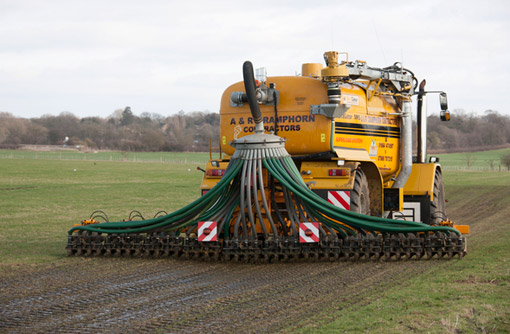
A new cross-compliance requirement to protect water from pollution by fertilisers and manures has added to an already substantial list that farmers in England must meet to ensure they receive their single farm and certain rural development payments in full.
That list now runs to 18 Statutory Management Requirements (SMR) and 16 standards to maintain land in good agricultural and environmental condition (GAEC). The former are established in EU law and the latter are established under CAP regulations, and penalties for non-compliance can be severe.
Adhering to so many conditions appears to be daunting. But not all will affect every farmer, and where they do, abiding by them may not be that difficult, says RPA inspections manager Russell Graham.
“In most cases, they also relate to existing law so most farmers should be adhering to them anyway,” he adds.
Nevertheless, several requirements have become regular cross compliance failures on arable farms. The latest introduction, No spread zones (GAEC 19), which came into effect on 1 January, could become one of them, says Mr Graham.
“I think it will feature because it is new. We had to introduce this as it was part of the CAP health check and we have let people know well in advance, but not everyone has picked up on it.”
Under GAEC 19, inorganic fertilisers must not be applied within 2m of surface waters, and organic manure generally not within 10m. The latter cannot be applied within 50m of a spring, well or borehole. Growers who apply organic manure must have a map showing all surface waters and land within 10m of them, as well as all springs, wells and boreholes both on the holding and within 50m of the boundary and land within 50m of them.
“This new GAEC standard is based on existing rules included in the nitrate regulations, therefore farmers meeting Nitrate Vulnerable Zone requirements will already satisfy these new regulations,” says Mr Graham.
“However, this extends these requirements outside NVZs and although it may be difficult to pick up actual evidence of a breach, the fact this GAEC has a record-keeping requirement suggests this will account for some cross compliance failures.”
It is a prediction based on plenty of experience. Some of the more common failures share the need to record information, notably Cattle identification and registration (SMR 7), which accounted for 1273 failures in 2011, 62% of the total.
“Although this does not affect pure arable farms, many growers also run livestock. It is worth remembering that even with just a few cattle on a large arable enterprise, failing to report all details and movements or keep accurate records could affect the whole farm payment,” says Mr Graham.
Incomplete or irreconcilable records were the most common cause of failure last year for Nitrate Vulnerable Zones (SMR 4). These included failing to record nitrogen applications and not having sufficient recorded information to enable inspectors to fully assess N use. Failure to produce manure storage calculations, nutrient-management plans and/or a risk map also featured.
“It sounds obvious, but do check to see if any land is in an NVZ – I have recently heard of a couple of farmers who were unaware that some outlying fields were included. The most important thing is to ensure you have up-to-date records. As with many of these requirements it may be difficult to identify non-compliance on the ground, but very easy to see if there is a problem with the records.”
Key new rules could also catch some mixed farmers out. These include six months’ storage capacity for pig slurry and poultry manure and five months for other slurries as well as a ban on high-trajectory slurry spreading (above 4m).
Not conducting, adequately completing or updating the farm’s Soil protection review (GAEC 1) is another problem area. “We still find farmers who don’t know they are supposed to keep a review,” says Mr Graham. The review should identify broad soil types and problems and rectifying measures taken, while updating is required for new land taken in or when management systems or cropping are changed.
Poor record-keeping and incorrect use of sprays, usually not complying with conditions of approval or the code of practice, were key reasons for failure under Restrictions on the use of plant protection products (SMR 9). Not having the necessary certificate of competence also featured.
Many farmers also fell foul of the Water abstraction standard (GAEC 18). Some failed to adhere to licence conditions, others failed to submit records of volumes abstracted or annual abstraction returns.
Other transgressions are easer to spot on the ground. Cultivating or applying fertilisers or pesticides too close to hedges and ditches accounted for most failures under GAEC 14, Protection of hedgerows and watercourses, while footpaths obstructed by standing crops were the usual problem under GAEC 8, Public Rights of Way.
“There is no hiding from these. As far as GAEC 14 is concerned, if you know you have made a mistake, stop. Once you carry on, the infringement becomes more severe.”
Cross-compliance
Cross-compliance requires farmers to comply with a set of Statutory Management Requirements and keep their land in good agricultural and environmental condition (GAEC) to qualify for full direct payments and certain Rural Development Programme payments including ELS and HLS.
SMRs relate to the areas of public, animal and plant health, environment and animal welfare. GAEC standards include soil erosion, organic matter and structure, avoiding the deterioration of habitats and protection and management of water.
Inspections and deductions
From 1 January 2012 RPA took over cross-compliance inspections from the Environment Agency on groundwater, sewage sludge, NVZ and water abstraction, and now also inspects no-spread zones. This opens up a new area of environmental inspection during an RPA visit. Growers should be prepared for this.
The agency must inspect 1% of single-payment scheme claimants annually for SMRs and GAECs, for which it is responsible. Cattle and sheep inspection regimes partly satisfy this requirement. All inspection findings are considered by the RPA and it decides reduction levels for non-compliance.
The standard reduction for a negligent breach is 3% of payment receipts, though these can range from a warning letter to 5%, depending on the extent, severity and permanence of the breach. An intentional breach carries a standard 20% deduction, which can also be varied. If the non-compliance is repeated the following year the deduction triples.
Further information:
Guide to Cross Compliance in England 2012 (publication rpa157 sent to all farmers earlier this year; also available at http://rpa.defra.gov.uk)
Farming Advice Service: 0845 345 1302 or advice@farmingadviceservice.org.uk
Failures
In 2011, 2046 cross compliance failures resulted in deductions of almost £2.57m. Those most likely to affect arable farmers were:
SMR/GAEC Failures
Nitrate Vulnerable Zones (SMR 4) 72
Restrictions on the use of plant protection products (SMR 9) 32
Soil-protection review (GAEC 1) 88
Public rights of way (GAEC 8) 20
Protection of hedgerows and watercourses (GAEC 14) 77
Water abstraction (GAEC 18) 37
Cattle identification and registration (SMR 7)* 1,273