

‘Push-pull’ strategy boosts maize yields for Ugandan farmers
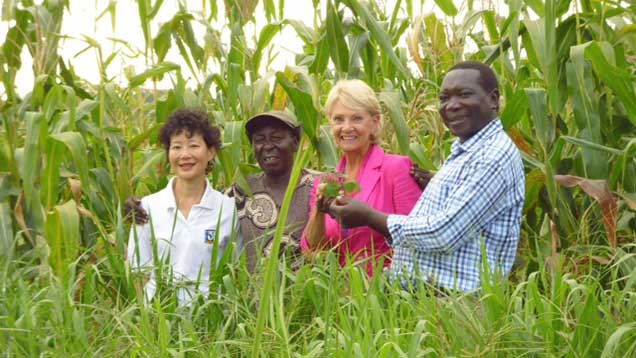
British scientists are using “push-pull” crop technology to help farmers in Uganda boost maize yields.
Maize is a major food source in the east African country, but agricultural pests often attack and devastate the crop.
Stem borer larvae feed on maize leaves and bore into the plant, while the parasitic weed striga attacks the roots.
See also: Fish oils from GM crop fed to Atlantic salmon
Pesticides are prohibitively expensive for small-scale Ugandan farmers and yield losses of up to 100% caused by these pests are often a reality that increases the risk of starvation for farmers.
Therefore, scientists from Rothamsted Research, the International Centre of Insect Physiology and Ecology (ICIPE) and Harpenden Spotlight on Africa (HSoA) have joined forces and established a pilot project near the town of Mbale, Uganda.
They have developed an ecological pest control system to use on maize based on a “push-pull” strategy, which drives away pests to enable higher yields of cereal crops such as maize, sorghum and millet.

The “push” crop, desmodium, is planted between the rows of maize to deter stem borer moths with its smell. The “pull” crop, Napier grass, is planted around the borders of the field to attract the moths and trap them with the glue-like substance it emits.
Meanwhile, the roots of desmodium deter the attachment of parasitic striga weed to the cereal crop, killing it before it flowers.
The collaborative pilot project used this approach with Ugandan farmer Nimrod Mulonde. Mr Mulonde has reported an almost fourfold increase in the maize yield from the pilot plot.

He said: “I have been honoured to be part of this pilot project, not only because I can see tangible benefits in terms of the yields in my field, but also I have learned a lot from this new technology and now I am able to share this knowledge with other farmers in my region and help them.
“This is extremely rewarding and important for me as loss of yields in our region is a truly devastating problem with many health and social implications.”
Desmodium has many additional benefits for the farmers. Less fertiliser is needed as desmodium is a legume and adds nitrogen into the soil, an essential nutrient for crops.
Desmodium also acts as a protective covering on the soil, retaining moisture and reducing soil erosion and improving water efficiency. Furthermore desmodium is a nutritious feed for livestock as well as tilapia fish.
The pilot has now been rolled out to 44 small-hold and subsistence farmers. A demonstration was carried out at each of the 44 sites, with 20 farmers attending each time, thus reaching more than 800 farmers.
Professor John Pickett of Rothamsted Research said: “This case study with the use of ‘push-pull’ technology is an excellent example of a successful outcome from HSoA’s concept of the sustainable effects that can be achieved through an integrated approach, by engaging with farmers and enabling them to secure their food provision to support their health and contribute to income generation.”
