
Practical sessions
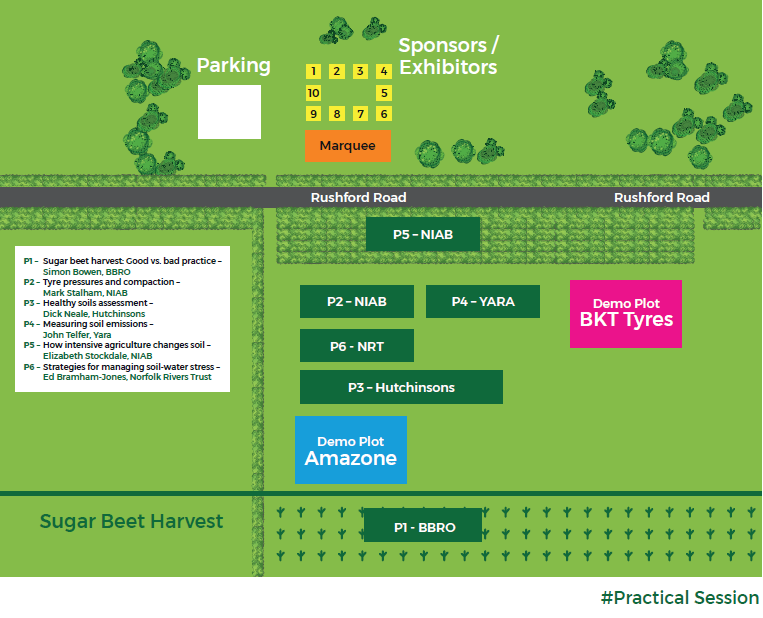
Maximising best harvesting efficiencies: Minimising soil impacts
Stephen Aldis & Simon Bowen, BBRO
The team from BBRO will be discussing and demonstrate how careful planning, regular monitoring and being prepared to react to changing soil conditions is vital to successful beet harvesting. The help of applying a little bit of crop and soil science will be delighted.
Monitoring crops during harvest for losses will be demonstrated and how new technology such as the electronic sugar beet may provide a focus. Minimising traffic by controlling beet carting operations will be also highlighted as part of an approach to reducing potential soil compaction.
Tyre pressures and compaction
Mark Stalham, NIAB & Dr. Blair McKenzie, James Hutton Institute
This practical session on soil compaction will demonstrate the use of the Terranimo soil compaction model in predicting the effects of machinery type, tyre pressure, soil texture and water content on the extent and depth of likely compaction. This will involve examining soil profile pits under different trafficking scenarios during the harvesting of a sugar beet crop and discussion on avoiding and alleviating compaction on contrasting soil types.
Healthy soil assessment
Dick Neale, Hutchinsons
This practical session will be based around a Visual Evaluation of Soil Structure (VESS) assessment, looking at the factors such as colour, smell, aggregation and compaction, which are good indicators of soils structure and composition.
Dick will talk through the ‘healthy soils assessment protocol’ and look at the pH profile, and soil leeching and accumulation layers through the soil cross-section. He will also briefly discuss alternative cultivation options to the plough and keeble.
The soil pit-based practical will also examine the presence, depth and binding of rooting systems, with the aid of various in-situ early-growth cover species and mixtures. The session will look at water infiltration and earthworm activity in Euston’s sandy soil type.



Measuring soil emissions
Jon Telfer & Natalie Wood, Yara
This practical session will look at how farmers can approach the increasingly important discussion around ‘good emissions and bad emissions’. Jon and Natalie will look at techniques of measuring emissions associated with a healthy soil – CO2 and low N2O which is associated with a poor soil. The session will also examine the interesting topic of ammonia levels which, while not related specifically to soil, are an important impact of fertilizer choice and application.
How intensive agriculture change soil
Elizabeth Stockdale, NIAB
The woodland margin to the field lets us get a glimpse of how the soil would have formed under natural vegetation and so how it might have appeared before cultivation 200-300 years ago. Elizabeth Stockdale will explore these natural soil-forming processes and consider what we can learn from field edges and uncultivated areas to help with in-field management.
Innovative and practical ways to reduce diffuse pollution on farm
Ed Bramham-Jones & Robert Camps, Norfolk Rivers Trust
The session will look at innovative and practical ways to reduce diffuse water pollution (sediments, phosphates and pesticides) leaving fields and causing problems to watercourses and drinking water abstractions. These will include looking spcifically at reducing the effect of wheelings and tramlines through using tramline disruption and management to minimise runoff and reduce potential water escape from fields adding to pollution and flood risks. Within the session, there will also be advice on the placement of tramlines, headlands and other mitigation measures which could be employed.

Demo plots
Soil tillage – making sure it is flexible and sustainable
Crop rotation, and subsequently straw incorporation, plus the way we look at grass weed control, are crucial factors in how we care for our soils. Nutrient levels are affected by cropping and, generally, soil organic matter content is at an all-time low. Changing our approach to cultivation can also help boost the traffic carrying ability of our land – preventing the need for deeper cultivation and improving timeliness of both drilling and subsequent crop care operations. Amazone, at Soils in Practice, will look at the challenges behind these management techniques in a series of practical demonstrations.
BKT Tyres
Over the last decades, a progressive compaction of agricultural soil has occurred – the loss from this phenomenon is estimated to reach up to 20% of the total harvest. Limiting soil compaction is an urgent practice for maximizing the yield per hectare while preserving both the land’s integrity and peculiarities.
BKT Tyres will demonstrate how their new Agrimax V-Flecto can remarkably reduce soil compaction through an optimized footprint and 20% larger tread profile compared to a standard tire of the same size. This results in major overall efficiency in terms of both farming operations and business profits. At Soils in Practice 2018, BKT Tyres will demonstrate the great performance of the V-Flecto tire compared to the standard one.


Headline sponsors