

Calls for bovine viral diarrhoea ‘laggards’ to be named
 © Tim Scrivener
 A commitment to eradicate bovine viral diarrhoea (BVD) by the majority of Scottish farmers should not be hindered by a minority, according to NFU Scotland vice-president Gary Mitchell.
He has called on all cattle keepers to dispose of all known persistently infected (PI) animals, a measure veterinarians say is key to eradicating the disease.
His clear message follows meetings with government officials where he revealed his experiences of tackling the disease in his own dairy herd.
See also: Scotland to get new BVD ‘positive’ status
He wrote that those who weren’t removing PIs were “putting a lot of good work at risk”, adding he was shocked to learn how many known PIs there were in the country.
Low-down on Scotland’s PI
- There are 382 known PIs
- 140 holdings have two or more PIs
- One Scottish holding has 24 PIs
“We all know that even good colostrum management will not change the immune status of a PI calf,” he wrote.
“That prompts me to ask the question of fellow farmers? If you have a PI, why are you keeping it?”
He added May is a key time for action as breeding stock are turned out and some farms have heifers away on summer grazing.
Website advice
Mr Mitchell urged farms to use the ScotEID website to check on the BVD status of every animal.
- Go to scoteid.com and look up the status of any certified in public health (CPH) number
- Click on BVD “look up”
- Enter a CPH number to see if it is negative, not-negative or positive
- Learn about the date of the last test on that holding
Own experiences
After three years of tissue tagging (tag and testing), Mr Mitchell is hoping to have a year free of BVD.
The first year returned six positives, the second year four and the last year only two positive animals.
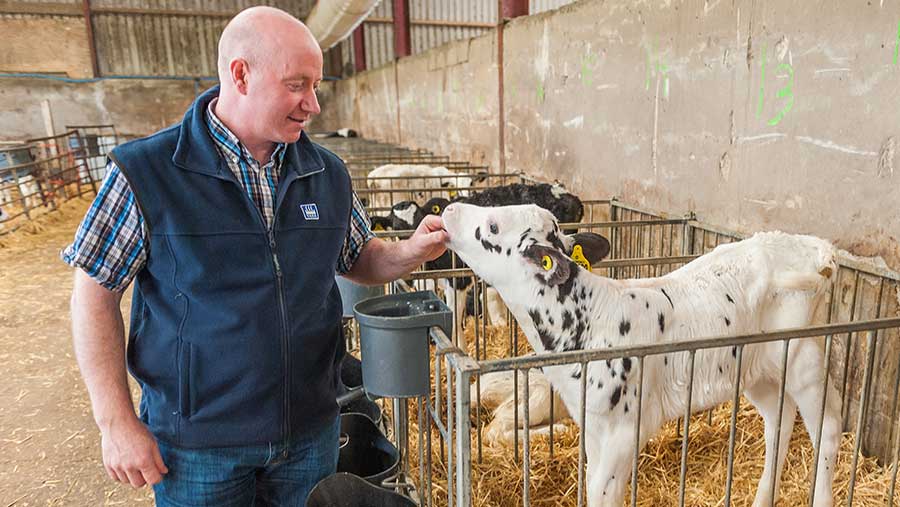
NFU Scotland vice-president Gary Mitchell believes farmers not tackling persistently infected stock is hindering the fight against bovine viral diarrhoea © Robert Smith
In his previous calf-rearing career, he used to buy 1,000 calves from up to 30 farms a year, meaning if every farm had one PI he could end up with more than 20.
He added: “I am a very simple person and this how BVD was explained to me many years ago. When the calf is being formed in the womb, there is a stage when the immune system must decide what is a good thing for the body and what is bad.
“If a cow is exposed to the BVD virus during this period, the cow will transmit it to the womb and the immune system will then take it as a good thing.
“I have experienced this through my previous life as a calf rearer, buying and rearing 1,000 calves from up to 30 farms a year. If the average farm had one PI, I could have had a pen of 20 calves with two PIs.
“These calves would always take pneumonia first then spread it, the same with scour, but I had no way of knowing exactly which calves they were.”