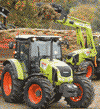
Claas' new Axos tractors might not look too different from their predecessors but delve under the skin and you'll find a raft of changes. Nick Fone test drives the 90hp 330. First, here's the video:
(Video: Jonathan Page; Voice-over: Emily Padfield)
At first glance, I'm not sure how to take the new Claas Axos. As it sits there with its boggle-eyed stare, I can't quite be sure if it's angry or not.
Maybe it is. After all, it hasn't had the usual facelift most tractors get when they're revamped. The truth is that from a distance the Axos looks much the same as the boldly-styled Celtis it replaces. When it first arrived - in Renault orange - the Celtis' radical looks caused something of a stir. People weren't sure if they liked it, but along came New Holland's bug-eyed TS-A and Deutz-Fahr's shark-nosed Agrotrons and everyone forgot about the Celtis' styling. But the launch of its doppelganger replacement has made me question its appearance once more.
Some will like it, others won't. I'm still sitting on the fence - it certainly isn't beautiful. But that doesn't really matter, it's what's under the skin that counts and that's changed a lot.
Until now Claas - and previously Renault - tractors used Deere engines to provide the muscle. The 74-100hp Axos range has changed that, switching to a Perkins power plant.
|
| The 74-100hp Axos range is the last of the ex-Renault line-up to be truly Claasified. It replaces the Celtis - the last orange-liveried tractor to be developed at Le Mans without German intervention. |
Why? We're told it's down to the way that Perkins goes about meeting the latest round of tough new emissions rules.
So what is different about the way the Peterborough company makes its engines cleaner and greener? Unlike many other manufacturers, who have gone down the route of clever, computer-controlled common-rail fuel injection systems, the firm's engineers have stuck with a simple mechanical fuel injection pump. That means they can't rely on a series of split-second squirts of fuel to clean up what comes out of the stack. Instead, they've opted for a system of internal exhaust gas recirculation.
|
| Axos should be good on the maintenance front. |
This means a small percentage (usually less than 10%) of exhaust gases is pumped back into the combustion chambers. This lowers the oxygen content of the intake air, reducing the combustion temperature, which ultimately brings down nitrous oxide emissions.
This is the reason Claas cites for choosing a Perkins power plant. It's a straightforward all-mechanical unit, ideal for simple stockman-spec machines like the Axos.
Appearance-wise you'd have to be a bit of an anorak to spot the difference between an Axos and its predecessor. But get up close and you'll note the gill-like grilles in the side of the bonnet to encourage airflow through the beefier cooling pack. The hood lifts as one to allow much better service access.
The roofline has changed as well. Bells-and-whistles CX versions get a high-profile cabin which no longer takes on the appearance of mid-'70s Ford bubble Q-cabs, but has a chunkier, more modern plastic lid. Mid-spec CLs and bog-standard C-variants get the low-profile flat-top.
Both have huge, full-width roof windows which make for awesome views skywards - an industry best for loader work.
In fact the cab itself is one of the biggest on the market for this size of tractor. There is plenty of room around the seat to cram in feed-bags, baler twine and the odd terrier. But the tractor's unique feature is its forward-opening doors. Because they're hinged at the front and can be latched open they're a favourite for yard work when you're on and off the seat every five minutes.
A small word of caution here though - make sure the loader pipework doesn't clash with the door if you're to avoid regular Autoglass callouts.
| Claas Axos 330 CX Tech Spec -
Power 90hp -
Engine 4.4-litre Perkins 4-cyl turbo intercooler, mechanical fuel injection -
Transmission Twin range, five-speed mechanical 20F x 20R with clutchless shuttle and splitter, 40kph -
Hydraulics 60-litres/min -
Linkage lift 4.2t, Cat 2 -
Weight 3.7t -
Turning circle 8.6m -
Price £39,700 |
Up in the cab not too much has changed visibly. The dash has been tweaked to accommodate more digital readouts and warning lights, but the trade-off is a smaller, squint-inducing analogue rev-counter, temperature dial and fuel gauge.
The flat-floor cab looks ready for a good blast from the pressure washer and overall trim quality seems ok, although on the pre-production machines we drove not everything lined up quite as it should. We're promised that regular-issue versions will be screwed together in a much more German fashion.
Jauntily angled mudguards with tidy, built-in light clusters improve views to the rear. Alongside these live the external linkage controls. Depending on whether you opt for snazzy Bosch electronic linkage controls or more traditional "arm-draulic" levers, you either get buttons or a nicely sculpted grab handle to ratchet the lift-rams into place.
Axos CXs and CLs all come with a clutchless column-shift shuttle, though the mid-spec lacks the CX's Twinshift splitter, leaving it with a straight 10F x 10R box. The entry-level C shares this but ditches the electro-hydraulic direction changes, making for an all mechanical setup.
Having had the chance to try both 20- and 10-speed boxes, it becomes clear why splitter-equipped versions are Claas' top sellers. It might save £400 to go without Twinshift but the CL is not nearly as versatile around the yard, let alone out in the field.
Claas claims a 50:50 weight balance front-to-rear for the Axos and that would certainly seem true. On the road there's very little nose-nod and with the Claas-badged MX loader's gas suspension it's even smoother. The top-spec electronic hydraulic control package also adds linkage damping to soothe the ride with mounted kit.
 |
| Big cab, little tractor. The Axos' cabin is seriously spacious. A stubby lever down on the floor to the driver's right switches between high and low ranges. The lankier one is responsible for the five manual shifts and hosts a clutch button to allow pedal-free gear changes. |
What's Changed?
- Engine - now a 4.4-litre Perkins 4-pot turbo with internal exhaust gas recirculation to meet Tier 3 emissions regs but retains mechanical fuel injection. Was previously a 4.5-litre Deere 4-cyl.
- Cab - new proper high-profile roofline with low-profile option. Improved switchgear and a revised dash.
- Transmission - option of completely mechanical 10F x 10R box now with a clutchless shuttle on CL-spec machines. Strengthened splitter gears on CX versions and beefier back-ends across the board.
- Hydraulics - new Bosch system. Still 60-litres/min but standardised Claas fittings and spools borrowed from larger Arion stable-mates.
- PTO - optional three-speed - 540, 540 eco and 1000rpm with interchangeable stub-shaft.
- Diff-lock - auto-engage foot pedal.
| FW VERDICT Great little loader tractor with big tractor feel thanks to a gargantuan cab. Three different spec levels cover all bases. Our advice? Go for the top-spec CX with its splitter and shuttle to get the most out of the tractor. If you're really anti-electrics, order it with lever-operated hydraulics. |