Management Matters: Family farm launches website
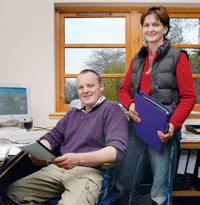
In the icy grip of winter in north-east Scotland, most of John Scott’s time has been spent struggling with an unusually bitter winter. But while the real world seems to be doing its best to thwart him, the farm’s foothold in cyberspace is going live.
“The thermometer has just reached -3˚ and that’s the mildest we’ve seen for a week. We’ve been hitting -14˚ or -15˚ overnight and there’s 5in of snow on the ground. But for about 10 days it’s been so cold, with no wind, so we’re feeding out an awful lot of silage and straw. I hope I will have some straw left to sell.”
Under these conditions, there’s little alternative. Some 200 acres of stubble turnips sown after spring barley are under heavy snow, while another 25 acres of Swedes are frozen solid.
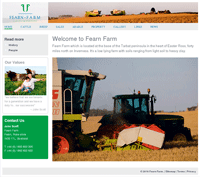
Luckily, in the warmth of the farm office, another project is nearing completion. Fearn Farm’s website, which has taken a year to develop, will go live this week.
John admits it’s a project that has had to take place in the background, when the practical farming work has allowed him to focus attention on it.
“Like all these things it comes down to time and, with only me and Dad now, we’ve struggled to put the time into it. But it’s up and running now.”
Many farm businesses have embraced online technology, recognising that an effective website is as important to their business as word of mouth or reputation. But most of these have tended to be farms that have a significant interface with the general public – those with farm shops, open farm parks, or other diversification projects – enterprises that need to reach big numbers of people outside farming.
So why go to all this trouble for a relatively traditional family farm, producing high-health breeding cattle and sheep?
“It really began with the idea of creating a Fearn Farm brand, with an easily-identifiable logo. I wanted a brand that people could identify with good quality stock and good farming practices.” says John.
“We wanted it to reflect how we felt about ourselves – something straightforward, uncomplicated, but a fresh clean image. I suppose we really just wanted to raise awareness of ourselves as J Scott & Partners, whether that was a sign on the gate, our stock at a sale or online.”
An Australian cattle breeder’s website gave John the inspiration for Fearn’s graphic identity. “This guy had done something with the two letter Ys, so I asked our designer to come up with a play on the two Fs in Fearn Farm, and he created an image of this reflecting the shape of an animal’s face,” John says.
John and James have had their logo printed on some promotional gifts, such as woolly hats, which they’ve handed out to livestock hauliers, visitors and friends.
 “It’s just about raising awareness of J Scott & Partners and hoping people remember seeing that image and associate it with us. This year we’ll have a banner up at the sales over our bulls and hope people make the connection between the brand and what we’re selling. We hope they’ll recognise that identity when we come south with cattle and sheep for sale”
John also wants to get some jackets made with the Fearn Farm brand on them, to wear at shows and sales.
But it’s a big step from there to a fully functioning website. “It’s all useful marketing. We’re not in the middle of the country, but people can get to us quite easily and we want them to know we’re here and tell them what we’re doing. So we need to have somewhere people can go and see what we’re about and what we’re trying to do. And it can be useful in business to be able to learn a bit about an operation before you necessarily pick up the phone. It’s a bit of a shop window for us.
“Also you have to acknowledge there are fewer farmers than in the past, and we have to find ways of reaching each other. It’s not just the younger generation online now. Many more people are looking online for the type of stock they want and buyers often want to find out as much as possible about a few select animals before they go to a sale. We all seem to have less time to go to auctions and some people now prefer to do their business on a farm-to-farm basis if they are after certain levels of health status. We want to appeal to all types of customer, from family farm to the larger estates.”
John reckons the website and logo will have cost about £2000 in design, photography and construction overall. “We wanted the website to tell our story – we’re proud of who we are and what we do as a fourth generation family farm preparing to hand on to the next generation. We also wanted the site to be a window for the general public into what farms like ours are doing, what we produce and our goals and aspirations.”
A team of three – web designer, photographer and graphic designer – all local, have worked on the project.
“The homepage has a little bit about us, our history, and the various different breeds we have. We’ll have a News section, with updates about what we’re doing at different times of the year, and a ‘For Sale’ page, with details of young bulls and links to the Breedplan and breed society websites where people can look at EBVs and other figures in detail,” John says. “We can also link to people we do business with.”
The home page also prominently features John’s contact details – reflecting an aim to appear friendly and approachable.
“We’ll have four bulls going to the sales at Stirling in February, so we’ll also have pictures of them in the sales section – good photography is so important, I’ll be the first to admit that I am on a learning curve here, so viewers may need to be patient.”
John is also keen to explore ways to drive traffic to his website. “We will probably look at things like Google analytics in time, as we’ll want to monitor how many hits we’re getting and look for ways to improve that.”
While he’s wary of social networking sites such as Facebook and Twitter, John sees great potential in using the video-sharing website YouTube.com. “This is definitely something I could be interested in – good quality, easy-to-watch video footage of our bulls moving has got to be far better than just a still picture.”
Ultimately, John says he wants to give potential buyers of his family’s stock another avenue to reach them, rather than relying on the traditional routes.
“The website hasn’t cost a great deal of money and if you can explain your background, tell buyers what you do, and you have a good product in the first place, it can only be a good thing. Eventually, we’d like to hold our own bull and tup sale on farm, and the website would be key to promoting that.”
In the meantime, much less sophisticated technology is occupying John’s time.
“Every morning is spent going round with a blowtorch trying to get water running in the cattle shed. I know of some people who’ve had it much worse – hours spent with a torch trying to get water to flow.”
And the bitter winter temperatures have brought unexpected irritations. “Take the catches on the back of our stock trailer, for example. After just a five-mile trip they had frozen in place, and I had to take a blowtorch to them before I could get the back of the trailer open.”