Hybrids show their mettle
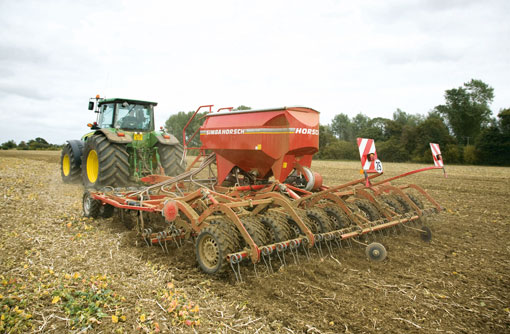
Hybrids offer many benefits, particularly in the earlier drilling slot. Philip Case looks at how growers can get the most out of them.
Hybrid barley varieties have been performing exceptionally well this dry season with yields of more than 10t/ha in some parts of the UK.
Northern Irish grower and arable Farmer Focus writer Allan Chambers grew 36ha of Volume yielding an average of 10.1t/ha at 17% moisture. “Our winter barley, all Volume, was our best ever,” he says.
Similarly, Robin Barfleet saw 10.4t/ha with Volume at Abraham’s Farm in Nottinghamshire.
Hybrids also offer other benefits. AICC Yorkshire-based agronomist Patrick Stephenson points out that the hybrid vigour means they can be drilled at lower seed rates than conventional. In addition, the early cutting helps spread harvest workload.
Crop establishment
The primary driver for getting the best out of hybrids is growing the right number of plants, he notes.
“Hybrid barley’s vigour helps it establish quickly. There are an increasing number of six-row hybrids grown in the UK and these produce many more grains/sq m.
“This means you can get a good yield with slightly lower seed rates.”
Seed companies, such as Syngenta Seeds, recommend planting hybrids at a low seed rate of about 200 seeds/sq m.
However, Mr Stephenson reckons there are added benefits to slightly increasing seed rates. “I prefer to increase seed rates nearer to 250-275 seeds/sq m to establish near 200 seeds/sq m,” he suggests.
“In my opinion, it’s always easier to manage more plants coming out of the ground than fewer.”
The optimum drilling date for hybrids is mid-September, although most varieties can generally be planted until mid-October, he says.
“Later drilled barley, after 10 October, is going to start performing poorly and there will be a definite yield penalty.”
Weed control
Weed control of hybrid barley can be carried out at either pre- or post-emergence, but Mr Stephenson has a preference for pre-emergence.
At pre-emergence, a combination of flufenacet products with pendimethalin and DFF-type mixes would fit ideally, he says. “There are also options with the use of chlorotoluron (CTU).”
Nutrients
At planting, growers must ensure that they have adequate amounts of P + K, especially phosphate, he says. “Make sure your phosphate levels are right – it’s critical for good crop establishment.”
Hybrids are good fertiliser scavengers and they can yield exceptionally well off fields with moderate amounts of nitrogen, says Mr Stephenson.
“For example, applying 180kg/ha of nitrogen can give you a crop yield of 4t/acre.”
However, fields with lots of trash in the ground can lock up nitrogen and there may be a requirement for an early N application to aid crop establishment.
In early spring, an application of a bigger first dressing of nitrogen may be necessary.
“Hybrids seem to benefit most from having around 75% of their nitrogen requirement applied earlier in the season and the remaining 25% later,” he says.
“That’s where good crop management comes in. Look at your crop and if you have got good establishment, which the heavier seed rates should have, then you might be able to spread your nitrogen application to a 50/50 split.”
An early application of a plant growth regulator is essential, he adds.
Fungicide programme
On most soils, there will be no requirement for an autumn fungicide, says Mr Stephenson.
“The mainstream hybrids are pretty “clean” varieties and after good weed control at pre-emergence they will tiller out and establish very well.
“But on light land, there might be a need to monitor crops for disease development.”
Later in the season, Mr Stephenson believes growers could gain a big advantage by using SDHI chemistry.
“A robust fungicide programme will provide results and growers should be considering the top-end fungicides,” he says.
Case study: Andrew Gloag, North Yorkshire
North Yorkshire grower Andrew Gloag says growing hybrid barley gives him the perfect entry into the following oilseed rape crop.
“South of the Humber, growers have the benefit of the earlier wheat harvest and they can realistically establish their oilseed rape behind wheat,” he says.
“But being as far north as we are, we need barley in the rotation to get a proportion of our oilseed rape well established.”
Mr Gloag, who has a first wheat/second wheat or barley/rape rotation, grew 250ha of Volume barley this year.
This year, the average barley yield is 9.4t/ha. The best field yielded 10.4t/ha, which puts it almost on a par with the highest second wheat yields achieved on farm.
Early indications of wheat yields are good. although only 25% of wheat has been harvested to date. “We have seen second wheats of up to 11.4t/ha.”
“At that level, it’s challenging second wheats,” he says. “In terms of agcrochemical costs, we spend around £220/ha on second wheats and about £150/ha on barley.
“Currently, we probably have a gross margin penalty inclusive of drying and storage costs of around £25/ha from growing barley against a second wheat.
“But we can easily pull that back in the following rape crop as earlier crop establishment gives us better autumn rooting and yield potential.”
Mr Gloag is planning to increase his acreage this season to 300ha. “The hybrid six-row barleys have given us the option of having even more barley in the second cereal position.”