GPS precision farming equipment – Farming by the square centimetre
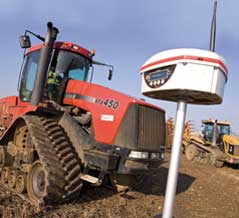
As the machinery giants throw their weight behind GPS precision farming equipment, ultra-accurate electronic guidance will increasingly be the name of the game. David Cousins and Emily Padfield look at a fast-moving field Everyone in the 1950s thought that the future would involve a compliant robot in every home, a prediction that is still a long way from reality. But out in the fields, technology is arriving that makes the average car satnav look pretty primitive and will transform the way that crops are grown. John Deere has already carved itself a chunk of the market with its autosteer and is pioneering totally hands-free (including the headlands) GPS fieldwork systems. New Holland announced at LAMMA that it had struck a marketing agreement with GPS equipment giant Trimble to fit its GPS equipment on its tractors and combines. And just last week Agco, which makes Massey Ferguson, Valtra, Fendt and Challenger tractors, said that it has entered a marketing agreement with another GPS giant, Topcon, to sell its equipment. Meanwhile Swiss giant Leica has made a big push into the agricultural guidance sector, as has US RTK pioneer AutoFarm. The fact that some of the biggest machinery makers are putting their weight behind GPS precison technology confirms what many already suspected, that this is a technology that is here to stay. It may be bigger farmers who use it now, but the benefits in better steering accuracy, fewer overlaps and less driver fatigue mean its influence will no doubt spread far and wide. And new technologies are coming along, like network RTK that give accuracies of 1-2cm without needing a base station. It’s not cheap (and you need a decent GPRS signal) but it allows growers to try ultra-precise RTK with a relatively low investment in equipment. In this feature we look at what network RTK offers in relation to its base-station equivalent and talk to two farmers who have tried both systems. Farming near Welton, Lincolnshire, neighbours Joe Vaughan of RH Ward Welton and Jim Beeden of Flagleaf Farming have both been using Leica’s Mojo RTK system, albeit in different guises. They’d looked at several systems and, together with a group of farmers in the area also keen to adopt GPS technology, even considered installing an aerial at a central point. But they discovered this would require signal repeaters every 20 miles or so. Even with these, signal quality would depend on topography and vegetation, meaning some would be left with decidedly patchy coverage. “The cost of putting up the aerial was also prohibitive,” says Mr Vaughan. “And with developments moving so fast, that sort of investment needs to wait until things have settled down somewhat.” Every farmer has different priorities, so it would have been difficult to get a system that met everyone’s requirements, Mr Beeden added. So, both farmers started looking at the alternatives. Both had seen the Leica Mojo RTK system at its launch at Cereals 2008 last year and Mr Beeden arranged a unit on demo on his Challenger. The system itself is a straightforward plug-in item on newer machines, but with the QuadTrac 450 being slightly older, they had to fit a separate wiring system and EasiSteer autosteer. Next-door’s Challenger was easier as it was already configured to “plug-n-play”. Leica’s system, which comes with central console, antennas for attaching to the top of the tractor and base station, supports existing factory and third-party steering systems, and claims repeatable 5cm accuracy 99% of the time. The console fits snugly into the standard radio slot in the cab, and comes with CD, radio and MP3 compatibility. Once the base station is set up, it calibrates itself by finding the satellites, which usually takes about a minute. Generally, it needs 8-10 satellites to work at full accuracy and if it can’t find enough, it starts again, adds Mr Vaughan. “Having seen how simple it was, we ordered it and had one in time for the start of cultivations in August,” says Mr Vaughan. The farm currently has a QuadTrac 535 on order, and again the system will just plug in. The biggest cost-saving comes from not overlapping, he reckons. “It may not seem a lot land-by-land, but multiply this across the field and you could be doing upwards of 20% of the field twice.” Although Mr Vaughan uses RTK at the moment for cultivations and drilling, he’s keen to filter it down for potato seed-bed preparation, too. The main reason for choosing the Mojo was the cost and simplicity of the system, he maintains. “It worked out the cheapest that we had looked at, coming in at about £10,000, and it does exactly what we need it to.” “It’s not just the first pass that benefits from cost savings,” he adds. “Every pass thereafter, each spray application, also has straight lines to follow.” Meanwhile neighbour Jim Beeden, a manager for Flagleaf Farming, has been testing Leica’s first network RTK system. On the tractor you might not notice much difference in the equipment fitted. However the control unit has a SIM card reader in the back which acts as a GPRS modem. It’s currently fitted with a Vodafone SIM card, which receives correction data from the Ordnance Survey network of 90-odd masts. This signal does the same job as the base station, establishing the position of the OS masts in relation to the mobile unit and comparing that to the satellite signals. The annual fee for this service hasn’t been established yet, and it will depend on how many units use the technology, says Mr Beeden However in terms of overlapping alone, Mr Beeden reckons this costs him around £8500 a year across 1400ha (3500 acres) of which a large portion is saved. So it should soon pay for itself. “There’s no doubt it’s better for driver fatigue,” he adds. “And because the operator is concentrating on getting the most out of the machine, there’s definitely increased output.” He reckons it works just as well as the base station system, and without the hassle of having to set the receiver up in the field. His next step, he says, is to fit it to his new John Deere 5430i sprayer and drill tractor. RTK and network RTK – a quick guide How does GPS work?
CASE STUDY – Joe Vaughan and Jim Beeden, Welton, Lincolnshire 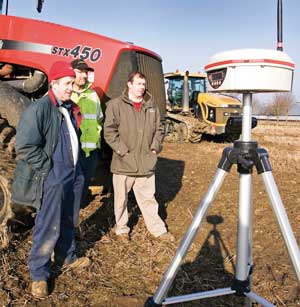
Joe Vaughan (left) and Jim Beeden (right) are trying two different approaches to RTK.
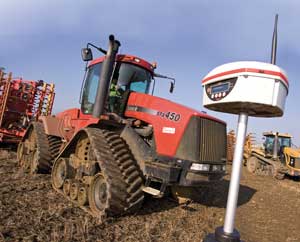
Chris Harwood drives the QuadTrac.
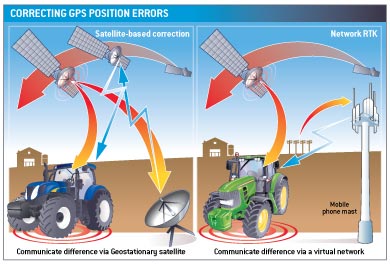 How accurate is all this? GPS alone gives an accuracy of about +/–10m, but a number of free differential GPS systems (like EGNOS or Omnistar VBS or Starfire SF1) add positioning information to give +/–15-30cm. If you want better accuracy than that you can pay a subscription to use the Omnistar XP or Deere Starfire 2 system, giving you an accuracy of roughly +/–10-20cm. And if you want the best accuracy, you need a separate RTK base station. The kit is more expensive but will give you accuracy down to +/–1-2cm. All these figures will depend on your local conditions.
What is RTK?
The letters stand for Real Time Kinematic. Nothing to do with old cinemas, but actually just a technique for using a base station to add greater accuracy to the signal you get from the satellites. Since the base station knows its exact position, it can calculate a correction and boost the standard accuracy from the GPS system sharply.More importantly for many farmers is RTK’s repeatability. This means you can set an A-B line across the field for a tramline and know you can return to that exact point year after year. You can’t do that with non-RTK GPS.
How do I translate that into accurate fieldwork?
Good point. You could, in theory, use this RTK signal to produce a frighteningly precise lightbar and a very good tractor driver could get the benefit from it. In practice, humans can’t steer that accurately, so RTK set-ups will invariably be used with full autosteer (where the system taps into the steering hydraulic circuit) or the slightly less accurate assisted-steer systems (where an electric motor physically turns the steering wheel).What are the drawbacks of RTK?
Cost is a factor. Even if you have a tractor fitted with autosteer, you’ll still need to pay between £4000 and £10,000 for the base station. However, since the base station can transmit its signal about 10km, you could share it with a neighbour, though you’d need to have compatible systems on your tractors.And range is never guaranteed – trees and hills can block the signal and leave you adrift, though manufacturers are coming up with systems that keep you on the straight and narrow until the signal returns. The other drawback is that if you are a contractor or farm on more than one site, you’ll have to cart the base station with you.
Who makes all this kit?
The main players on the RTK front are US firm Trimble (which also has a marketing agreement with New Holland), Swiss camera and surveying equipment firm Leica, Japanese Toshiba-offshoot Topcon (which has a marketing arrangement with Agco) and John Deere. Claas works with Outback while one of the well-established RTK pioneers is AutoFarm.So will we all be using base stations soon?
No, many farmers don’t need this sort of accuracy. And anyway, a new type of networked RTK system has appeared in the last few months that may make some base stations redundant.It goes by various names – Trimble has its VRS Now system and Leica has its Spidernet. Topcon and Deere are also rumoured to have systems in the pipeline.
But the principle is the same – it does away with the local base station using instead information from the Ordnance Survey’s 80-odd base stations around the UK and sending that signal to the tractor or combine via the GPRS mobile phone network.
No more than a handful of units are out on farms, but the system has potential.
Advantages?
Well, you don’t need a base station, for a start. And that means less hardware to get obsolete as the years go by. It’s also a relatively low-commitment way to try RTK, particularly since some of the providers may decide to offer three-month or six-month subscriptions.Disadvantages?
You have to pay an annual subscription fee (VRS Now will cost £1195/yr including SIM card and all data charges) for the data and that fee is per tractor. So if you want to use RTK with several vehicles, it might be cheaper to have a single base station. Plus you need to enjoy a decent GPRS mobile phone signal over the whole farm, which may not be the case.
| CONTACTS |
|---|
| Leica SoilEssentials 01356 650 307 www.soilessentials.co.uk |
| Trimble |
| (North) 01228 562 234 www.precise-solutions.co.uk |
| (South) AS Communications 01480 861 824 www.ascommunications.co.uk |
| Topcon 00 31 104 585 077 www.topcon.eu |
| New Holland www.newholland.com |
| Claas www.claas.co.uk |
| Omnistar 0031 703 170 900 www.omnistar.nl |
| AutoFarm 01944 759 090 www.dempseyprecision.com |
| Deere www.deere.co.uk |
| Agco www.agcocorp.com |