

New co-op targets Easter with regional poultry brand
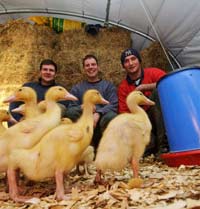
A new producer co-op is looking to develop a regional poultry brand in Northumbria. Wendy Short reports
Two Northumberland producers are taking part in a pilot project which aims to fill a gap in the market, by supplying local outlets with a variety of organic poultrymeat.
Members of the Northumberland Poultry group have already taken delivery of 200 free-range chickens, 200 ducks and 100 guinea fowl. The birds, which arrived as day-olds, will be ready in time for the Easter market.
If successful, the pilot project will be developed into a more formal, co-operative structure.
The two organic farms involved in the poultry production include Thistleyhaugh, Longframlington, which is run by brothers, Angus and Duncan Nellis. Assisted by their self-employed farm worker, Paul Mooney, who has taken on the group chairmanship, they will rear 400 birds.
The main enterprises at Thistleyhaugh are sheep and suckler cattle. A small number of Christmas chickens and turkeys have historically been produced on an annual basis, but this is the first time the farm has ventured into what could potentially become all-year-round poultry production.
Meanwhile, the Nellis’ neighbours, Graham and Michael Rutherford of Bewlaw Farm, are rearing 100 ducks. They converted to organic production in 2006, when their holding was almost exclusively devoted to arable production.
Since the conversion, they have acquired 800 ewes, and contract rear around 2000 finishing pigs each year. Michael says he felt it made sense to join forces with his neighbour, and diversify into a new enterprise with relatively low investment costs at the outset.
All the birds are being housed in polytunnels that have been custom-built to take free-range poultry. They can accommodate 200 and 400-bird groups.
The structures, which have not required planning permission, have been purchased by “Made In Northumberland,” an initiative which is part of Northumberland Tourism. The organisation, which has been established to encourage the production of regionally-branded food in the county, leases the buildings back to the producers.
Made in Northumberland was instrumental in getting the producers together to form the marketing group, and has provided some additional project funding, as well as putting up the capital to buy the housing.
Northumberland Poultry chairman Paul Mooney stresses that the project is still in its infancy. If successful, Northumberland Poultry will have its own marketing materials, including a website. The producers will pay a levy to Made in Northumberland, a fixed amount per bird sold, to repay some of the capital costs incurred.
A price related to the predicted cost of production, plus a profit margin, has been set for each bird. However this will come under review, once input figures have been calculated for the first batch.
For the housing, the indoor stocking rate has been set to comply with Organic Farmers and Growers standards, while the outside ranging area allows for 2.5sq m/bird (27sq ft). A pond has been built for the ducks, while the guinea fowl have access to home-made perches. Standard electric fencing encircles the housing, and the birds are shut in every evening.
Day-old chicks are kept warm under gas heaters, and bedded on wood shavings, which are replaced by straw after brooding for three to four weeks.
It is anticipated that the chickens and ducks will be slaughtered at around 12 weeks old, with the guinea fowl ready on week 16. The chickens have been sourced from organic parent stock, but the ducks and guinea fowl will go through a conversion period. Target weights are 2kg for the chickens, 2-2.5kg for the ducks and 1.5kg for the guinea fowl.
Once the birds are ready for slaughter, they will be processed at Blagdon Home Farm, Newcastle, where group member, Richard Tolson, is based. The meat will be available direct from the farms of origin, but a number of restaurants and food retailers across the north east have already expressed an interest in taking the birds.
These include the well-known Baltic restaurant in Newcastle, and local butcher, Chris Green of Longframlington, Northumberland.
Mr Mooney says: “We think this is a really good idea. Northumberland-branded beef and lamb is readily available, but there are very few farms that supply the type of poultry that we are producing.
“It is very early days, but we are hoping that demand will grow. If the venture turns out to be profitable, we may look into utilising some of our home-grown organic crops for poultry feed.”