Farmer seeder designs steal the show at LAMMA 2012
Two of the most intriguing developments in seeding equipment displayed at the LAMMA 2012 show last month were tucked away from the big stands and came from the fertile minds of growers rather than manufacturers.
Both aim to provide a more economical and/or more thorough approach to oilseed rape establishment without breaking the bank.
Richard Scholes farms at Skerne near Driffield, East Yorkshire. He, like many growers, has come to appreciate the value of shallow subsoiling to help oilseed rape put down deep roots, but regards broadcasting off a subsoiler as a backward step compared with sowing through a coulter.
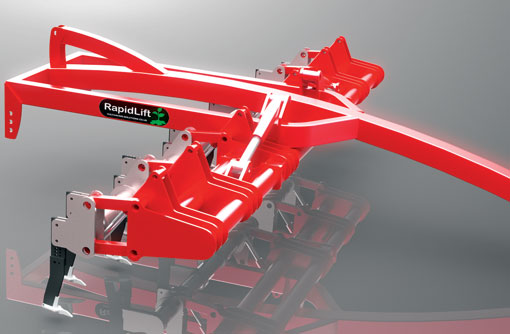
His solution is a replacement drawbar for trailed cultivator drills that incorporates a frame carrying soil loosening tines.
“The idea is to combine low surface disturbance soil loosening with accurate seed placement in one pass,” he explains. “Growers can seed into a loosened zone, sow to a very accurate depth and therefore also control plant populations with greater accuracy – these are all key aspects required to maximise OSR output.”
The RapidLift (pictured above), which is due to appear in production form this spring after prototype testing last year, comprises a long drawbar that bolts in place of the original and carries a subsoiler tine frame.
Tines are mounted on a separate bar attached to the frame by parallel linkage, with hydraulic cylinders lifting them out of work when not required.
Growers who like the idea of adding a “starter” fertiliser dressing as the crop is sown will have the RapidStart kit as an option. This puts a 1,500-litre stainless steel tank on the drawbar-cum-frame with a choice of delivery methods – by nozzle behind the soil loosening legs or through a combined seed-fertiliser coulter that puts the fertiliser in a band precisely alongside the seed.
“Trial work by Yara suggests the optimum rate for seed-bed nitrogen is 60+kg/ha to see significant yield responses from oilseed rape,” says Mr Scholes. “In nitrate vulnerable zones, where we’re restricted to 30kg/ha, the only way to achieve the optimum rate is to put it in a band.”
Four RapidLift configurations are planned – 3m rigid, 4m telescopic, and 6m and 8m sizes in three sections with hydraulic folding.
Further south, at Swaton near Sleaford in Lincolnshire, James Richardson also wanted to get away from broadcasting oilseed rape, but with an implement that could perform two roles.
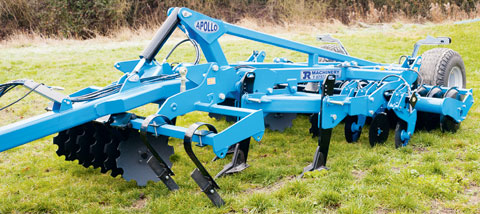
The trailed Apollo (pictured below) he showed at LAMMA may have baffled visitors at first by having different soil-working tools on either side – but it neatly illustrated how the implement could be set-up as a one-pass cultivator with discs, subsoiling tines and a packer or as a cultivator drill for sowing oilseed rape.
“Sowing oilseed rape has to be better than broadcasting but I wanted a versatile machine that could be used in different circumstances,” he explains. “It doesn’t take that long to change the configuration from one to the other, so I think the idea of having a dual-purpose implement like this is quite practical.”
As a cultivator, the 3.2m Apollo comes with a single row of 510mm scalloped discs carried on a subframe beneath, but separate from the drawbar; depth is adjusted by turnbuckles.
Next is a substantial main frame to which the drawbar is attached to give a high-angle lift on the rear transport wheels. This frame provides staggered mountings for five rigid soil loosening tines with wings and knock-through shear pins.
Another row of individually-mounted discs follows to mix crop residues and trash into the soil, with a choice of Tillso “diamond” packer or Mr Richardson’s own ring packer, which is constructed from non-stick plastic with Hardox steel wearing surfaces on the ridges.
For sowing, the leading disc assembly would be replaced by slitting tines positioned in-line with the subsoiling legs to prevent excessive surface disturbance, and the second row of discs with purpose-built disc coulters.
The seeding unit with a single metering roller profile to prevent rapeseed being crushed is added, together with a fertiliser placement set-up.

Meet us at Cereals