Disease tolerance to beat fungicide resistance breakdowns?
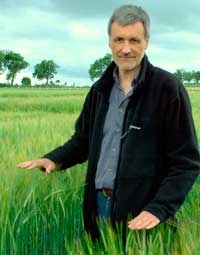
Potential spring barley traits that would allow crops to be more tolerant of disease have been identified as part of a Scottish government funded project looking at novel ways of improving disease management, says Ian Bingham of SAC.
Crops that were tolerant of disease would be able to better maintain yield in the presence of infections, he explained. “Why is that interesting? Because at the moment we rely heavily on varietal resistance and fungicides, both of which can be overcome by the disease. If we have varieties that are tolerant then we will lose less yield if that happens.
“It should also mean resistance is more durable, might mean we’re able to use less fungicide, and potentially tolerate more disease in the crop because we know it won’t lose yield.”
The project was trying to find characteristics that might impart tolerance. For example, a variety with prostrate leaves that allowed less light to the lower canopy might mean the lower leaves were less important as they wouldn’t contribute to yield as much, and would be able to tolerate disease lower down the canopy, he explained.
“Or finding a variety that increases growth of its leaves in response to disease lower down the canopy [might be more tolerant and lose less yield].
“The good news is we’ve found some genetic variation that might be useful.”
The project had thrown up one surprising result however. “In field experiments we were looking at the influence of crop structure on tolerance with and without triazole/strobilurin fungicide programmes and there were big differences in the amount of mildew that developed between different plant types.
“But the response to fungicides bore no relation to the disease level. So we think that fungicides might be having an impact on grain number formation separately from thier control of visible diseases.”
A new LINK project, in collaboration with ADAS and industry partners, was investigating that result further, Dr Bingham said. “One theory is the fungicide could be controlling some types of disease before symptoms are expressed.”
The finding did create a problem for the tolerance research, he added. “It can mask the effects, so this year we are using programmes based on the protectant fungicides Bravo, Talius and Flexity.”
The other focus of the trials this season was comparing old and new varieties for tolerance. “We’re testing the theory that breeding progress has inadvertently reduced tolerance to disease.”
Distillery closure points up soft wheat export potential