RTK precision helps Kent grower achieve controlled traffic farming
Controlled traffic farming with fixed wheelings isn’t a new idea, but GPS technology is making it a much more practical proposition. However, having the right kit is crucial.
It can be a long and tortuous route to achieving true controlled traffic farming (CTF) and it’s one that Kent arable grower Andrew Cragg hasn’t yet come to the end of.
But with the help of an ultra-precise GPS system and some carefully thought-out machinery buys, the journey has at least been made a lot easier.
“I’ve always thought that running all your kit down the same set of wheelings made good sense, but practically it was a headache,” says Mr Cragg (pictured).
“Consequently, I’ve always tried to spread our footprint with flotation tyres and tracks.
“With CTF I have to think about going back the other way if we stick to the same route every time and effectively sacrifice that ground, we want to make that area as small as possible.”
This approach has only become possible with the installation of an RTK (Real Time Kinematic) satellite guidance system at Brooker Farms near Newchurch, Romney Marsh.
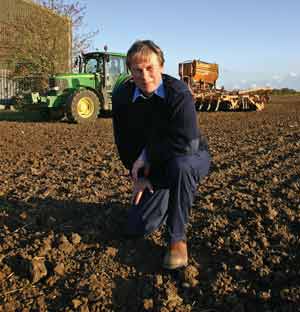
With a base station mounted on the grainstore roof, the set-up enables auto-steering to be used with sub-inch accuracy.
“When you run in the same wheelings all the time you create narrow compacted tyre tracks surrounded by soft, untouched soil.
“There’s a danger that if you don’t drive accurately you can drop out of the wheelings and end up with ruts. With RTK this shouldn’t happen, but you still have to keep your wits about you because the system can sometime veer off course unpredictably.”
Mr Cragg first ventured into the world of GPS technology when he bought an RDS yield-mapping outfit for his John Deere combine nearly a decade ago. For almost five years those maps went unused as he built up the confidence in their accuracy and scratched his head as to how the data could be employed.
Then in 2001 he bought an Amazone fertiliser spreader with an RDS controller, which gave him the ability to experiment with applying material at variable rates.
“We tried to spot some correlation between yield maps and soil nutrient maps, but there were too many other things going on confusing the issue,” he says.
“We learned to take a broad view and vary rates according to experience as well as what the maps were telling us.”
Then in 2006 things started to fall into place. A new Househam self-propelled sprayer arrived laden with all the bells and whistles, including a Topcon Zynx X20 auto-steering system and auto-section shut-off for the 24m boom.
“Within a year I could start to see the pay-back. I sprayed 5.1% fewer acres in 2006 than in the previous season because we weren’t overlapping so much.
“With an average of eight passes across our 560ha we saved over £3500 in chemical costs alone, not to mention time, diesel and wear and tear.”
“Importantly, that reduction in pesticide use represents a huge environmental benefit.”
Using the sprayer’s guidance system the farm was also able to experiment with a crude form of controlled traffic farming (CTF) by establishing accurate tramlines in a field and then reproducing them in the same place in the following year.
“I soon realised that if we were going to progress to proper CTF we were going to have to start harmonising our equipment widths. The drill, with its role of setting out the tramlines, seemed a logical next step”
He’d already been trying to ease the intensity of the farm’s cultivations regime and made an unconventional, but carefully planned choice in his drill.
Having persevered for many years with a rotational ploughing system that employed an aged 4m Parmiter box-drill with Suffolk-coulters and an even older Bettinson DD-4 disc-drill, he approached John Dale to build him a machine that would handle surface trash and be versatile enough to work in a range of conditions.
“I wanted a drill with that would provide some cultivation effect, but which had a low draft requirement.
“I liked the idea of full-width rollers ahead and behind the coulters to ensure accurate depth seed placement and a firm finish.”
“The guys at John Dale went away and thought about it for a long while. Their answer surprised me – they told me what I actually wanted was a Simba FreeFlow, but without its usual tines.”
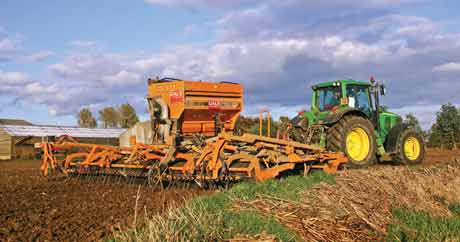
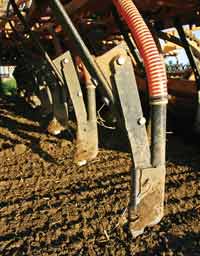
By replacing the Simba FreeFlow’s standard heavy pig-tail tine coulters with Seed-Hawk knife coulters, John Dale has reduced power requirement from 250hp to just 140hp
The solution saw a second-hand 6m FreeFlow enter the Dale workshops for a complete overhaul and a change of coulters. Simba’s heavy square-section pig-tail tines were swapped for lighter, narrower Canadian Seed-Hawk knife-coulters.
This immediately reduced its horsepower requirement thanks, in part, to the reduced rigidity and more forgiving nature of the tines.
“I’d spent the past 10 years looking enviously over hedges at my neighbours’ Vaderstads, but didn’t like the idea of having to have such a big tractor to pull one,” says Mr Cragg.
“The weight of such a heavy rig would have been a backwards step for us. Instead, for £23,000 I ended up with the perfect drill for our system and it only needs 140hp up front to pull it on our flat ground.”
Even stepping up to 6m, power requirement for the drill stayed pretty much the same as before, leaving the farm’s 250hp cultivations tractor to get on with seed-bed preparation.
Previously up to five passes – from plough to press and power-harrow – were needed to provide a clean enough tilth for the farm’s ageing drills. The Dale FreeFlow is much less demanding and because of this there is rarely a need for more than two to three runs ahead of the drill.
“We’re saving money on the cultivations front and the FreeFlow copes well whether you’re working into light fluffy stuff or heavier, stickier soils, with or without trash,” he says.
“At 6m it fits within our 24m tramline system and will work in with the controlled traffic wheelings. We’re just grappling with how we get the combine to fit with its 9m header.”
Farm facts
- Location Brooker Farms, Newchurch, Romney Marsh, Kent
- Farmed area 560ha (1380acres)
- Soils Silty clay loam
- Elevation 2m above mean sea level, 3m below high water mark
- Cropping 360ha (890acres) winter wheat, 100ha (250 acres) oilseed rape and 100ha (250acres) vining peas
- Machinery Tractors – John Deere 8420-T, 6920, 6620, 6800 and 6400 Combine – Claas Lexion 580TT Sprayer – 2500-litre Househam Air-Ride with 24m booms Loader – John Deere 3800
- Staff Two partners, two full-time plus one casual at harvest
Did you know? |
HGCA gets precise
Andrew Cragg is chairman of the HGCA’s knowledge transfer group. Starting at the beginning of 2009, the organisation is running a series of workshops looking at precision farming technologies and how the investment stacks up.
The initial sessions will provide a basic introduction to GPS and its applications in agriculture. Those wanting to delve a bit deeper can then attend the second series of workshops looking at the payback from precision farming. For more information see the HGCA’s ‘BePRECISE’ workshops, email BePRECISE or call 020 7520 3949.
Precision Farming Event |