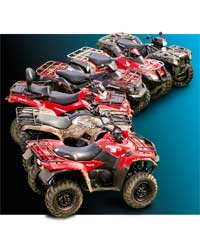
Do the current set of 700-850cc ATVs offer worthwhile advantages over the 400-500cc ones most farmers use at the moment? Emily Padfield and Nick Fone tried six full-sixed machines to find the answer
It seems like only yesterday that the first 250cc three-wheelers appeared on UK farms - though it was actually 25 years ago. Then came four-wheeled ATVs and 350cc gradually became the norm for a decently-powerful farm workhorse.
| THE LINE-UP | | | |
| Make & model | Fuel | Power | Retail price (exc VAT) |
| Can-Am Outlander Max 800 R EFI (EC) | Petrol | 800cc | £7819 |
| Honda Rincon AT FI | Petrol | 675cc | £7249 |
| Kawasaki KVF 750 V-Twin FI | Petrol | 750cc | £6599 |
| Polaris Sportsman 850 XP EFI Twin | Petrol | 850cc | £7499 |
| Suzuki King Quad 750 AXi | Petrol | 750cc | £6599 |
| Yamaha Grizzly 700 EFI | Petrol | 700cc | £6899 |
Now, the most commonly bought bikes for farmwork range from 400-500cc. But manufacturers, keen to tackle both leisure and utility markets in one go, are now tempting buyers with bigger and better models.
But what does having 850cc instead of 500cc actually mean? Does it turn feeding the sheep into something more akin to the beach race at Weston? Or does all that extra grunt enable you to haul heavy loads more safely and scale hills without difficulty?
In our test of six high-cc bikes, we assessed them for overall quality, rideability and their ability to do a range of farm tasks. All had independent suspension on all four corners and half had big V-twin motors; all six had electronic fuel injection.
Five had belt-driven CVTs; Honda opts for a torque-converter and three-speed auto-box. For most buyers, the way to choose is by colour and country of origin. But, favourites aside, we tried to highlight the good, the bad and the ugly in each model.
First, watch the video:
Now here's our verdict in detail:
Build quality Can Am scores highest here but you'd certainly hope so given that it costs substantially more than the others. But good value-for-money alternatives predominate, with Honda making a close second and Polaris bringing up the rear.
Practicality Given that you're only likely to be considering a bike this powerful, if it's muscle you're after the Kawasaki does it in the most practical way. It's a big bike but puts the power on the ground very smoothly. The right-hand range and direction shifter is initially an annoyance but quickly becomes normal, and selectable diff-lock is a real bonus. Honda scores well, too, thanks to its slick-shifting shuttle and jump-on-and-drive ability. Polaris is not so good in the practicality stakes, with its twin-tail pipes making hitch access a nightmare and plastic racks that just aren't meant for work.
Performance Polaris wins hands down here with its big, throaty V-twin pumping out masses of power. It out-climbed all the others on the hill and can handle a heavy load. Both Kawasaki and Can-Am come in close seconds. Naturally enough, with the smallest engine on test, the Honda does least well but this difference is in the main down to its lighter weight, making traction an issue.
Engine braking Again Polaris scores highest on engine-braking with its clever-but-effective active system capable of bring both bike and trailer to a halt heading downhill. Suzuki struggled the most in this department and needed large helpings of right foot to keep things under control.
Ride, comfort and noise Even with its adjustable shocks set to their second hardest setting - like all the bikes on test - the Kawasaki's suspension was by far the softest, making for a very comfortable ride and not adversely affecting handling. Yamaha's wide seat and strange-feeling chopper-style handle-bars give it an odd driving position that proved least natural. Honda's smooth-running 675cc engine was easiest on the ears while Polaris's raucous bark was gratifying at first but quickly became a serenity-shattering din.
Handling, steering Honda's light weight means it requires the least effort to shove about while Can-Am's big, bulky bus feels cumbersome because of its extra length. Both Yamaha and Polaris opt for electronic power-steering on their range-toppers, the Grizzly making best use of it with greatest refinement and responsiveness. Can-Am's heavy-feeling handle-bars put it bottom of the pack.
Sum-up These are great bikes with loads of power. But all that muscle inevitably reduces manoeuvrability and increases fuel use and price. If you're doing a lot of trailer towing on steep hills they are ideal, but for those with more modest farm tasks it's probably a case of overkill.
What did we test?
While our tests were not particularly scientific, we did try to put these bikes through their paces as they would be on any mixed farm in terms of agility, towing ability and practicality.
Towing: Each bike towed a Logic trailer loaded to 610kg (this is generally more than the manufacturers advise) 250m up an incline of about 1:10 from standstill and in 4wd. This was repeated three times and an average time was calculated.
Turning circle: This was checked on a clear piece of land and measured in 2wd.
Weight: Each bike was weighed on the farm's weighbridge without passenger.
Agility/ride: Each bike was set to tackle a particularly testing wooded, hilly course at varying speeds - which tested manoeuvrability and overall ride quality, as well as engine braking without a trailer.
|
| FW VERDICT As the most powerful of the group, this is the ultimate boy’s toy with a ride to match, but we’re not sure if build quality would be up to everyday farmwork. At £7499 it’s not cheap, and you might expect a slightly better finish. But it’s clearly the fastest and most capable in the line-up. |
Polaris Sportsman 850 XP EFi Twin First impressions With enough bling to satisfy the most diehard boy racers, the stealth bomber smartness of the Polaris is let down a bit by overall build quality. An insubstantial gear lever and wires protruding from the 4wd selector hint at lack of attention to detail. Alloys and colour align it with leisure bikes.
Practicality The two-handed handbrake would be a pain if trying to launch off to catch an unwieldy ewe. The usual Polaris hard plastic racks are sturdy but limited in carrying capacity, unable to carry a slug pelleter. Rear storage is good and rack and towing capacity the highest on test. However the tow bar is positioned dangerously below the full-width exhaust pipe - ouch.
Underneath, there's no wishbone protection and brakelines are exposed but in general guards are comprehensive and tough. It starts in gear on the key with either left handbrake or foot brake depressed.
Performance With 850cc and 70hp, you'd expect it to be the most responsive, and it is. Transmission belt slip means delay and jolty start at the low end, but belt life extends to 5000 miles, says Polaris. Handling is hardly affected when towing and the Polaris's engine braking is enough to completely stop the bike and heavy trailer running downhill, even without a clever extra braking feature called Active Descent Control. This, coupled with electric engine braking, means as well as limiting the engine, there's deceleration in all four wheels, too.
| LIKES - Power steering
- Exceptional engine braking
- Load/towing capacity
DISLIKES - Throttle delay
- Build quality
- Exhaust positioning over tow bar
|
Ride, comfort, noise Probably the throatiest of them all, this V-Twin lets you know it's all there. Ride-wise, the dual wishbone suspension is the longest on the market and the independent rear suspension means less bucking when accelerating or towing.
Handling, steering Equipped with electronic power steering, the steering feels a bit like a Mini Metro's. This is both good and bad. At high speeds it causes a wobble, but it's certainly kinder on your arms after a day in the saddle. Braking in two-wheel drive at speed is slightly unstable, and the single brake seems biased towards the front.
|
| FW VERDICT Ignoring the high price, this is the sturdiest of the line-up and for quality of ride it's one of the best. But its size and handling make it less-than-ideal for tight spots. |
Can-Am Outlander Max 800 R EFI
First impressions The Hummer of the group with a wheelbase of 1.5m, the Outlander is the mammoth of the test. Although we had the two-seater, this second seat can be replaced by a sturdy rack for extra loading space. It had the strongest build quality of the lot - no flimsy panelling here.
Equipment and spec Lots of clever gadgets which wouldn't look out of place on a car, including clever Digital Encoded Safety System (DESS) anti-theft feature and courtesy lights which stay on after the keys have been taken out of ignition, but no good for lamping. It's wired as standard for a winch - and there's a snow plough available in case of another cold winter.
Practicality Because of its longer wheelbase, stability was good and turning circle isn't as bad as you'd expect. It can start in gear with left-hand and footbrake. The dash is the most car-like and comprehensive and the front storage lid reveals coolant and radiator filler and fuses. Racks were the strongest on test, with handles for the passenger. Storage is enough to stow a lamb in the back - with a rubber gasket to make it watertight.
Performance Switch on and there's intially a delay in turning over. But the V-twin doesn't disappoint, and although it's the heaviest in the group, acceleration is far from sluggish. Thanks to the longer wheelbase, trailer towing is good with none of the characteristic back-end dip at start off.
| LIKES - Like an armchair to drive
- High build quality
- Good storage compartments
DISLIKES - No right-hand brake
- Feels big and cumbersome
- Grab handles make filler cap access tricky
|
Ride, comfort, noise Noise consists of a fairly throaty rumble and slight transmission whine at high speeds. A fancy swing-arm suspension arrangement helps each tyre remain in contact with the ground, eliminating wheel scrub. Even if you're carrying a passenger, ride remains stable.
Handling, steering The ViscoLok 4wd system allows 100% power to go to the wheel which has traction, ensuring good grip even on rough terrain. The steering would benefit from being power assisted - it's a real bicep expander at the moment. Braking is the best in the group.
|
| FW VERDICT A no-nonsense, well-made bike. Probably not one to go for if you do a lot of heavy towing, but around the yard and on the hill it's still a proper utility bike, without all the bells and whistles of some of the others. |
Suzuki KingQuad 750 AXi
First impressions Good, wholesome, boy-next-door sort of bike. Simple, well laid out, traditional looks with high build quality throughout.
Equipment and spec The halogen headlights follow the handlebars when selected via a switch on the ignition. There's also a moveable reversing light and digital dash.
Practicality Storage is good with a watertight cubby hole (not to be confused with the fuel tank) and a rear compartment big enough to carry a can of Terramycin and foot shears. The racks are sturdy with holes to bolt things on. The turning circle is best in the group. The 750AXi starts in gear only if you hold the left-hand brake, not the footbrake.
Hitching up a trailer is straightforward and access is easy. There's a nose guard and protection is good underneath, but no wishbone guard. The snorkel-type air intake is good for those with a penchant for going through deep water.
Performance There's a steep acceleration curve and plenty of poke, thanks to the bike's low weight. Left-handed gate-type gearshift is easy to use and has three drive modes available. Smooth belt-driven CVT makes for consistent power delivery.
| LIKES - Simple, well-laid out
- Build quality
- Good service access
DISLIKES - Towing ability
- Engine braking
- Two-handed handbrake
|
Ride, comfort, noise A narrow seat and good riding position, Suzuki's independent suspension makes for a smooth ride.
Handling, steering The lightweight frame makes the Suzuki feel like a rocking horse, and it's very nimble.
It's not so great with a heavily loaded trailer - at speed it can start to weave and engine braking is poor.
 |
| FW VERDICT Although it has the smallest engine on test, the Rincon is a lively performer that can fling mud with the best of 'em. The gearbox is by far the simplest and smoothest to use although take-up is snatchy. Power is unlikely to ever be a limiting factor although its light weight means is not quite as capable of handling heavily-laden trailers. |
Honda Rincon 680 First impressions Plastic panels merge seamlessly into one another to make this a slick-looker. Floppy black plastic outer wings give way if you lean on them but are easily replaced - a real plus point on farms where panelwork gets a hard time. Smallest in stature - and engine size - of the bikes on test.
Equipment and Cost Basic spec includes digital dash, a limited slip front diff and the option of electronically overriding the three-speed auto box. Relatively expensive, but solidly built.
Practicality Basic storage extends to a single flap-topped compartment in the front left-hand mudguard, big enough to hold a pack of Woodbines - though whether they'd be dry enough to smoke is another matter. Front and rear racks lack any sort of backstop so loads are likely to skate about.
While Honda has done away with its over-fiddly reverse engagement nonsense at long last, start-in-gear still requires a squeeze from the right-hand brake lever.
Performance Relatively speaking, the Rincon was a midget among monsters in this test, its 675cc motor making it the smallest of the lot. While most of the other manufacturers opt for a belt-driven CVT, Honda goes for a hydraulic torque-converter and three clutch packs to provide riders with a car-like auto-box or thumb-shiftable three-speed.
| LIKES - Simple smooth-shifting transmission
- Agile, responsive chassis
- Good build quality and flexible replaceable panels
DISLIKES - No reverse limiter over-ride
- 'Blippy' throttle
- Poor under-belly guarding limits sump-plug access
|
In either mode the transmission has a tendency to be rather more lively - and snatchy - than the more sluggish belt-drive ATVs.
It tows fine and engine-braking is no issue although, whether travelling uphill or down-dale, its low weight can mean a heavy trailer becomes boss of it.
Ride comfort and noise The Honda's seat is the stiffest of the lot although not uncomfortable and the single cylinder motor is the quietest of the bunch.
Handling and steering Being the lightest, the Rincon steers easily although the turning circle is surprisingly substantial. That said, its small stature makes it feel the most nimble and the chassis reacts promptly to shifts in bodyweight.
 |
| FW VERDICT The definitive grey man, the Grizzly melts into the background. It isn't loud, brash or overly muscly but gets on with the job as is required. |
Yamaha Grizzly 700FI
First Impressions Camouflage colour-scheme makes the Grizzly blend into the background but flimsy one-piece panels don't inspire much confidence when herds of inquisitive cattle take an interest.
Medium-sized, it slots into the lower end of the line-up on engine capacity.
Equipment and cost Digital dash is one of the clearest on test but is hidden away in front of the handlebars, so is difficult to view when travelling in anything other than a straight line.
Chunky towbar is easy to access and has comforting back-plate to protect rear end gubbins.
At £6899 it again slips into the middle of the pack.
Practicality Best racks on test with back-stops. One small screwtop storage pot in front right-hand mudguard.
The Grizzly starts in gear with a stamp on the footbrake or a squeeze of the left-hand brake.
| LIKES - Smooth wish-bone and underbelly guarding
- Sensitive power-steering
- Quiet capable engine
DISLIKES - No hand-brake
- Obstructive fuel-filler cap
- Front brake lines foul drive-shaft guarding
|
Performance Once again the Grizzly falls in the middle of the pack when it comes to engine performance - its 686cc motor is certainly no monster but had no issues with anything we threw at it.
The belt-driven CVT is smooth on the uptake and progressive right through the rev range. Strong engine braking is provided by a one-way bearing on the driven pulley that transfers load back to the engine as soon as forward speed out-runs revs.
Ride comfort and noise The Grizzly floats effortlessly over lumps and bumps at speed. Again, middle of the road when it comes to its bark.
Handling and steering Electric power-steering seems like namby-pamby overkill at first but quickly becomes a pleasant luxury, making life very easy on the shoulders although inevitably feedback suffers. It's better than the Polaris in this respect though, and doesn't tend to dip its shoulder as much as others when rushed into a tight turn.
|
| FW VERDICT If is a big V-twin you're after and you can cope with the colour-scheme (more sombre liveries are available) then this is the bike to go for. It's one of the cheapest on test and yet one of the most refined and comfortable. |
Kawasaki KVF750
First impressions With its glossy black paintwork, bling alloys and red-trimmed racks and coil-springs, there's definitely something of the American muscle-car about the Kawasaki KVF750. No surprise there, then, given that that's exactly the market the Japanese firm is targeting with this bike. It stands tall but squats down on its squidgy suspension when you sit on it.
Equipment and cost Straightforward and does what it says on the tin. Big V-twin motor and well respected name make it seem cheap in comparison to the other players.
Practicality Storage lockers in both front mudguards. Net-fronted right-hand cubby-hole is useful for notebooks and Nokias. Red racks lack back-stops and are disappointingly weedy.
Performance Big V-twin engine puts the KVF right up there in the power-stakes. Not the raw muscle of the Polaris but certainly more refined and more smoothly delivered. Right-hand gear shift a pain at first but is quickly forgotten. Switchable 2/4wd as all others but nifty front diff-lock arrangement allows the rider to engage at the squeeze of a yellow-stalked hand-grip. Releasing it immediately knocks the lock out, making for lighter turns and less tyre scrub.
Artificial, although effective, engine-braking a winner. A solenoid squeezes together the driven pulley of the belt-drive CVT as forward speed overtakes engine revs.
| LIKES - Smooth power delivery
- Overall build quality
- Reversing light
DISLIKES - Poor racks
- RH gear-shift
- Farm un-friendly bodywork
|
Ride, comfort and noise Squidgy suspension set-up makes the Kawasaki a real armchair ride but strangely doesn't seem to adversely affect handling or towing performance. Least mouthy of the three V-twins.
Handling and steering Soft shocks mean the KVF does have a tendency to roll like a tall ship at speed but for everyday tasks it's unnoticeable. Steering has a tendency to skip at top-end speeds, especially over rough stubbles.
| VITAL STATISTICS |
| Model | Can-Am | Honda | Kawasaki | Polaris | Suzuki | Yamaha |
| Engine capacity (cc) | 799.9 V-Twin | 675 | 749 V-Twin | 850 V-Twin | 722 | 686 |
| Fuel | Petrol | Petrol | Petrol | Petrol | Petrol | Petrol |
| Transmission | CVT, h/l ranges | 3-stage Hydrostatic | CVT | CVT | CVT | CVT |
| Power (hp) | 62 | N/A | 49.1 | 70 | 49.6 | 45 |
| Towing capacity (kg) 590 | 590 | N/A | 590 | 680 | N/A | 590 |
| Hillclimb with trailer (secs) | 29.55 | 35.44 | 32 | 26.78 | 33.45 | 28.82 |
| Machine weight (kg) | 350 | 280 | 290 | 395 | 295 | 290 |
| Turning circle (average in m) | 4.6 | 4.8 | 4.5 | 4 | 3.7 | 4 |
| Rack capacity (F/R) | 45/90 | 45/90 | 40/80 | 55/110 | 30/60 | 45/85 |
| Cost before VAT | £7819 | £7249 | £6599 | £7499 | £6599 | £6899 |