Potato growers urged to check crops in stores during cold spell
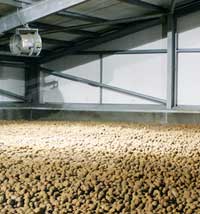
Potato growers are being advised to check crops in store to ensure they are not suffering in the present cold snap.
Most stores are well insulated to keep the storage environment isolated from the impact of the freezing conditions outside, said Adrian Cunnington, head of Sutton Bridge Crop Storage Research.
But stores should be checked for any leakage or spots where cold air may get inside the building, he added. “Even small gaps in the insulation ‘envelope’ can lead to localised chilling when there is wind pressure to assist the penetration of cold into the stores,” he said.
Cold weather also increased the risk of condensation in the roof of the store as the warm, high humidity from the crop would condense on the cooler roof above.
Condensation can be managed by using roof space heating if this is fitted or by using a combination of heaters if there is air movement in the space. Processing stores are most at risk, he said.
The cold can also create temperature gradients so there is a greater risk of condensation within the crop, but recirculation can help to alleviate this.
“Where ambient air is used for ventilation, check that the louvres are opening and closing correctly as ice can often form around them and result in them sticking,” Mr Cunnington says. A stuck-open louvre could have catastrophic effects at this time of year, he warned.
Therefore, growers should check that there is a back-up thermostat covering the air delivery that will shut down the fan when cold air risks being blown into the crop.
“This override thermostat should be entirely independent of the control system to guard against any faults with sensors,” Mr Cunnington said.
Cold air usually also affects the flushing of stores, he added. Manual flushing systems should balance the need for fresh air with the risk of chilling, whereas automated systems should have a minimum temperature set for air delivery in the duct.
Fry colours should be tested regularly to identify any impact of the cold conditions on market acceptability.
Processing stores are most at risk, he believes,