

Beware danger of maternal bluetongue transmission
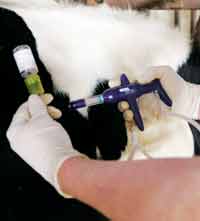
Farmers considering avoiding vaccination against bluetongue strain eight (BTV8) this year, in the belief cattle will only be mildly affected, are being warned of the danger posed by transmission of the disease to unborn calves when cows are infected in the early stages of pregnancy.
Speaking exclusively to Farmers Weekly, Ian Anderson, Intervet Schering Plough’s product manager, said experience of the disease in Holland had shown that BTV8 could be transmitted to unborn calves before their immune systems were fully prepared and these calves could then go on to be reservoirs of disease once they were born.
“There’s no clear cut answer as to when the disease is transferred across the placenta to the calf, but it’s likely to be in the first trimester of pregnancy, as the calf’s immune system isn’t fully active at that point and the calf won’t recognise the virus as being a foreign organism,” he said.
“We’ve heard many cattle farmers suggest they aren’t overly worried about vaccinating against BTV8 if cattle only show mild symptoms and then go on to develop natural immunity to the disease. But if these farmers don’t vaccinate their cattle and cows then become infected early in pregnancy there is a high chance their calves will be born infected.”
It had been known for these calves to remain alive for many months post-birth, allowing midges to pick up the virus from them and pass it on to other BTV8-naive stock, he said.
“There are a number of symptoms in these calves which farmers need to look out for, the first of which is stargazing – calves wandering around with their noses pointed towards the sky. Infected calves frequently also have opaque, blue eyes, which occurs as a result of a complex reaction between the virus and maternal antibodies in the calf, calves may also just appear to be incredibly stupid and have trouble walking,” added Mr Anderson.
A sample of cows and calves in Holland found that calves positive for the virus were being born to cows which tested negative for it after the calf had been born, indicating calves were infected early in pregnancy. “Testing also showed that BTV8 prevalance was higher in newborn calves than in older calves, indicating that positive calves could become negative by the time they were four or five months old.”
While some farmers may not be worried about seeing mild signs in older animals, the potential for an entire crop of unborn calves to be infected with BTV8 and potentially fail to thrive or die was a risk many farmers simply could not afford to take, he said.
“Spring-calving herds should be particularly aware of the risk, as their cows are likely to be in the early stages of pregnancy during summer when the risk of BTV8 infection is at it highest. Not that there isn’t a risk for autumn calving herds, too. And anyone considering importing in-calf cattle should think carefully before going ahead even when the cattle themselves show no indication of active disease, as their calves could be infected.”
But it was not just cattle farmers who needed to be wary of the risk, as maternal disease transmission had also been found to happen in sheep on the Continent, he added, with lambs born infected with BTV8 while their dams showed no sign of active disease when tested.