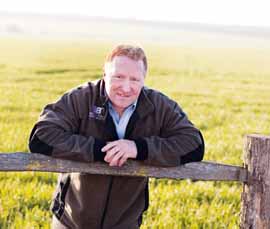
Andrew Pendry has made intensive arable production a fine art on the substantial farm he manages for Burden Brothers on the Isle of Sheppey in Kent.
Quality crops are the main focus, as the farm's Grade 1 loam and heavy London blue clay soils regularly return milling wheat yields of more than 11t/ha.
These yields can cause protein dilution, so Mr Pendry gives the crop a decent nitrogen dose and doesn't skimp on inputs. "Because we are growing for quality, we never cut corners."
He also uses biosolids, compost and gypsum to improve soil fertility and structure. "The soil is now so much more friable and easier to work. We have managed to reduce fuel bills and wear and tear on metal parts."
This year's crop is due to receive 180kg nitrogen in a three-way split, he says. "Some crops are looking very forward, so I'm not in a hurry to get the first dose on."
Mr Pendry is BASIS, FACTS and BETA qualified and gives his wheat crops a full fungicide programme.
Septoria is the main threat on the island, so he will be using 0.4 litres/ha straight Opus (epoxiconazole) at T0, followed by a T1 treatment of Envoy (epoxiconazole + pyraclostrobin) at 0.5 litres/ha and Ceando (epoxiconazole + metrafenone) at 0.75 litres/ha.
At T2 he plans to spray Ennobe (epoxiconazole + prochloraz) at 0.5 litres/ha and Envoy at 1 litre/ha. A T3 is not normally required as the island is so dry at that time, he says.
"In certain areas off the island I sometimes add Bravo chlorothalonil in the T1, but this would not be included in my main programme on Sheppey."
He is also going to try using some of the new SDHI chemistry on his wheat crops this year. "The current programme works well and as SDHI chemistry is more expensive, it will need to show a significant benefit on the yield maps for me to switch permanently."
Gallant was grown for the first time last year and was his top performer, returning 11.4t/ha, with 13.6% protein. "It was spot on."
This year's quality wheat area is split between Gallant, Kingdom, Cordiale and Invicta. He also has a 50ha block of Paragon spring milling wheat, which he finished drilling on 6 March.
Most wheat goes to Tilbury for export through his main merchant, Immo Grain, Hampshire.
Resistant blackgrass is a significant problem, particularly on the heavier soils, but Mr Pendry manages the weed through his rotation, using a significant area of combinable and forage maize and some temporary Westerwold grass.
Some of the 80ha Dominator forage maize, 60ha Falkone and 60ha Cerruti combinable maize is used to feed the farm's 1100 suckler herd with followers, and some is sold to other producers.
The combinable maize is either dried using a 30t Mecmar mobile batch drier or crimped. Due to the high volume, the farm hires in a high-capacity crimping machine during harvest.
Maize is grown continuously on some of the rented ground furthest from the island. "It's not a problem to grow maize continuously and it really helps us with the rest of our rotation."
This year he has established 65ha Westerwold grass, which is a three-way mix of fast-growing Italian rye grasses. "We should do the first cut in the second or third week of April, which will be ensiled. The second cut will go into haylage for the horse market."
Oats are also used as a wheat break and his 44ha Muscony also provides valuable quality straw.
All straw, including oilseed rape, is baled and sold, with a large proportion exported. Flash and PR46W21 are split equally across the 80ha oilseed rape area and were direct-drilled, using the farm's 8m Sumo Versadrill.
Almost all equipment is sourced through Burden Brothers' two machinery dealerships and is replaced annually. This year, the farm is running two six-straw walker John Deere T670i Hillmaster machines, fitted with 7.5m Zurn Premium Flow headers.
Once cereal harvest is completed, one machine is fitted with an eight-row maize header. This year Mr Pendry harvested all maize bird covers in March, which is being dried and will be used to feed game birds. "It should be doing about 1.5t/acre."
All crops have come out of the winter well, and fertiliser spreading is the current priority. Oilseed rape has already received 80kg/ha and is due for another 80kg/ha in early to mid-April, he says.
"We use urea on all oilseed rape applications and for the first splits on wheat and grass. We then switch to ammonium nitrate as soils start to become drier."
Maize drilling will begin as soon as soil temperatures rise to 8C, but the soil thermometer said they were 3-4C on 8 March, he says.
The farm runs one Bateman RB35 sprayer with a 4000-litre tank and 32m boom. It is fitted with Agleader GPS and sprays over 12,000ha a year, says Mr Pendry. "It is backed up with a 17,000-litre water bowser, to help improve efficiency at busy times."
Four sets of nozzles are carried on the machine, including various types of air-inclusion jet to maximise the number of spray days.
The quantity of maize and grass in the rotation means the sprayer can keep to fungicide timings, he says. "If we had more wheat we would have to consider getting another machine."
Wheat is generally established using the farm's Versadrill, pulled by a John Deere 8345, but in wet conditions he switches to a 6m Carrier tine drill. "The Versadrill and tractor weigh 25t, so it's really a dry weather outfit."
Primary cultivation is largely carried out using a tillage train put together on-farm. A 6.6m Simba X-press is hooked up to a 6.6m Cultipress with a 7m set of Cousins flat rolls at the rear.
Auto-trac GPS is fitted to all tractors, combines and the sprayer. Mr Pendry says it has reduced the area of worked ground by 5-8% and reduced seed, fertiliser and chemical inputs. The drilling tractor and combine are on the more accurate SF2 system, while machines for cultivation and general tasks are on SF1.
The whole farm has been soil zoned over the past three years by Farm Image and Mr Pendry is going to start variable rate seeding and fertiliser applications this year. "It has been a big investment, but if you're going to use this technology you need to invest and do it properly."
The farm is in an ESA scheme, which is being replaced by an ELS and HLS agreement on 1 May. Every field has a 6-12m buffer strip and there is a significant proportion of pollen and nectar, and wild bird seed mixes planted.
Mr Pendry is hoping to double the area farmed by entering into contract farming agreements. "I'm very privileged to have the support of the brothers and we have no fear of investing in machinery. If it was a big enough block we would travel up to 30 miles to farm it."
Andrew Pendry
Old Rides Farm kit list
Tractors
All John Deere
8345 - Main drilling machine 8330 - Cultivation
7530 - General tasks
6930 - General tasks
Combines
John Deere T670i Hillmaster with 7.5m Zurn header x 2
Eight-row maize header
Sprayer
Bateman RB35 with 32m boom
17,000-litre water bowser
Drills
8m Sumo Versadrill
4m Accord combination with Khun power harrow
6m Carrier tine drill
Monosem eight-row maize drill
Cultivation
4m Sumo Trio
6.6m Simba X-press coupled to Simba 6.6m Cultipress, followed by 7m set of Cousins flat rolls
Six-furrow Gregoire Besson plough for maize ground
Fertiliser spreader
Amazone spreader with 4t hopper and 24-52m spread pattern
Dryer
Mecmar 30t mobile batch drier
Telehanders
Merlo 40.7 x 2

Burden Brothers, Old Rides Farm, Eastchurch, Isle of Sheppey, Kent
Andrew Pendry manages all farming operations on the 681ha ground owned by Burden Brothers on the Isle of Sheppey, as well as 419ha rented ground on the mainland. Soils on the island range from Grade 1 loams to heavy London blue clay, while the rented portion shifts from thin chalk to almost pure flint.
The farm's 1100 suckler cows and followers are calved in outdoor corals and grazed on the farm's own grass as well as 2000ha rented conservation grazing from neighbours, including the Elmley Bird Reserve, Natural England and the Environment Agency.
Burden Brothers also run a substantial farm contracting business, two John Deere dealerships in Stockbury, Kent and Framfield, East Sussex, a second-hand machinery business, a construction firm and the Ferry House Inn public house on the Island.