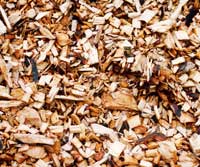
Woodchip pads are a sustainable alternative to outwintering stock on grassland and are a reduced-cost alternative to conventional housing, said Ken Smith, ADAS, at a recent meeting at High Tor Farm, Coalville, Leicestershire.
"The pads are made up of a layer of woodchip over an impermeable subsoil or lining, with drainage pipes directing effluent to a store. This differs from woodchip corrals, often seen in Scotland, which overlay free-draining soil, with no impermeable base."
Although bark pads are not new, there has been little research into their design and management, and as such research is being undertaken by ADAS as part of a LINK funded Research Project.
"Our work has shown bark pads can be cost-effective and work well when design is considered thoroughly," said Mr Smith.
On average, bark pads cost about £250/head, depending on how much work is contracted out, versus £400/head for a yard or £900/head for a shed.
But there are a series of key considerations when constructing bark chip pads:
Planning and construction
• Plan ahead - in most cases some sort of planning will be needed. Anything more than 465m2 in size will require a full planning application. For sites below this figure, a planning notification should be sufficient.
• Choice of site will depend on planning - where possible, use existing concrete areas, position at the side of trackways and make the most of natural drainage.
• The base of the pad must be sealed. On clay ground subsoil compaction may be sufficient, but on permeable soils, a suitable plastic lining will be necessary.
• A drainage system must be installed to collect effluent produced by the pad.
• Drainage pipes should be perforated plastic with a minimum 80mm internal diameter.
• Pipes should be installed in trenches or at the base of subsoil ridges with a fall of at least 2% and covered with 30cm of drainage stone.
• Depth of woodchip above the drainage stone varies between 20-50cm.
• A separate feed and water facility should be placed off the pad area - the feed stand should be concrete and should be easily scrapable.
• A step up/down to the woodchip with a curb will help keep slurry off the pad.
Research has also demonstrated some environmental benefits from using pads.
Pad runoff and emissions
"Technically, the effluent produced from wood chip pads is viewed as slurry, however our research has shown it falls well within the guidelines for dirty water," explained Mr Smith.
At Lower Porthamel, Brecon - one of several sites trialling woodchip pads across the UK - effluent quality analysis from the pad from January to November showed a maximum of 224mg/litre of nitrogen produced.
"To be classified as dirty water, the total N value must be below 500mg/litre, showing woodchip pads fall well within these criteria."
The pad also produced a maximum of 148mg/litre of ammonia - well within guidelines of 300mg/litre for dirty water classification. And these results are mirrored across all other trial sites.
"The absorptive properties of woodchip means the volume of effluent produced is just 20% of total rainfall," says Mr Smith.
And because of their absorption abilities woodchip pads have also been shown to reduce ammonia emissions by 25% compared to housing on slats.
Woodchip
 |
| Woodchip pads for outwintering carry cost, health and environmental benefits. |
The depth of woodchip and size of chip will vary depending on preference and availability, he said.
"Depth of chip can range from 20-30cm, with large, fist-sized chunks of wood more commonly used, but finer chips preferable for animal comfort.
"A coarse mat of chip, at about 20-30cm, can be used for the base and then topped up with finer material. This is more comfortable and retains more solids on the surface, meaning underlying drains are less likely to get blocked." This fine chip can then be scraped off about once a year and spread on land.
"Large chips are not as good on grassland and will generally need to be stacked and composted.
"Chip replacement will vary depending on the coarseness of the chip, with coarse chips potentially lasting about five years."
And when rainfall is good and conditions are right, the pad will self-clean, meaning a certain amount of rain is needed for the pad to function effectively.
Animal health
Although this project does not tackle the health benefits associated with housing on woodchip pads, research has shown lower incidence of respiratory problems and greater expression on natural behaviours with cattle outwintered in such a way, explained Mr Smith.
Research has also demonstrated increased intakes and liveweight gains in cattle on woodchip systems.
"However, I would not recommend keeping lactating dairy cows on pads because of the likelihood of mastitis problems. But it could be possible to out-winter dry cows from spring calving herds on such a system."
Case study
Andrew Danvers Leicestershire
For the Leicestershire and Rutland Wildlife Trust, which works in partnership with beef farmer Andrew Danvers, High Tor Farm, Coalville, installing a bark chip pad has been the answer to a specific problem.
Six years ago they was finding it increasingly difficult to find graziers to take on marginal land, explained the Trust's Neil Pilcher.
"As a result we decided to take on our own livestock and have since expanded numbers to include 25 Longhorns and 35 Shetlands."
However, because all grazing sites were nature reserves and designated land, stock could not be put out in the winter. "We were struggling to find out wintering land, but after hearing about the success of woodchip pads, myself and Mr Danvers decided to bite the bullet and install a pad at High Tor Farm."
The pad has been in use for one-and-a-half winters with the Wildlife Trust's cattle housed on the pad from November until May. Wood is supplied from Charnwood Lodge Estate and chipped onsite by the Danvers.
Housing cattle outside on the pad has had huge benefits in terms of animal health and has eliminated pneumonia and respiratory problems, said Mr Danvers.
"Not bringing in straw every day is a huge advantage and we only need to scrape the concrete feed pad every couple of weeks."
But investing in a separate feed area is essential to get the best from wood chip pads, he stressed. "Chip pads will work well, as long as you don't feed on them. Because it was difficult to feed the Longhorns at the barrier we introduced a ring feeder on the pad, but this did not work as well and churned the pad up." As a result, Mr Danvers is looking at introducing an alternative feeding area.