

UK cattle face bluetongue catastrophe without jabs
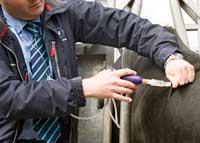
Cattle farmers shouldn’t assume bluetongue is only a threat to the sheep sector. If UK beef and dairy farmers adopt that attitude and fail to vaccinate stock this spring, the cattle sector could be heading towards an animal health catastrophe, Dutch vet Karin van Heuven-van Kats warned during a visit to Lancashire.
“Farmers in the UK haven’t seen enough cases of bluetongue in cattle, compared with our experience of the disease in Holland, to realise the full extent of the damage this disease can do.
“This is not just a sheep disease and my concern is that UK cattle farmers don’t have a grasp of what a major impact this disease could have in their herds if they are complacent about vaccination,” Ms van Heuven-van Kats told a meeting of farmers organised by Intervet/Schering-Plough Animal Health in Garstang.
She said there was no doubt one of the bluetongue serotypes would eventually have a serious effect on cattle in the UK unless there was a big swing towards vaccination. “There’s still a lot we don’t know about bluetongue. But one thing is for certain: It isn’t going away and farmers must protect their stock. When I first saw cattle with bluetongue I didn’t recognise it. It wasn’t a disease I thought they were suffering from. And that’s the big danger here. Farmers may have it in their cattle and not realise it.”
In Holland the motivation to vaccinate – 95% of cattle were vaccinated last year – was driven by farmers actually seeing cows with bluetongue symptoms.
“Seeing is believing. Farmers saw exactly what this virus could do during that first year of the bluetongue outbreak and they didn’t want it to happen again. So they vaccinated and I must urge all cattle farmers in the UK to do the same. You have the opportunity to avoid the massive problems suffered by Dutch farmers, who had no means of controlling bluetongue when the virus was first detected.
“The midges can travel 5-10km a day, and while fingers are pointed at all sort of sources – such as flower importations and midges hitching a ride on competition horses travelling across Europe – we must remember that we now live in a world where travel between continents is an everyday occurrence for people. But with that comes a bigger risk of infected midges travelling long distances even faster.”
As well as urging cattle farmers to vaccinate their stock this spring, she said animals were not totally protected from the disease until three weeks after their final dose. Farmers had to be diligent in the way they checked their stock for any physical signs of the disease such as scabs on the mouth. But dairy cows showing reduced yields, sore teats, lameness, muscle degeneration and weight loss may be infected with bluetongue.
“Farmers need to look out for what I term as ‘stupid’ calves or ‘stargazers’. These are calves that show unnatural behaviour such as an inability to find the milk bucket or to lie down or just to stare at the sky. These calves can be born to cows that have been vaccinated, so great care must be taken to monitor the health and behaviour of all calves,” Ms van Heuven-van Kats told the meeting.
In her own farm practice in Deventer, which had vaccinated many thousands of dairy cows, she said there had been no adverse health effects after vaccination.
“Where farmers did contact us to say there had been a death the day after vaccination, the animal was always subjected to rigorous tests. In every case the cause of death had no link to the vaccination.”
- For more on bluetongue visit www.fwi.co.uk/bluetongue