

Easier-care system suits Welsh flocks
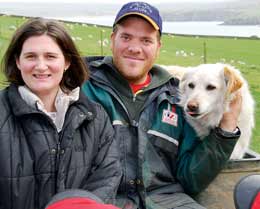
Simplified sheep management and a focus on genetics are paying dividends for one Welsh farm
Easier-care systems for both commercial and pedigree flocks are at the core of farm management for Neil Perkins of Pembrokeshire following his travels to New Zealand on a Nuffield Farming Scholarship.
He, his wife Lynda and father Roger farm 260ha (640 acres) within the Pembrokeshire Coast National Park, including the 161ha (400 acre) Dinas Island Farm at Pwllgwgwaelog, which is almost totally surrounded by sea.
His trip to the Antipodes convinced him that, as EU support for farming declined, UK sheep producers would have to move towards easier-care systems using stock selected on performance data.
“Ewes have to be hardy and productive, lamb with as little assistance as possible, and rear at least the equivalent of their own body weight with the minimum of supplementary feeding,” he claims.
Once a firm fan of Continental terminal sire breeds, Mr Perkins returned from his trip acknowledging that his wife’s enthusiasm for the Suffolk breed might be justified.
But he remained sceptical about tups from “mollycoddled” pedigree flocks that are so stuffed with concentrates they fade when asked to work.
He was also convinced that traditional selection by eye rather than on flock performance figures had to change. Mrs Perkins had already accepted that her 70-ewe Dinasisland flock of Suffolks, which she founded with five shearlings in 2001, was expensive to run and could not compete with the top ram-producing flocks.
“The decision to breed rams for our 1800 commercial ewes turned my hobby flock into a working farm enterprise in its own right, and one that had to support itself economically,” she explains.
“This meant I had to stop bulk concentrate feeding and look towards genetics for the survival of my flock. In 2006 we started performance recording, back fat scanning, purchased two high index rams from the Drinkwater flock and used Orton Supersire 05 for AI.
Instead of lambing inside in January, the Suffolks were expected to deliver their lambs on an exposed north Pembrokeshire coastal headland in March and April.
“In 2007 we again used a high-index tup and semen from a New Zealand Suffolk ram carrying the MyoMax gene. We also purchased an embryo-transfer bred New Zealand Suffolk ram lamb from Robyn Hulme’s flock.
“Not being convinced by his unique front-end slenderness compared with my traditional rams, I put my trust in genetics, closed my eyes and hoped for the best.”
The tup proved to be an enthusiastic worker and sired lambs with “plenty of get up and go”. Their small heads and narrow shoulders meant there were few lambing problems and the vigorous lambs coped well with being born outside.
In 2008 the New Zealand ram was used on the whole flock and his daughters will be covered by a home-bred MyoMax tup. Mrs Perkins, the current NFU Cymru/Nat West Welsh Woman Farmer of the Year, says she aims to breed Suffolks with good mothering ability, vigour and hardiness, from which she can supply the farm’s commercial flock with good conformation rams.
To achieve this she is selecting ruthlessly and any rejected rams are slaughtered and used to make some of the frozen ready meals she sells to tourists staying at the family’s five holiday cottages and two small campsites.
But the changes at Dinas Island go far beyond the Suffolk flock. The partners have invested in 320 performance-recorded Lleyns which are being bred pure to provide replacements for the commercial flock.
The Lleyn breed is favoured for its prolificacy, size, mothering ability and a level of hardiness that makes it suitable for outdoor lambing. Electronic identification is working well within the expanding Lleyn flock and the records are being used as the basis of selecting the best sheep for breeding pure.
Poorer-quality Lleyn ewes go straight into the commercial flock, where they stand to homebred Suffolk tups. Faecal egg counting is being used to optimise anthelmintic use and a targeted approach to footrot is part of a flock health plan.
Though grass tends to grow all year round, Dinas Island is a dry farm and there can be insufficient forage to finish lambs. One solution being tried is to sow a mix of chicory and high sugar grasses, and strip graze the resulting sward.