Tractor exhaust soil injection system pioneer admits to pre-harvest nerves
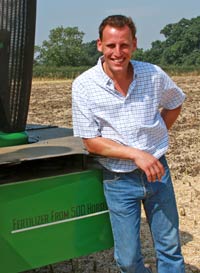
Will it work, or not? Tension is mounting for East Midlands contractor Steve Heard as harvest approaches and the results of his pioneering soil exhaust injection system are revealed.
Last autumn, Mr Heard became the first person in Europe to trial the NC-Quest system, which claims to reduce the fertiliser requirement of crops by pumping tractor exhaust gas into the seedbed.
“It’s going to be very interesting when we get the combines rolling – and not a little nerve-wracking,” he says. “One of them will be fitted with a yield-mapping system and I plan to weigh the grain harvested from treated and untreated plots to get a comparison.”
Earlier this year, Mr Heard reported that treated areas of the 1400ha (3500 acres) of cereals grown on land he farms at Illston on the Hill, Leicester, were looking greener and more advanced than those drilled normally.
Since then, a biomass field comparison map generated by a Yara N-sensor has highlighted the extra crop density in treated strips of fields. Not just that, but results of soil samples taken by Reading University before any nitrogen applications were made have shown a 300% increase in available ammonia in treated plots.
Buoyed by these results, Mr Heard, in conjunction with Cranfield University, has applied for a DEFRA Link grant to help fund research into understanding how the injection of exhaust gas may benefit the soil. “The harvest will provide the first indication of whether the system works – and there are a lot of people waiting to see the results,” he says. “Despite some promising signs, I’m keeping an open mind.”