

Food Chain: Make the most of lamb opportunities
A new initiative that provides consumer research to producers and growers could help improve farmgate returns. In the first of a series of exclusive articles, Paul Spackman examines the latest sheepmeat trends
Consumption of mutton and lamb has increased steadily over the past five years and, in the past 12 months, sales of fresh lamb were up 15% in volume terms.
That is just one finding from the latest consumer research conducted by Kent Business School, in a joint initiative with the Institute of Grocery Distribution and the NFU [see “Find out more”]. The research, based on data collected from 1.4m Tesco Clubcard customers, proves that there is still strong demand for lamb, despite the recession, although the cuts being bought are changing.
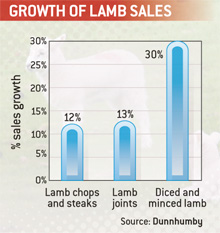
Cheaper cuts have benefited most, with sales of stewing and diced lamb up 30% over the past year, despite modest price increases. Sales of lamb chops and steaks have increased by 12%, and lamb joints by 13%.
It is these changes in consumer spending and other trends that farmers must understand if they are to take the lead in developing a long-term sustainable market for their products, IGD agri-business programme leader Peter Whitehead says.
“Data show lamb sales are increasing overall. Price is always important and people are just as, if not more, conscious of it as they used to be. There is a switch to cheaper cuts, such as stewing meat or diced lamb, although there’s a lot of variation between age groups and regions.”
There are significant opportunities for farmers who get their animals “fit for the market”, but farmers, whether selling direct or via an auction market, must ensure they understand what the market is looking for, he says.
“Getting lambs right for the market by regularly weighing and monitoring stock and selling them at the time they meet your customers’ requirements is critical for success.”
Branding
Consumers are becoming more conscious about how much they spend, but there is still a strong desire to buy locally-produced food, Mr Whitehead says. Research shows the number of shoppers who specifically buy food produced locally has increased from about 12% in 2003 to nearer 27% in 2009. What’s more, about half (47%) of shoppers say they would buy more local produce if the availability could be extended.
“Lamb is a product which benefits from a rich heritage of regional breeds,” Mr Whitehead says. “Opportunities exist to differentiate based on the breed of lamb, the farmland on which it’s been raised and feeding regimes to give distinct quality, flavour and texture. There are a lot of examples – such as Welsh lamb – that prove this can work well.”
Animal welfare is another increasingly important selling point. Almost one in five (18%) shoppers choose products based on animal welfare standards, up from 13% last year, he adds.
Market segmentation
Most markets can be divided into distinct groups of people with similar behaviour, or who buy similar products, and lamb is no exception.
The IGD research shows that all categories of fresh lamb appeal to families with children under 10, but struggle to attract those aged 20-39. Minced and diced lamb have the broadest appeal due to their versatility.
The biggest-selling lamb product – half legs – has a distinctly different profile from the fastest-growing category (mince). Both appeal to families with children under 10, but families with older children and adults aged 40-59 are much less likely to buy lamb mince than legs. Neither product has strong appeal to people over 60, who generally prefer chops and steaks instead.
“Shoppers may write ‘lamb’ on their list, but this can mean so many things for different people,” says Mr Whitehead. “Awareness of shopper behaviour will help you understand how the supply chain has to work, how the supermarkets promote different products and what shoppers really want from the animals you supply.”
Regional variation
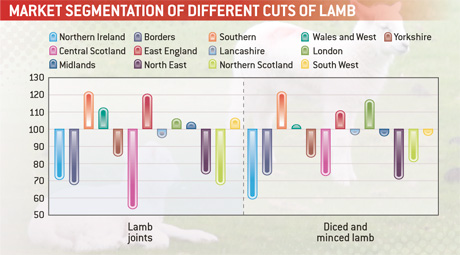
Lamb sales and the types of products bought also vary considerably between regions (see chart). For example, the research shows all categories of fresh lamb appeal to shoppers in southern England, East Anglia and Wales, but less so in Scotland and the north east. Minced and diced lamb and joints are most popular in London, while chops and steaks are favoured in Lancashire.
This wide variation provides opportunities to target different areas with bespoke products, Mr Whitehead says. A better understanding of what cuts are preferred in each region could also help abattoirs and meat processors improve carcass utilisation, he says.
“By making this information available, we’re trying to empower farmers to bridge the gap between the farm gate and the consumer. We all know that without the farmer, there is no end product, but don’t forget, without the consumer you don’t have a sale. It’s critical we find new ways of generating sales and get on the front foot and engage with the supply chain.”
| Key findings |
|---|
| • Fresh lamb sales up 15% in past 12 months • Stewing and diced lamb increased most • Legs (whole and half) still the most popular product • Buying patterns vary regionally • Half (47%) of shoppers would buy more local produce • One-in-five shoppers base product choice on animal welfare standards • Cuts bought vary between age groups • Lamb market struggles to attract adults aged 20-39 |
| Find out more The joint venture between Kent Business School and IGD follows on from the work of the Food Chain Centre and aims to provide farmers and growers with insights into the shopping behaviour of UK consumers. This allows them to develop their businesses to meet the changing needs of consumers and ensure their products are relevant. Kent Business School is supported by a range of organisations, including the sector companies of the new levy board. The first sector to be examined is sheep production, covered by the Fresh Lamb – A Local Opportunity report. Collating information from IGD, the NFU and Kent Business School, the research includes: • Data on the increase in lamb sales • Market segmentation of different cuts of lamb • Why and where shoppers buy lamb • Opportunities for lamb providers Farmers can request their free copy here. Kent Business School can provide free tailor-made consumer research for individual farm businesses. Click here to find out more. |
|---|