Preparing for drier times
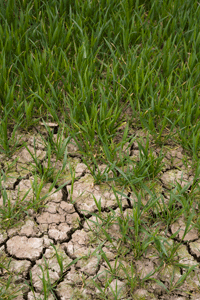
Water already limits UK crop yields in some seasons, but with drier summers on the horizon, growers may have to shift drought tolerance further up their agenda.
Choosing varieties able to extract soil water effectively and use it more efficiently will become increasingly important as climate change made summers drier, according to Eric Ober, crop physiologist at Broom’s Barn research centre.
In trials last season, drought caused a 38% yield loss in one crop, and with 30% of the UK’s wheat area grown on drought-prone land, the problem could worsen, he said at a recent Association of Applied Biologists conference.
That meant it was important to determine how well different crops performed in drought conditions, he added.
Research on 64, mainly UK, varieties showed a significant difference in drought tolerance between them. The varieties were planted in poly tunnels and subjected to drought and irrigated conditions, he said.
“We have no specific recommendations as yet, but different varieties did give variable yields in different water situations.”
Crops with larger root systems tended to perform better in dry soils as they were able to access water deeper in the soil profile, he said. “Plants that mine an extra 10mm of water [in dry soils] yield an extra 0.2t/ha.”
But where there was more moisture, this additional root mass tended to give lower yields, he added.
Yield potential was, therefore, still the most important consideration when moisture was available, but those in drier regions could benefit from knowing which varieties had better drought tolerance.
The varieties with the greatest ability to capture water were not the most efficient in average UK conditions, he said. This was because water was often not limiting enough to counteract the lower yield potential. “However, it should be possible to find varieties that combine the highest yields with drought tolerance.”
As summers become drier this balance is likely to shift in favour of drought tolerance, he added.
Peter Werner, wheat breeder for research partner KWS, said that while yield was still his key consideration, the ability to withstand drought was becoming increasingly important.
“We want to find top-performing varieties that won’t bomb out when we get an unexpected drought,” he said. “We want yield stability, but maximum yield is the most important trait at the moment.”
Dr Ober told Farmers Weekly it would be useful for the HGCA Recommended List to classify varieties according to drought tolerance using data already collected in the RL trial system.
SPRAYING CROPS
Spraying crops with a waxy film that prevents water being lost from the leaf surface could help maintain yields in dry conditions.
Applying antitranspirant film that blocks some leaf stomata could help reduce plant water loss through transpiration, said Peter Kettlewell, crop physiologist at Harper Adams University College.
These films had been trialled in the past, but because they covered the leaf surface, carbon dioxide absorption was prevented, he said. This reduced the photosynthesis rate, which counteracted the benefits of reduced water loss.
But trials carried out at the University showed these negative effects could be reduced if the film was applied just prior to ear emergence. “This is when the plant seems to be most vulnerable to drought.”
In a UK field trial, yields were increased by 42% when the film was sprayed at this time, he said. But more research was needed, as there was some variation in the benefit between trial years.