Farmers Weekly Interactive

VIDEO: Rodenator makes burrows go - with a bang

Wednesday 21 April 2010 16:18

There are few jobs more satisfying than blowing things up. Combine that with effective pest control and it's no surprise that the Rodenator burrow-collapser has become a hit with UK farmers since it was launched in 2007. In fact, more than 1200 have been sold.


After seeing coverage of the Rodenator from the World Ag Expo in America six years ago, Robin Purser got in touch with the company and secured the rights to sell the Rodenator in the UK and Europe.

"It took quite some time in negotiations with DEFRA to agree the use of the Rodenator in the UK. It was a long and hard slog for the first four years and we invested a lot of money."

In its native USA, the Rodenator is legally used to kill rabbits and rodents inside their burrows. It kills instantly, explains Mr Purser, by sending a massive shockwave through the burrow. In the UK, however, the Rodenator can only be used to collapse burrows which have previously been emptied or are disused.

According to the 1981 Wildlife and Countryside Act, the operator must make every effort to ensure the tunnel system is empty before using the Rodenator.

The first model, the R1, went on sale in 2007 and, from the autumn of that year, sales took off, he explains.

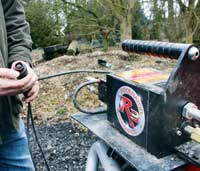
The way the Rodenator works is pretty straightforward. Once in position, gas is mixed at a ratio of 97% oxygen to 3% propane in a combustion chamber. Because of the different specific weights of propane and oxygen, both gases are pumped separately into the rifled combustion chamber to obtain the perfect mix. The propane then carries the mixture down into the tunnel system.

The gasses travel through the burrow without the operator needing to stop up all the entrances (like standard gassing measures) unless it's a windy day.

Once the burrow is full of gas, which usually takes 30 or 40 seconds, a high-voltage spark is released to ignite the propane. This rapidly-burnt propane superheats the oxygen which expands to produce a 5000ft/sec shock through the burrow, destroying any tunnels and the burrow system itself.

The original R1 or Rodenator Pro required operators to wield a large lance, stick the end down a burrow or hole and hold the gassing lever for the time it took to fill the burrow. "The biggest downside of the R1 was operator fatigue; it's more physically tiring holding the machine and there was a lot of dead time."

Then, in 2008, came the R2, complete with a wireless remote control that prevents those more exciting moments when you pump a little too much gas and stand a little too close. "The bonus of the remote control is that you can leave the machine during the time it takes to gas the tunnel and look for the next disused burrow system."

The R3, launched late in 2009, offers a lower cost option for smaller farms, says Mr Purser. "Instead of a wireless remote, the user can control detonation via a lead. A catch holds the lever in place for gassing, too."

The Rodenator R2 costs £1950 and the R3 costs £1250.


Counting the cost of burrowing pests


Rabbits

Although rabbit damage varies largely according to soil type, it’s often worse on light, free-draining types where rabbits tend to be more prolific, explains Mr Purser.

"Peaks in rabbit damage include autumn, when the crop is getting established and spring, when crops are in their initial growth stages and rabbits start their main breeding season."

Damage caused by rabbits isn’t just due to direct feeding, he adds. "Uneven harvesting and structural damage to ditches, hedges and fields are also problems.

"Some of our larger arable customers reckon their total annual losses from all grazing pests can be as high as £25/acre (£62/ha), but taking a 5% average, the cost to a 10t/ha wheat crop could be as high as £50/acre from rabbits alone."

And, if you multiply this up to a national level, assuming 3.2m ha yielding 8t/ha with 2.5% damage loss, the loss would total 640,000t. At £100/t, this adds up to £64m plus wastage of inputs worth £26m, leading to national losses of £902m without taking into account overheads, explains Mr Purser.

Moles

More of a grassland problem than an arable one, mole damage includes sward loss, stone damage to mower blades and other machinery plus listeria infection to livestock through soil-contaminated silage.

With a total UK grassland area of 7.1m ha (excluding rough grazing), the damage is difficult to quantify but is estimated to run into the tens of millions of pounds, adds Mr Purser.

Rats

Damage from rats includes direct feeding damage to feed, and contamination.

More than 20% of rats carry leptospirosis (Weil’s disease) which is easily passed to cattle and can be fatal to humans.

Losses could well run into the millions, not to mention the amount spent on poisons.


Case studies

Mr L Carmarthenshire

Mr L bought two R1 or Rodenator Pros for mole tunnel destruction and has about 15 regular customers.

"Depending on how large the infestation is, we usually target most places twice," he explains.

Once it’s been established that tunnels are empty, they are gassed for 30-90 seconds, depending on how big the network is. "We start at about 8am and tend to work for 10 or 12 hours, and it’s never caused me any trouble using the lance."

Mr H Cambridgeshire

Mr H runs 600ha (1400 acres) of all-arable land in Cambridgeshire. He bought his first Rodenator four years ago.

"Rabbits are a constant problem to us and we’ve tried numerous ways of getting rid of them. Now, early in the season, we pick the worst patches and, once we know the burrows are empty, we use the Rodenator to destroy the burrow network. If it’s bad, we usually revisit an area three times.

"We upgraded to an R2 last year and it’s a lot more operator-friendly. It also allows you to leave it gassing the burrow and identify other disused burrows.

"We still shoot and trap some rabbits but, without the use of Cymag, it’s certainly a crucial part our armoury."

Rodenator-R2

Power Farming
blog comments powered by Disqus