Beet agronomy challenges the best
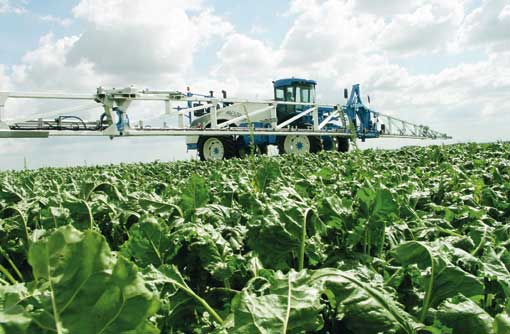
The importance of sugar beet fungicides in maximising crop output came to the fore during the second round of the Beet the Best competition. Robert Harris reports
Increasing numbers of growers recognise the importance of good disease control in modern sugar beet production, but there is still scope to fine-tune fungicide use to help boost yields.
That was the key message emerging from the second round of judging in this year’s Beet the Best competition, where entrants were tested on weed, pest and disease control.
Standards were generally high, with about 70% of teams answering most multiple-choice questions correctly. However, an open question on the main factors to consider when deciding a fungicide strategy for sugar beet proved slightly tougher, with just 60% of teams scoring 50% or more.
Mark Stevens of Broom’s Barn suggested there was still a need to deliver key messages to help growers squeeze more adjusted tonnes out of their crops.
“Many factors need to be considered in any fungicide strategy. Key ones include understanding how and when the main diseases affect plants, physiological benefits of fungicides, how varieties differ in their response to fungicides, the relative cost and effectiveness of different treatments and at what rates and timing they should be used, as well as the importance of lifting date and the need for frost protection.”
Other factors like weather effects, knowledge of harvest intervals and awareness of potential resistance risks were also important. And Steve Wilcockson, senior lecturer in crop production at Newcastle University, liked the fact that some teams recognised the need for good information.
“Several mentioned the BBRO advisory bulletins as a key source, and the experts available in that organisation. Growers pay a levy for these resources, so it makes sense to use them.”
Most growers understood the need for a July/early August spray, said Dr Stevens. “A full-rate fungicide should be used to provide long-term protection from foliar diseases to maximise the canopy and hopefully some early frost protection.”
Fewer recognised the importance of a second spray at the end of August/early September, he noted. “If levels of powdery mildew rise above 20% on untreated leaves by the end of August and/or there is known rust pressure and/or if the crop will remain in the ground after October, then a second fungicide application should be applied, although the rate appears to be less crucial at this stage.”
Average yield gains from Broom’s Barn trials during 2010 were six adjusted t/ha from the first fungicide and a further six adjusted t/ha from the second, said Dr Stevens. That represented about a 10-fold return from a typical fungicide programme at 2011 beet values.
Growers were well versed on herbicide strategies, with 70% recognising that a mix of phenmedipham, desmedipham, metamitron and adjuvant oil offered best control of a weed spectrum containing fat hen, annual nettle and black bindweed under cool, dry conditions. “Desmedipham plus oil is the key under cool conditions,” said Dr Wilcockson.
However, irrigation, which also came under scrutiny in this round, was less well understood. Few growers recognised that the typical yield gain from 25mm of irrigation in July was four adjusted t/ha.
“There is a perception that irrigating sugar beet does not pay,” said Paul Bee, British Sugar’s agriculture communications manager. “But with all of the crop attracting the full contract tonnage payment this year, the situation has changed.”
Irrigation application costs could easily be recovered and growers stood to gain considerable returns at current beet values, as well as ensuring contract tonnage was fulfilled in certain seasons, he explained.
Not many growers appreciated that insecticide use in terms of kg of active ingredient/ha had plummeted by 90% since 1990, mainly due to better seed treatment technology.
“One of the reasons we and British Sugar put together the Sustainability Report was to get such messages out,” said NFU chief sugar adviser Helen Kirkman. “Knowing how far the industry has come may not help improve yields, but if growers have a few facts like this at their fingertips it can do wonders for the industry’s PR.”
Beet the Best

Over 80 teams have been battling it out in the Beet the Best competition, designed to test growers, agronomists and students on what it takes to produce a 100t/ha crop, said Mr Bee.
The third round, tackling harvest and delivery decisions, closes early in January when winners will be announced. They can look forward to a sugar beet study tour of Spain in April 2012.