Fischer Boel rules out dairy reforms
Market managers in Brussels are happy to apply all the safety net measures at their disposal to prop up EU dairy markets, but more fundamental reform of EU dairy policy is out of the question.
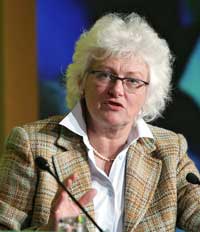
Addressing farm ministers at their monthly meeting in Brussels on Monday (23 March), EU agriculture commissioner Mariann Fischer Boel said she was “very concerned” by the deterioration of the dairy market.
“Farmgate price for milk of approximately 20 cents/litre (18.5p/litre) in many regions of the EU does not provide for sustainable production in the long term,” she said.
A “state of the market” report circulated to ministers at the meeting showed how EU butter and powder prices had peaked in 2007, then declined during 2008 and were now at or below intervention levels. Cheese prices were also at their lowest level for four years.
Mrs Fischer Boel insisted the commission had done all in its power to support the market, buying up 30,000t of butter in the first few days of March, and accepting a further 6665t at up to 99% of the full intervention price at the first tender last Thursday (19 March). “We will continue to run purchasing tenders until the end of August,” she promised.
Together with private storage aid, (in respect of 60,000t of butter), and export refunds, (in respect of 50,000t of butter, 61,000t of SMP and 60,000t of cheese), the commission had at least stopped the downward spiral in prices.
But it was not the EU’s role to lift dairy prices above the basic safety net level, she insisted. “Only the sector itself can establish a sustainable market through balancing supply and demand.”
Mrs Fischer Boel also dismissed any suggestion that this season’s increase in milk quota had anything to do with the weaker dairy market.
“Despite the recent quota increase, we have seen a slight reduction of EU production since the start of the quota year. This clearly shows that farmers understand that it is market prices and their cost structure, rather than quota levels, that should determine their production decisions.”
The current problems in the dairy sector were down to increased production in a number of third countries and falling global consumption, in part due to the recession and in part, due to the previous high prices of dairy products.
Mrs Fischer Boel said there was no possibility of her stepping back from the CAP “health check”, which instigates further quota increases in the run-up to their removal in 2015.
 For a comment on the current state of the dairy market and what it might mean for British farmgate prices, visit Phil Clarke’s Business Blog