

Avian flu risk from factory farming
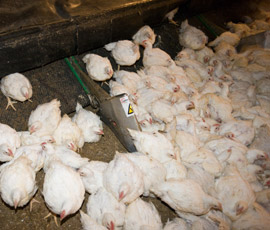
Avian flu will continue to remain a threat to human health as long as factory farms exists, a leading acdemic has claimed.
Dr Aysha Akhtar, author of the recently-published “Animals and Public Health: Why treating animals better is critical to human welfare”, says factory farming has created a “worldwide natural laboratory” for the rapid development of a highly infectious form of the virus which could harm humans.
“The stressful and crowded conditions make a perfect breeding ground for new infectious diseases that can harm humans,” explained Dr Akhtar, a neurologist and public health specialist at Oxford University.
She argues that, in order to promote human health, the treatment of animals needs to be improved. “Public health has long ignored the relationship between our health and animal treatment, largely owning to a misconception that animal welfare is an opposition to human welfare.”
But Peter Bradnock, chief executive of the British Poultry Council, says the risk needs to be kept in perspective.
“There is a risk that, when you have a large number of birds in a confined space, there is a potential for low pathogenic avian flu to multiply and mutate into a pathogenic form,” he said. “But that happens in the wild too; at least in a controlled poultry unit you are managing to protect against it.”
Mr Bradnock said while producers should remain vigilant to minimise the risks of avian flu, there was a place for factory farming. “Without intensive poultry production, human populations may be denied the proteins they need in their diets and this could have other human health consequences.”