Alternative fertilser policy brings savings
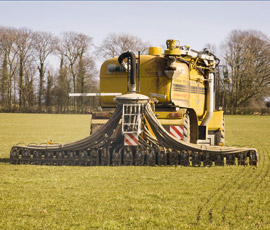
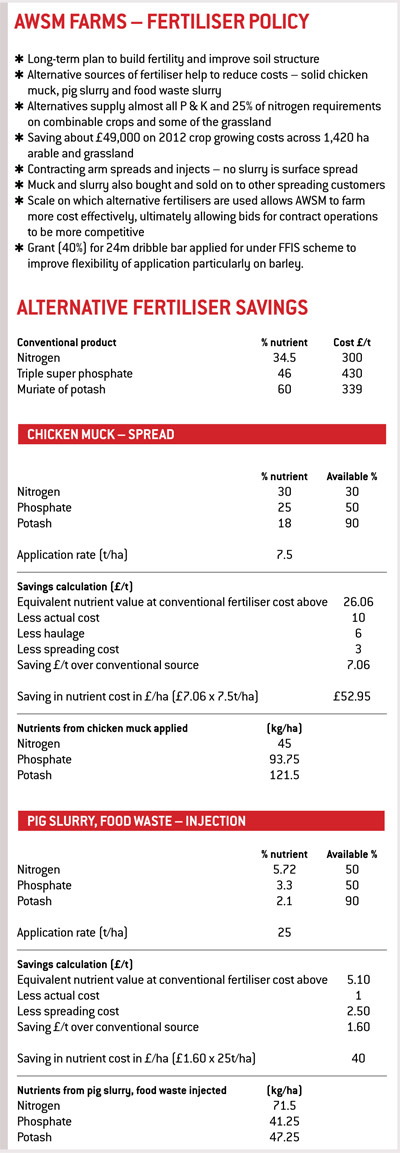
A lot of effort goes into saving money on inputs at AWSM Farms, with fertiliser one of the main target areas. Owner Adam Metcalfe has been developing the use of alternative nutrient sources for the last 10 years and now has a large contract spreading and injection business alongside his farming operations. For the 2012 crop, more than £49,000 is being saved by using food wastes, chicken muck and pig slurry at varying rates on 1,420ha of arable and grassland. This will supply about 25% of nitrogen and almost all the P and K requirements on the land farmed by AWSM. “We’re trying to cover every acre with one manure, either in autumn or on to the growing crop in spring, and then we balance that with conventional product,” says Adam. “We mix and match the right product to the right field, depending on the crop and what the soil analysis tells us.” GPS soil maps across most of the land indentify nutrient status and help in tailoring applications, with the SOYL service being used to set application rates for both conventional and alternative fertiliser products. “With the chicken muck, getting the right amount of nitrogen is more tricky because you’re never sure how much you lose to the atmosphere but there’s a big benefit because you’re getting organic matter and organic nitrogen to benefit the soil structure.” Improving soil structure is an important long-term aim. Although the fertiliser value is limited, the new bed and breakfast pig finishing operation will contribute important organic matter for the farm’s clay soils with 25t/ha applied on as much land as possible. Although the N, P and K from alternative sources are cheaper than from manufactured fertilisers, accuracy of soil analysis and spreading is crucial to achieve the savings and to make sure nutrients are not wasted. Accuracy is enhanced by on-board weight cells on the Strautman muck spreader where spreading rate is constantly adjusted as spreader forward speed changes. AWSM has two Challenger 2244 DNMS self-propelled solid muck spreaders and also uses a Challenger Terragator 2244 NMS for shallow injection of pig slurry and of food waste, which has roughly the same nutrient component as pig slurry. Injection allow up to 50% of available nitrogen to be taken up compared with just 10% from surface spreading. For example, pig slurry injected is worth £49.74/ha more than surface spread slurry. As well as carrying out soil analyses, slurries are all analysed so that applications can be closely tailored to requirements. “I wouldn’t want to go any higher with the alternative sources than we do at the moment because we would be overloading with P & K, which would be a waste as well as risking P & K lock up,” says Adam. To increase the flexibility of fertiliser operations further, a 40% grant has been applied for under the Farming and Forestry Improvement Scheme to help with the cost of a 24m dribble bar for slurry application. “We can only shallow inject to GS32 and barley isn’t that keen on it anyway; wheat is a lot more resilient.” While manure applications are straightforward, food waste is in a different environmental category and requires a waste deployment permit before it can be applied to land. AWSM’s environmental manager Kristy Blakeborough handles assurance and compliance for the business, including applications for waste deployment permits. These must be made separately for every 50ha, with supporting evidence of soil nutrient levels and an analysis of the waste to be applied. The waste must be coded, the area mapped and a certificate of agricultural benefit submitted with the application.