

Managing herd health is vital
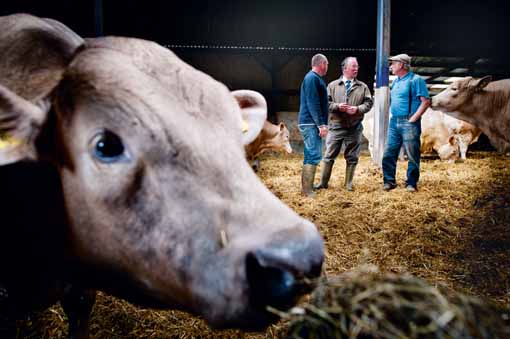
Good management is vital at Simon Frost’s focus farm to maximise cow and calf health.
When animals are stressed their immune system is less effective leading to an increased risk of health problems.
And with weaning potentially one of the most stressful times in a calves life brought about by a change in diet, housing and separation from its dam, Mr Frost takes extra care to ensure stress is kept to a minimum and growth rates are maintained.
“We introduce creep feed in August so calves are used to taking concentrate by the time they reach the finishing unit in October. Creep isn’t fed ad-lib but restricted to 1.5kg a head a day,” he says.
MAINTAINING CALF WEIGHTS POST WEANING
Last year’s bull calves recorded a daily liveweight gain of 1.63kg from birth to weaning, but this performance has more to do with having calves sired by high index Charolais bulls and out of milky Limousin x Holstein-Friesian mothers, rather than the feed bag, believes Simon Marsh, senior beef lecturer at Harper Adams University.
Mr Frost’s calves are weaned in October. Two weeks prior to weaning they are vaccinated to minimise respiratory disorders, have their backs clipped out four days before weaning and are treated with a pour-on wormer.
On arrival at the finishing unit of Chesterfield farmers John and Alan Dore, the calves are unloaded into a well bedded and airy shed allowing 10sq m a bull – significantly more space than the recommended minimum of 3.8sq m for weaned bull calves weighing 390kg.
The bulls are housed in one group which last year contained 56 calves.
Says Simon Marsh: “This goes against the general recommendation of housing bulls in groups of a maximum of 20 a pen. However, Alan Dore finds suckler-bred bulls more placid than dairy-bred bulls and don’t ride or fight as much enabling a larger grouping.”
Bulls are immediately offered ad-lib top quality big bale silage and only 0.5kg a head a day of a high quality 16% CP barley-based home-mix comprising oats, hipro soya, linseed flakes and minerals. Bulls arrive with a supply of the creep they had been fed at Hopping Farm – a 16% CP high-NDF nut.
“For the first couple of days the creep nuts are sprinkled over the barley mix. It gets the calves eating the barley,” says Mr Frost.
But finisher Alan Dore doesn’t push the calves too hard in the first few weeks and lets them take four weeks to build up to the full daily intake.
Last year’s calves recorded DLWGs from weaning to slaughter of 1.59kg to slaughter at 714kg at 13.6 months old.
Intensive beef minerals are initially offered as free-access and last year’s 56 calves consumed a 20kg bag in three to four days – an intake of 102g a day. With good quality ad lib forage and home mix fed to appetite ensures problems with laminitis and bloat are non-existent.
About two months before the first draw, the 20 biggest bulls are taken out of the shed to help the remaining younger and smaller bulls.
 WEANING PROCEDURE
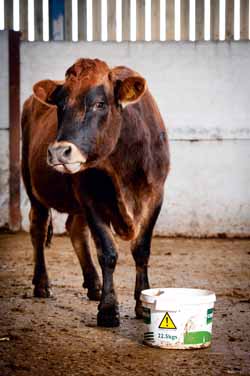
Ideally calves should be weaned two weeks before housing, or the cows and calves housed together for a month and then weaned. This avoids the stress caused by weaning, housing and changing the diet all at the same time which is particularly traumatic for the calf.
However circumstances dictate that Mr Frost has to wean at housing but the care and attention to calf husbandry at this critical stage – combined with the high ranking genetic status of the calves’ sire – helps achieve exceptional growth rates. Last year’s calves reached a 427kg carcass weight at 415 days old – a daily carcass gain from birth to slaughter of 0.97kg.
COW HEALTH
Mr Frost firmly believes management, genetics and nutrition are the three crucial elements responsible for cow health. Hopping Farm suffers from specific copper, selenium and cobalt deficiencies linked to limestone soils containing high levels of iron, molybdenum and sulphur which antagonise the uptake of these trace elements.
If not corrected, there would be an adverse effect on the immune system, as well as fertility and growth rates. To counter these deficiencies cows are treated with two boluses just before bulling to provide copper, selenium and cobalt with the aim of enhancing fertility.
Cows also have year round access to molassed mineral buckets with a high copper and selenium specification.
Says Mr Frost: “If the cows don’t receive this level of copper supplementation the coats soon start to have a red tinge and having an adequate selenium status has eliminated retained cleansings.”
In a recent survey by the SAC into causes of mortality in suckler herds, hypomagnesaemia (staggers) and milk fever were shown to be responsible for 23% of deaths in suckler herds and were the primary reason for cow mortality.
Staggers is associated with low circulating levels of magnesium in the blood and usually caused by a low dietary input alongside a high magnesium output in the milk when the cow is in peak lactation,” says Mr Marsh.
“Since magnesium can’t be mobilised from skeletal reserves it must be provided daily in high risk periods either by feeding magnesium-rich compound feeds, adding magnesium to the water supply, dusting the pastures, boluses or free access to either magnesium-based molasses licks or magnesium-rich minerals.”
Mr Frost uses molassed mineral buckets to supply trace elements all year round – including 10% magnesium. Buckets are provided at the rate of one for every 20-25 cows and intakes average 55g a cow a day.
Supplying minerals and trace elements all year round with buckets and boluses costs £14.80 a cow (£10 for buckets and £4.80 for the boluses).
PREVENTING CALF LOSSES AT CALVING
The SAC survey also showed the second major cause of mortality in suckler herds was calf loss through calving difficulties – accounting for 20% of deaths.
Says Mr Marsh: “This loss can virtually be eliminated by using terminal sires with positive Calving Ease Direct EBVs with accuracies above 50% and having the cows in lean condition at body score 2 at calving. Pedigree breeders must give greater priority to calving ease.”
Calf scour and joint ill
At Hopping Farm all first and second calved heifers are vaccinated against rotavirus four weeks prior to calving. Cleanliness in the calving boxes is a priority and they are pressure washed and disinfected every three weeks to minimise disease problems. The navel of new-born calves is treated on both sides and then again at 24 hours to help prevent joint ill.
Coccidiosis
The only major threat to calf health in recent years at Hopping Farm has been coccidiosis. The symptoms are a “mucky dark scour” which if untreated quickly include blood. It’s treated quickly with a coccidiostat which has proved very effective.
Internal and external parasites
Fluke is on the increase. Calves are treated with a broad spectrum persistent anti-parasiticide in August – it’s a combination product based on ivermectin and closantel which is effective against fluke as well as gutworms, lungworms, eyeworms, mites and lice. They are treated again at weaning when they have their backs clipped out.
Says Simon Marsh: “In theory mature cattle should develop immunity to gut and lungworms provided they have received a gut and lungworm challenge either through natural infection or vaccination, but if a cow starts to lose significant body condition at Hopping Farm she’s treated with the anti-parasiticide. All of the cows are treated routinely at housing to target liver fluke and external parasites.”
Mr Frost believes diseases such as BVD, IBR, leptospirosis and Johne’s Disease need to be given more consideration but he has yet to experience problems with them. Positive action is nevertheless intended.
MAINTAINING HIGH HEALTH
The herd’s replacement Limousin x Holstein-Friesian heifers are bought from one source that has a high health status dairy herd.
“But this is no guarantee they are free from disease,” says Mr Frost. “Running a totally closed herd minimises disease transmission and is the reason many producers now breed their own replacements. But herds are unlikely to be totally closed since they have to buy-in stock bulls.”
Screening bought in replacements for BVD and ensuring stock bulls are of a high standard of health is considered a good starting point along with joining a Health Scheme. BVD is probably the most common viral disease of cattle in Europe.
Testing for BVD involves blood sampling five calves (over nine months old) per management group. Two clear tests at a one-year interval will confer accredited status to the herd.
Mr Frost intends to begin a vaccination programme and join a health scheme. He will also screen a sample of his weaned calves for evidence of circulating antibodies and screen his cows for Johne’s.
Summary:
• Try and avoid weaning calves at housing and minimise stress
• Ensure calves have been creep fed and build levels up gradually post weaning. Offer top quality forage.
• Select bulls with positive Calving Ease Direct EBVs with high accuracy
• Disease prevention is far better than cure
• Adequate mineral and trace element supplementation needn’t be costly
• Join a cattle health scheme
Read more from our Beef Focus Farm on our dedicated page.
HABFF