Sclerotinia risk still present despite dry weather
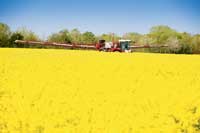
Don’t underestimate the risk of sclerotinia in oilseed rape even though dry weather and cold nights have seemingly prevented much sclerotia germination.
So far, none of the official BASF monitoring sites has recorded any sclerotia germination, although low levels had been found at Rothamsted in wider testing, Peter Gladders of ADAS reported on Tuesday [27 April].
But the first tests in Devon found up to 50% infection on petals, and lower amounts in Herefordshire. “There is every sign that spores are out there, and potentially in high numbers in the south and west,” he said.
The dry spring of 2007 should also serve as a warning to those growers thinking it was turning into a low risk year, he said. “It was a very dry spring, but one of the worst years for sclerotinia ever.”
Flowering was just beginning in many crops, leaving growers with two strategies, he suggested. “The safe route is to go now and then look for another spray day in around two weeks’ time to protect crops until the end of flowering.
“For low-risk or average situations, waiting until mid-flowering before putting on the main sclerotinia spray is a reasonable thing to do as well.”
The first spray in a two-spray strategy could be used to maintain green leaf for longer, as well as covering sclerotinia, Chris Charnock of Syngenta told growers at a Sigma oilseed rape club meeting (see p46). “The average yield increase from Amistar in the absence of disease is 0.35t/ha.”
But it was vital to follow up that spray within two weeks, if Amistar had been applied alone, as its persistence against sclerotinia was less than some other competitor products. Where it had been tank-mixed with a stronger product, follow-up should be within three weeks.
An alternative to Amistar for the first spray was Galileo, Mark Hemmant of Agrovista suggested. “We’re recommending it for yield response from yellow bud into early flowering, and it is pretty good on sclerotinia.”
In trials it had yielded 0.4t/ha over Amistar when both were used at 0.8 litres/ha, he said.
For the main sclerotinia timing, Filan, Proline and Compass have shown in trials at ADAS sites to give the best results.
“If light leaf spot is an issue then it would push you towards Proline,” Mr Hemmant said.
Keep water volumes up to give the best coverage, he advised. “It is a big dense canopy, and for sclerotinia you need to be coating the crop down the canopy, so water volume is very important. A lot of growers aren’t using the recommended 300 litres/ha, and in trials we’ve seen a distinct drop-off in performance when the water volume has been dropped to 200 litres/ha.”
Watch out for powdery mildew in early-drilled crops, he added. “At our Easton site drilled in mid-August 100% of the plants had powdery mildew early on, and an incubator test for light leaf spot a couple of weeks ago showed it was still around.”
Adding a triazole fungicide would help take care of infections. “Desiccants don’t work very well on crops infected with powdery mildew,” he said.
For the latest risk assessment for sclerotinia visit www.fwi.co.uk/sclerotiniawatch