EFA spray rules still unclear – but farmers should play safe
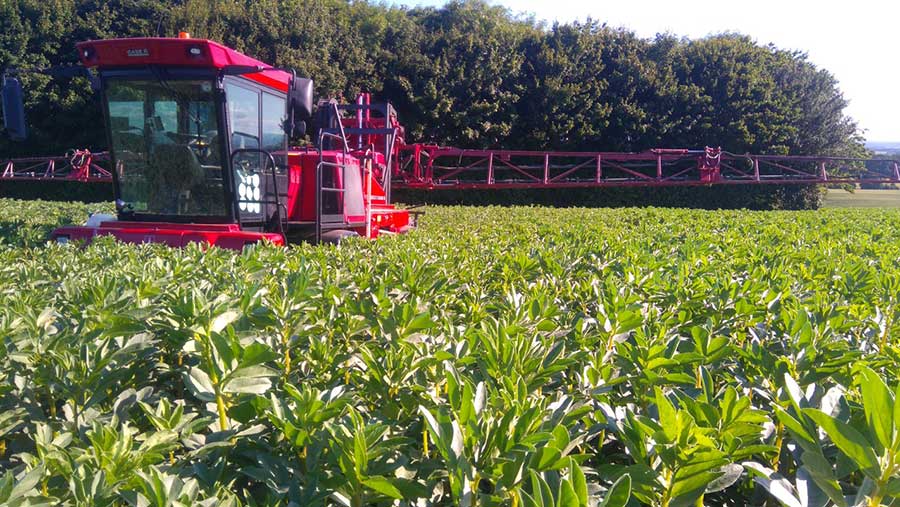
Farmers are being advised to work on the principle that the ban on the use of plant protection products (PPPs) on “productive” Ecological Focus Areas (EFAs) will apply from 2018, although it is possible that it could be delayed.
The proposed ban, which first emerged last summer, would affect nitrogen-fixing crops, catch crops and fallow land – which account for the bulk of EFAs in Europe.
Guy Smith, NFU vice-president, said EU farm commissioner Philip Hogan had been pushing for the new rules to apply from the 2018 Basic Payment Scheme year.
See also: EU greening proposals will make ‘life harder, not simpler’
This would mean that farmers will have to factor them in when making their cropping decisions this autumn.
It was not clear when a final decision would be made as it was “lost in the labyrinth” of the EU Parliament, he said.
“But we now hear that some delaying mechanisms are being put in by the European Parliament which mean that it might not be the case from this autumn,” he said.
“It may be delayed until the following autumn.”
But Mr Smith said when drawing up his own cropping plans he was working on the basis that farmers would not be allowed to use PPPs from 2018 and advised others to do the same.
Strong farm opposition
The ban is being fiercely fought by farming organisations across Europe.
The NFU had always argued that it makes ecological sense for farmers to be allowed to use PPPs, because crops like beans are of more value to pollinators if they are disease and weed free.
Pekka Pesonen, secretary-general of EU lobby group Copa/Cogeca, said it was an issue of major concern.
“Such a requirement will pose both agronomic and administrative problems which is particularly worrying as we need to encourage farmers and public administrations to implement the greening measures under the CAP and increase its acceptability.”
EU Commission report
A report by the European Commission published last week showed that nitrogen fixing crops account for 37.4% of the physical amount of EFA found on the ground across Europe.
Catch crops account for 33.2% and fallow for another 25.9%.
However, landscape features, such as trees, hedges, field margins and buffer strips are viewed as offering greater environmental benefits.
EFA rate
The report also confirmed that the area of land that farmers need to dedicate to EFAs will remain at 5%.
The commission had been considering an increase to 7%, but has ruled this out as the percentage of EFA areas declared by farmers at an EU level is almost twice as much as the required 5% at farm level.
The report was due to be discussed at the European farm council meeting on Monday (3 April).