Farmer Focus: An autumn full of establishment experiments
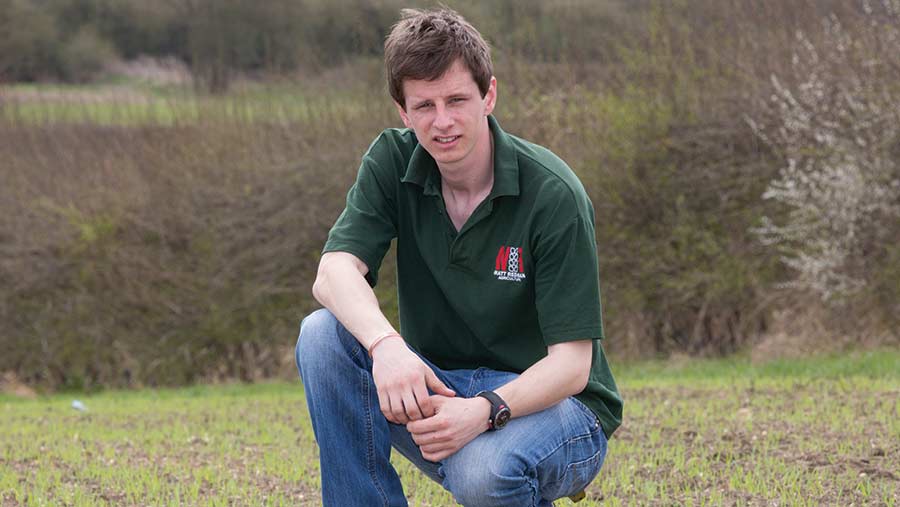 ©Tim Scrivener
This year I’ve learned two things. The first being don’t start any major DIY work on the house when you suddenly get two wet days in September.
It will instantly dry up and you’ll have to live around stacks of timber and half wallpapered walls.
Secondly, buying a front door for the house is more stressful than buying a new seed drill.
Post-harvest field work has highlighted that more is still required to better manage previous crop residues.
Perhaps it’s time to consider a straw rake to help rectify the inconsistent spread and chop behind the combine?
I’m not sold on that idea as it’s all more time and diesel, however cutting higher and leaving longer stubble is an attractive option and needs to be looked at in more detail.
See also: Read more from our arable Farmer Focus writers
Oilseed rape crops look fantastic, a combination of mid-August drilling and favourable conditions mean both the direct drilled (with the 750a) and the subcast (with the V-Form) fields are edge-to-edge green.
They’re probably too thick at present, but that’s less stressful than wondering if there’s still a crop. First drilled wheats are now emerged and looking well, with the final fields drilled last week.
A robust pre-emergence herbicide programme is being used throughout, consisting of Crystal (flufenacet+pendimethalin), diflufenican and Avadex (tri-allate) which will most likely be followed up with a post-emergence treatment.
It’s been an autumn of experiments with crop establishment. Direct drilled wheat into westerwold ryegrass sprayed off 24 hours before, single pass cultivation versus two, three and four passes and direct into standing mustard/oat cover crops.
It’s been an interesting and exciting autumn. Time will tell how each method fares, but lessons have already been learned.
With autumn work starting to wind down, we can soon shift our attention from monitoring the weather forecast for wind and rain to frosts.
With the change in hedge-cutting regulations this year we need a few extra frosty mornings to sneak around some fields that the cultivator got to first.
One final note, we should probably all give a thought to all the gundogs expected to find birds in the knee- to waist-high cover crops that are popular this year and brush up on our plant identification for the inevitable ‘what’s this’ question.
Matt Redman operates an agricultural contracting business and helps out on the family farm at lower Gravehurst, Bedfordshire. The 210ha farm grows mainly wheat, oilseed rape and beans