Too much left to harvest in Londonderry
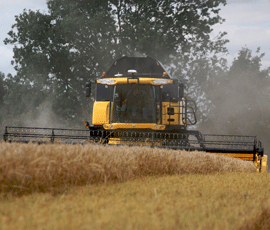
Richard Kane still has 61ha of spring barley left to cut at Broglasgow House, Myroe, Londonderry, along with the same area of straw lying in the swath.
“At this time of year, that is too much,” he said. Winter barley yields had been 30% down, at 6.8t/ha, with oilseed rape at 3.5t/ha.
“For the past two years we’ve averaged 4.7t/ha, but it was very badly brackled.”
Winter wheat was very variable, ranging from 7.4t/ha to 9.8t/ha. “We didn’t cut the Grafton early enough, so lost yield there – the Diego was better at 9.8t/ha.”
However, he lost 100ha over the winter, having not been able to sow until November as it was so wet. “And then we lost it – it’s probably been the wettest 18 months we have ever had.”
As a result, Mr Kane ended up with a lot of spring barley, which, fortunately, was yielding quite well at 7.4t/ha, despite having been badly lodged in places.
Camelina, a brassica grown for aviation biofuel, produced just 0.7t/ha. “We had hoped for closer to 2.5t/ha, but it’s an interesting thing to grow.”
Ground conditions were soft, and Mr Kane still had Concerto spring barley to cut.
“But we managed to sow 57ha of oilseed rape a couple of weeks ago, as it was too wet to combine. And it’s already at two-leaf stage.”
With a couple of dry days ahead of further rain forecast next week, Mr Kane expected to be on full pelt over the weekend.
“We’re probably going to have to spread and re-gather the straw just to dry it out – it’s still quite green.
“It would be nice to get cleared up ready to start sowing wheat.”
Crop: Winter wheat
Variety: Grafton
Yield: 7.4t/ha
Variety: Diego
Yield: 9.8t/ha
Crop: Spring barley
Variety: Westminster
Yield: 7.4t/ha
Crop: Winter barley
Variety: Retriever
Yield: 6.8t/ha