

Methiocarb loss has greater impact on spud and veg sectors
The loss of methiocarb slug pellets in 2015 has had a much greater impact on the potato and field veg sectors, according to new data.
Back in January 2014, the EU voted to ban the active as a slug killer due to the risk of harm to grain-eating farmland birds.
Agrochemical distributors had until September 2014 to sell methiocarb-based pellets and growers could use them up to September 2015.
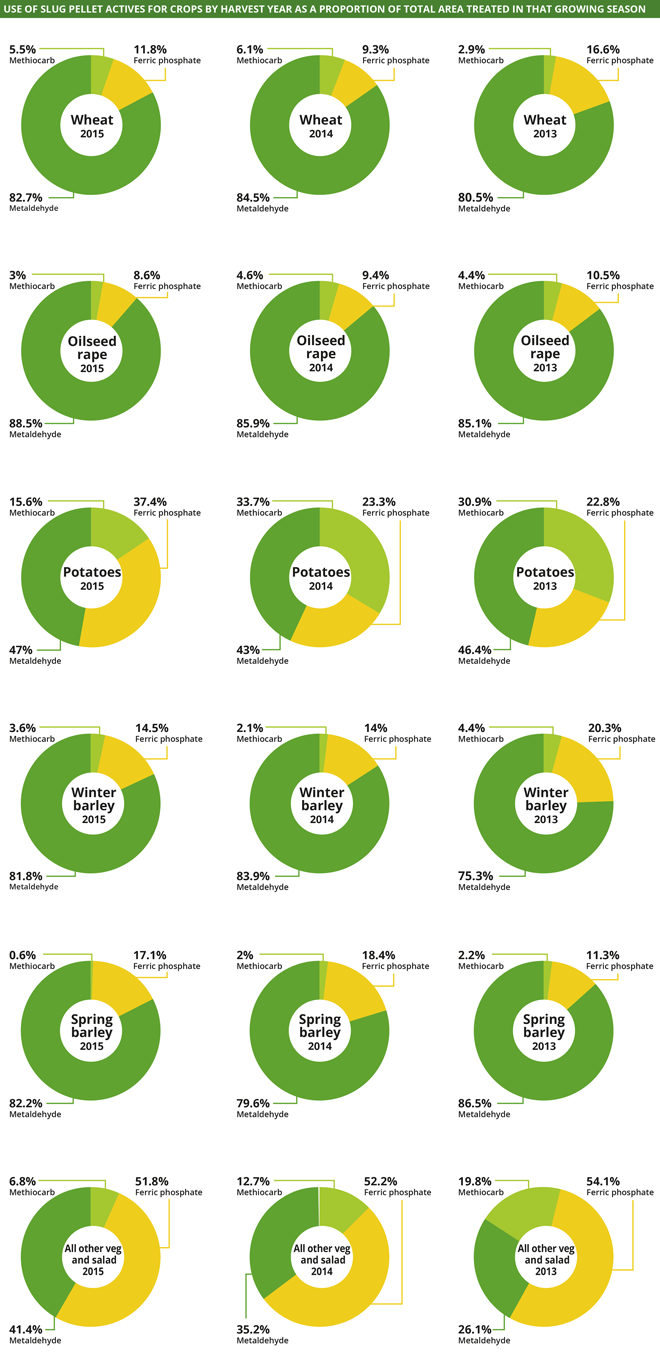
However, aggregated Agility Crops data shows that growers were already making changes switching to one of the two remaining active – metaldehyde and ferric phosphate.
For example, from 2012-13 to 2014-15, methiocarb use halved while veg grower use fell from nearly 20% to just under 7%.
However, one striking trend is that combinable crops tended to rely more on metaldehyde for slug control.
But metaldehyde has its limitations, such as it cannot be applied within 6m of watercourses and its future remains under pressure, being detected in surface water.
With higher value crops, there is a more even split, possibly as they have more to lose from slug damage with retailers taking a zero tolerance to slug damage.
But when it comes down to which active to use, Simon McMunn, commercial manager at De Sangosse which manufactures pellets with both actives, believes choice is largely down to bait quality.
“Unlike other pesticides, with the exception of rodenticides and pheromone traps, it needs to attract pests. Therefore, it has to be attractive.”
Persistence is also important. “In spuds, the key time to apply is 50-75% canopy cover to through the canopy and is onto bare soil. Once the canopy closes, you get a microclimate with moisture where slugs thrive.”
Metaldehyde and ferric phosphate*www.getpelletwise.co.uk
|
|
Metaldehyde |
Ferric phosphate – Ironmax Pro |
|
Type of pellets |
Varying formulations containing 3%, 4% and 5% active |
Wet extruded pasta based (TDS) containing 30g/kg of active |
|
Max individual dose |
Maximum application rate 210g metaldehyde active/ha. For additional protection of water, suppliers/Basis advisers may recommend rates reduced to 160g active/ha or less* |
7kg of product/ha (210g/ha active) |
|
Max Total dose |
700g active/ha a year |
28kg/ha a year (840 active) |
|
Buffer zone |
6m |
None |
|
Harvest interval in potatoes |
Product specific –from 7 up to 21 days |
None |
|
Toxicity to non-target organisms |
Low |
Low |