

Advertiser content
ADAS tillage trials insights
- Independent ADAS tillage trials insights
- Varieties proven to perform are a good option when trying different tillage and establishment methods
- Versatile GLEAM winter wheat performs across tillage trials
- Seed treatments fit within a sustainable farming approach
First indications from Syngenta commissioned, independently run tillage trials with ADAS show that GLEAM winter wheat is extremely versatile and delivers high performance when in a plough-based system but also in non-inversion tillage and direct drill approaches as well.
Throughout the season the plough-based approach appeared to have the advantage visually. There were significantly higher plant populations in the plough-based system at growth stage 13.
This trend continued throughout the season and GLEAM had a significantly lower plant population where direct drilled at growth stage 31 compared to the non-inversion tillage system, whilst populations were highest where ploughed.
There was a far higher tiller density in the ploughed plot where GLEAM was producing 636.2 tillers/m2, compared to the direct drilled area which was producing 567.2 tillers/m2 which would generally be deemed sub-optimal.
However, due to the plant density, we could already see that GLEAM was producing more tillers per plant in the direct drilled area to help compensate for lower plant populations.
“Wheat in general has an excellent capacity to compensate when in sub-optimal conditions, but GLEAM seems to be superior in its ability to deliver high performance across a vast range of conditions and scenarios” says Matt Bull, Seeds Technical Expert.
“The components of yield is where it gets really interesting. Throughout the main growing season, you would have absolutely picked the plough-based system. More plants, more tillers, deeper rooting and in turn a greater density of fertile ears. But GLEAM compensated through thousand grain weight and grains per ear to deliver marginally higher yield from the direct drilled area”.
ADAS agronomics approach
The yield data was analyzed using the ADAS Agronomics approach, which cleans the data and accounts for spatial variation across rows and along rows, resulting in a robust understanding of the impact of the treatments in question.
The highest yielding area was the direct drilled at 11.22 t/ha followed by the plough-based system at 11.15 t/ha and then the non-inversion tillage was third at 10.72 t/ha.
The yield analysis highlighted that there were no significant effects of the cultivation treatments on yield across the trial which is exciting, as it demonstrates how versatile GLEAM is as a variety.
There are several risks associated with switching to reduced tillage, and whilst every farm is different, having an adaptable variety like GLEAM that delivers in all situations, is a good risk mitigation strategy during the transitional period.
GLEAM is widely renowned for its adaptability on farm and that is clearly demonstrated through the Recommended List trials where it has delivered 103% of the control mean in almost all situations.
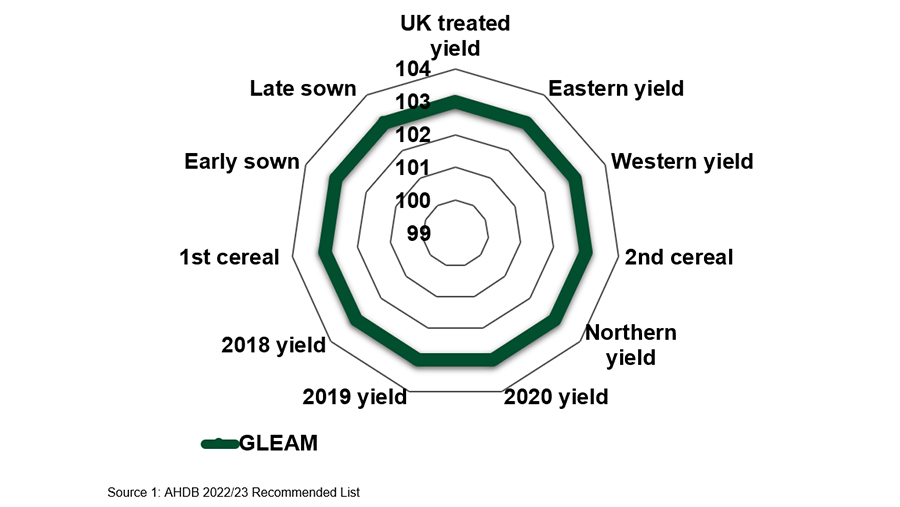
AHDB 2022/23 Recommended List © Syngenta
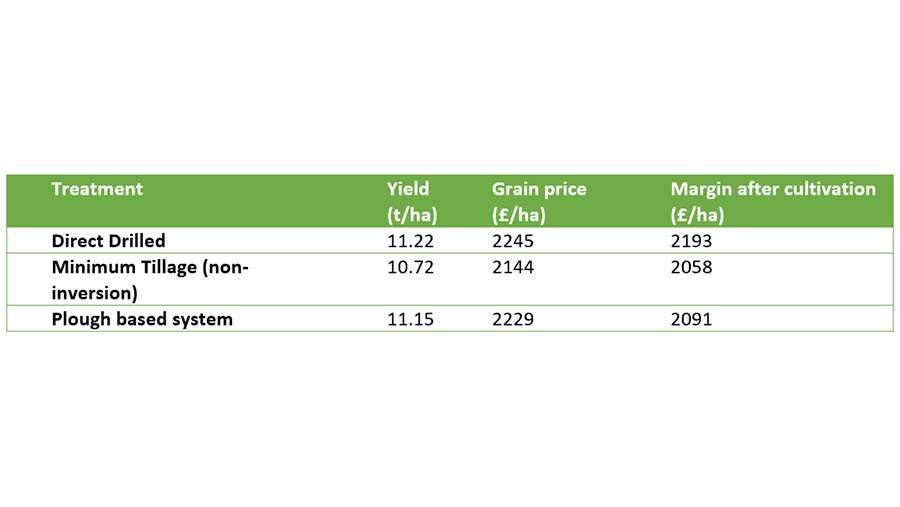
Effect of cultivation and variety treatment on margin after cultivation © Syngenta
An estimation of the effect of the cultivation treatments on margin after cultivation costs were made using the modelled treatment effects presented in the table above.
The numbers shown represent winter wheat at a conservative £200/tonne and uses cost estimations for cultivations from John Nix 2021 (Farmers’ Average Cost), as follows:
- Direct Drilling (£51.56/ha)
- Shallow discing (£33.63/ha)
- Ploughing (£53.07)
The gross margin analysis assumed that ploughed areas were disced before drilling. The direct drilled treatment had the highest margin over cultivation costs of £2193/ha compared to £2058/ha for the min-till treatment and £2002/ha for the ploughed treatment.
Kathryn Hamlen, Marketing Manager at Syngenta, highlighted that “understanding variety performance under different tillage and establishment methods is becoming more critical. With market volatility and ongoing uncertainty around policy, having varieties which have proven to deliver on farm over several years, like GLEAM, is a good place to start. “
Syngenta are committed to understanding more about variety performance under different cultivation practices and this work continues across hybrid barley, spring malting barley and wheat.
We look forward to sharing more results with you after harvest.
Seed treatments fit within a sustainable farming approach
Fungicide seed dressings are a key feature of a sustainable farming approach. It is important to carry on using a fungicide seed dressing to control key seed and soil-borne diseases, maximise crop establishment and lay the foundations to maximise crop yield and quality.
Many growers looking at sustainable systems will likely be using minimum tillage where practical. In these systems crop trash on the surface can increase the risk of seedling blights such as Microdochium, which the use of a seed dressing will protect against. In addition, using seed treatment VIBRANCE Duo can help improve establishment and increase rooting.
VIBRANCE Duo improved establishment and rooting across cultivations in wheat
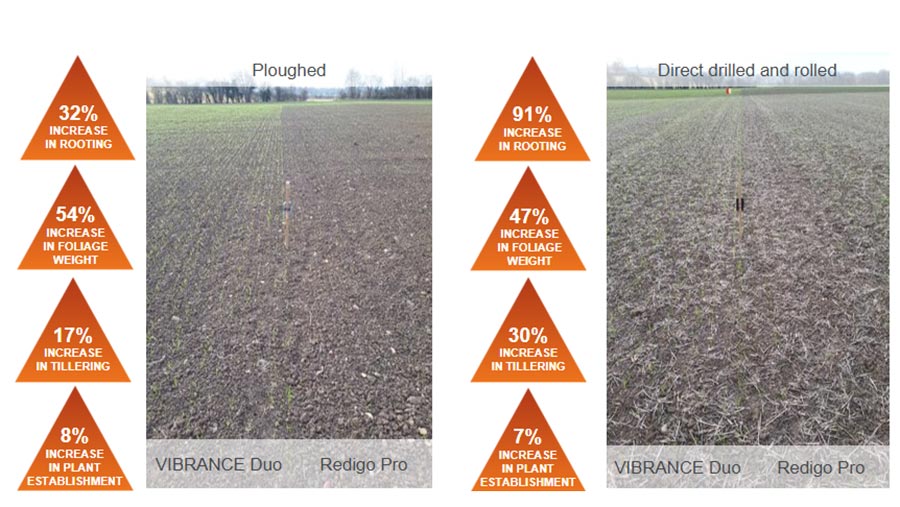
Shipston on Stour, Warwickshire, Heavy soil, drilled 29th October 2017 © Syngenta
This example is a typical heavy land black-grass situation at Shipston.
VIBRANCE Duo has improved establishment over Redigo Pro in a heavy land delayed drilled situation where achieving a stale seedbed is vital.
Increased plant establishment and rooting, alongside improved crop vigour and tillering equates to a more competitive crop against black-grass.
VIBRANCE Duo improves rooting
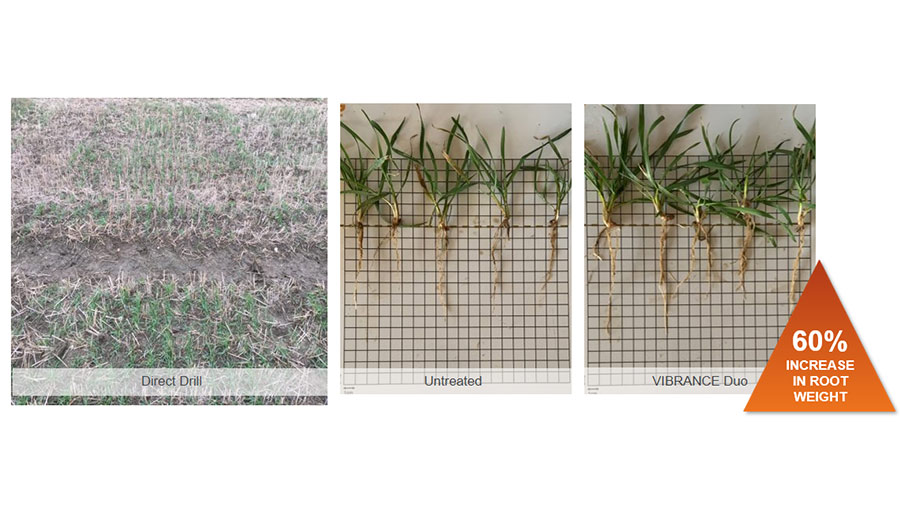
Barton, Cambridgeshire, drilled October 2021 and rooting assessed 20th January 2022, variety GLEAM © Syngenta
VIBRANCE Duo, just like we have seen in previous seasons, in a minimum soil disturbance cultivation system such as direct drilling brings real benefit through improved crop establishment and rooting.
Provided by
Syngenta is one of the world’s leading agricultural companies, comprising of crop protection and seeds. Our ambition is to safely help feed the world while taking care of the planet.