Glimmer of hope for UK spring malting barley growers
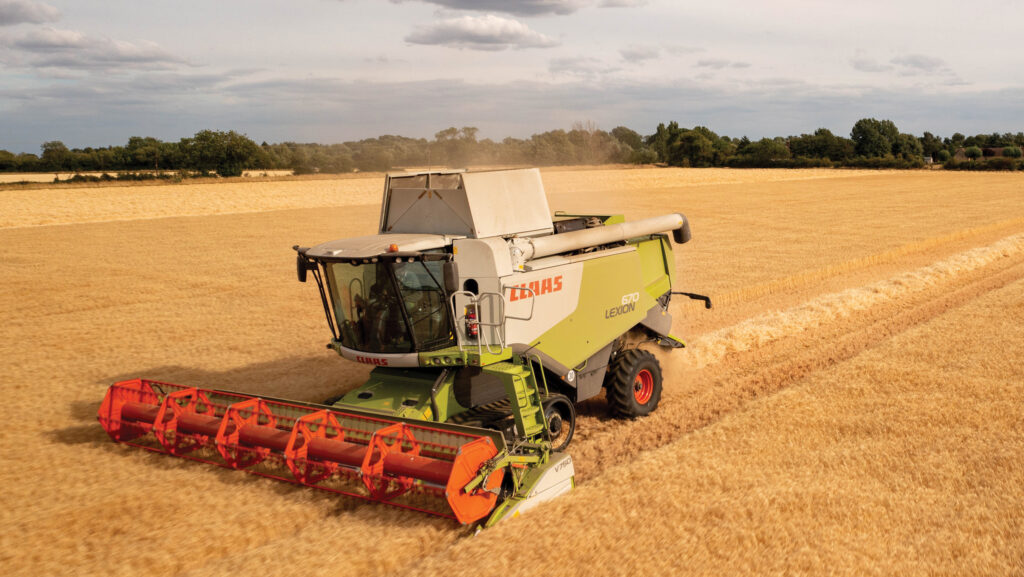
A forecast sharp drop in the spring barley area this year, together with industry capacity cut backs could inject some optimism into a depressed malting barley market and push up rock-bottom prices.
Faltering malting barley demand from both brewers and distillers has undermined malting prices, which are trading between feed wheat and feed barley.
However, one trader points to some glimmers of hope.
Jonathan Arnold, trading director of malting barley specialist group Robin Appel, is trying to inject some optimism into the market and is looking for crumbs of comfort after a bruising time for barley growers.
See also: How to tackle the increasing problem of Italian ryegrass
He believes prices for the 2026 harvest crop could be helped by his prediction of a UK spring barley 2026 area as much as 25% lower than the previous year, and a near-100,000t malting industry capacity cutback.
“It is always darkest before the dawn. It can only get better, and it will get better,” he says.
Jonathan argues that spring malting barley is a relatively cheap crop to grow and there is often no obvious alternative spring crop to grow for many.
Despite faltering demand from the maltsters prices simply can not go any lower.
Chalkland crops across the south of England showed good yields and grain quality during harvest 2025.
However, those in big malting heartlands of East Anglia and Scotland faired worse with low yields, high grain nitrogen contents and high screenings due largely to the dry spring and summer weather in the east.
Meanwhile, the continental European malting barley crop of 2025 is showing good yields and quality, helped by most of Europe getting more rain than the UK during the growing season.
This has put a dampener on big exports from the UK to the continent.

Malting barley demand
After over a decade of the UK maltsters buying about 1.9m tonnes of malting barley annually, Jonathan says this is set to fall to 1.6m tonnes from the 2025 harvest crop, and could be as low as 1.4-1.5m tonnes from the 2026 harvest.
Even though there is a reduction in alcohol consumption, especially with the younger generation, Jonathan sees some optimism coming from a smaller 2026 spring barley area and lower carryover stocks of malting barley into 2026.
“If you are a good spring barley grower, then grow spring barley.
“There is room for optimism with the forecast area of spring barley down, the winter malting barley area down, while the winter wheat area is likely to be up 10%,” he says.
The much smaller proportion of the 2025 UK barley crop that has made the malting grade will help clear the surplus that hangs over the market.
The forecast smaller 2026 crop will also help bring supply and demand more into line.
The AHDB’s Early Bird survey has forecast the 2026 UK spring barley area will be down 15% at 610,00ha from a 2025 harvest figure of 720,000ha.
Jonathan believes the spring barley area fall will be even steeper at 20-25%.
In addition, the Early Bird survey expects the UK winter wheat area to be up 1% at 1.675m hectares.
Jonathan estimates that good autumn weather and a lot of late drilling will see this winter wheat crop area up 10%.
Industry cutbacks
Furthermore, Jonathan points out that the malting industry has already cut capacity by up to 100,000 tonnes with the mothballing of one plant and the planned closure of another, both in Scotland.
Distilling giant Diageo, the company behind Johnnie Walker and Bell’s whiskies, said in November 2025 it had paused production at its Roseisle Maltings, near Elgin in Morayshire, until June 2026, due to a decline in demand.
Roseisle is one of four malting plants the group operates, with two others nearby at Burghead and Glen Ord, and the final one at Port Ellen on the island of Islay. Diageo said that Roseisle is not closing permanently, although future production is “under review”.
In the same month Soufflet Bairds said it was closing its Pencaitland malting plant, just east of Edinburgh.
This follows Soufflet’s acquisition of the United Malt Group in 2023, which had owned Bairds.
This will leave the combined group with four UK malting operations at Inverness, Arbroath, Witham and Burton-on-Trent.
The maltster’s view
One of the UK’s biggest maltster Boortmalt is taking a more optimistic long-term view.
It sees its own demand from the four big brewers in the UK – Heineken, Molson Coors, Anheuser-Busch InBev and Carlsberg – as being fairly stable, while the distillers are dealing with short-term volatility and market fluctuations.
Sam Colman, key account manager for the maltster, says he sees a stable to general declining demand picture from the brewers.
However, the distillers are suffering an excess of stock, and it might be 2028 before they see growth again.
”The UK spring barley area in 2026 is set to be down and this could have a positive impact on pricing.
“We are hoping we have hit the bottom of the curve, but the big unknown is in Europe where the European maltsters export a lot of malt, “ he says.
The maltster, which only buys UK barley for its UK malt production, is optimistic enough to be expanding production at its two Scottish plants at Buckie in the northeast of the country and Glenesk, near Montrose.
Its two other plants are in England – Bury St Edmunds in Suffolk and Knapton in North Yorkshire.
The breeder’s view
Spring barley purchases by the UK maltsters are still dominated by the variety Laureate, which accounts for about 63% for their spring barley purchases from the 2024 harvest.
This is likely to be a similar percentage from the 2025 and 2026 harvests, says Kathryn Hamlen, seeds portfolio manager at Laureate breeder Syngenta.
“Laureate works for everyone – the grower, the distiller and the brewer – and the majority of the market will be in Laureate this year,” she says.
Laureate is a dual-purpose variety, which means it can be used for distilling, where distillers generally look for a nitrogen grain content of below 1.65%, or for brewing where the requirement is for a nitrogen content of below 1.85%.
Plant breeder and agrochemicals group Syngenta is in the process of selling its two-row winter and spring barley business to fellow plant breeding group RAGT to focus on breeding hybrid barley and wheat varieties in the future.
This barley business includes newer spring barley malting varieties such as Tennyson and Arrow, as well as Laureate, while conventional UK wheat breeding – which gave growers varieties such as Cheer, Graham and Gleam – will cease.
The brewer’s view
Some brewers are optimistic that the malting barley market will recover in the medium-term, with Toby Heasman, head brewer at Dorset-based Hall and Woodhouse, saying his group’s beer volumes have been generally stable.
His company, which brews Badger beers from its Blandford Forum brewery, is taking on extra contract brewing work to eke out some future growth in an overall difficult European beer market which is seeing volumes decline.
The brewer looks for malting barley of below 1.6% nitrogen for its predominately ale beers and is starting a new malting contract which will use 100% Laureate from the start of 2026 as it moves away from the winter malting barley variety Flagon.
“The market will turn around, but it is a slow journey while supply and demand are not in line,” he says.
Malt costs at the Dorset brewery only account for 7% of the cost of brewing its 20m pints every year, dwarfed by labour, which takes up 42% of the production cost of a pint.
- All those mentioned were speaking at the Southern Spring Barley Malting Conference in Hampshire in December 2025, organised by independent grain trader Robin Appel and seeds and agrochemicals group Syngenta.