Why genetics must be central to late blight management
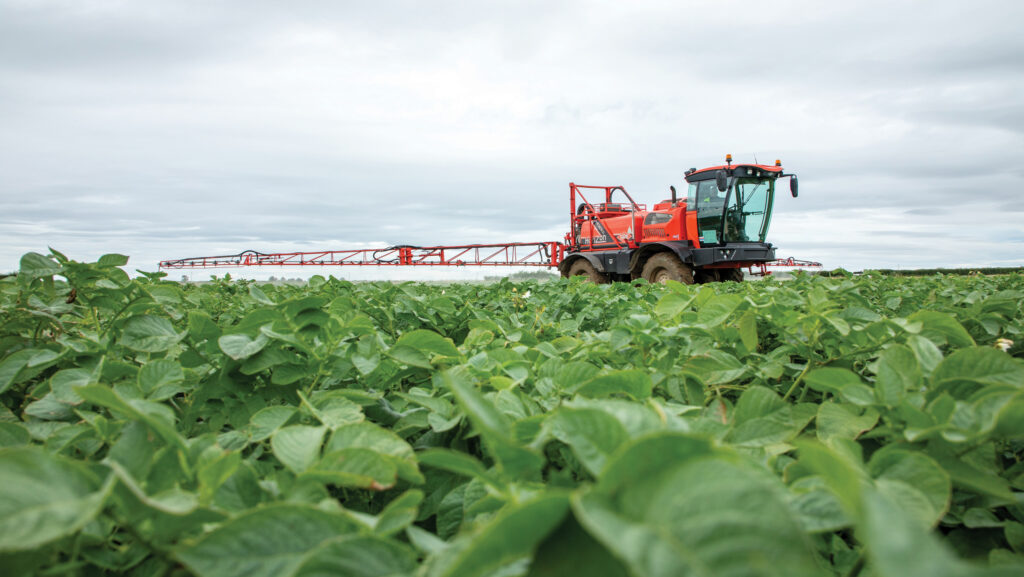 © GNP
© GNP Late blight resistant varieties must be an active component of potato crop management regimes, rather than a “just-in-case” safety net.
That is the view of Dan Milbourne, who is leading a major EU initiative aiming to help the industry shift away from its long-standing reliance on fungicides – an approach increasingly under threat from regulation and sustainability demands.
See also: Why leafhoppers are an emerging threat to potatoes
The Teagasc molecular geneticist and senior research officer says the IPMorama project, launched in 2024 with Horizon funding, has three broad aims:
- Develop genetic markers and germplasm that enable breeders to improve varietal resistance and enhance its resilience
- Design practical, real-world integrated pest management (IPM) strategies that integrate resistant varieties intelligently into potato rotations
- Improve decision support systems so that growers receive clearer guidance on using varietal resistance alongside other IPM tools.
“As someone who is partly responsible for trying to create these varieties, I’m very invested not only in creating them, but seeing that they are used,” he says.
“Up to now, deployment has been disappointing, and we have not seen many of them commercially, for a whole range of reasons.”
Current genetics
Researchers and breeders have made strong progress with resistance, but existing varieties are largely derived from a small set of R genes. These originate from wild potato relatives that co-evolved with the Phytophthora infestans mould over millennia.
R genes encode receptor proteins that detect pathogen effectors – in effect, sensing the pathogen’s attempt to invade – and trigger a localised hypersensitive response that halts infection.
However, these R genes are often strain-specific. A small mutation in a pathogen effector can allow the pathogen to evade detection, overcoming the resistance.
With many resistant varieties on the market or in the pipeline containing only a single R gene, they remain effective, but vulnerable to a dynamic late blight population.
Stacking genes
Consequently, not all R genes perform consistently within a single season, and their capacity to delay infection varies. But when breeders combine multiple genes – known as stacking – resistance becomes far stronger and substantially more durable.
Dual-gene varieties are now reaching the market, and multigene stacks are set to follow, supported by new genetic markers discovered by Dan at Teagasc and other geneticists around the world.
“Because many of the current crop of varieties carry only one gene – just like single-site fungicide chemistry – we must manage them very carefully while we transition to more robust resistance,” Dan explains.
This includes timely use of fungicides during periods of highest pressure, reducing the risk of R-gene breakdown, and protecting crop yield.
IPM strategy
IPMorama has been testing IPM approaches in multisite trials in Scotland, France and Poland, placing varietal resistance and decision support systems at the heart of disease control.
Two late blight control regimes were compared in 2025, including a farm standard programme, supported by weather-based decision support.
The other was a variety-centric programme, where the first fungicide spray was delayed, relying initially on the plant’s own resistance, followed by strategic sprays timed just before predicted resistance breakdown.
The susceptible variety Fontane acted as a control, with other varieties containing a range of R-gene groups. Varieties were grouped by the source of their resistance and their ability to delay the onset of disease, with first sprays delayed longer for the more robust groups.
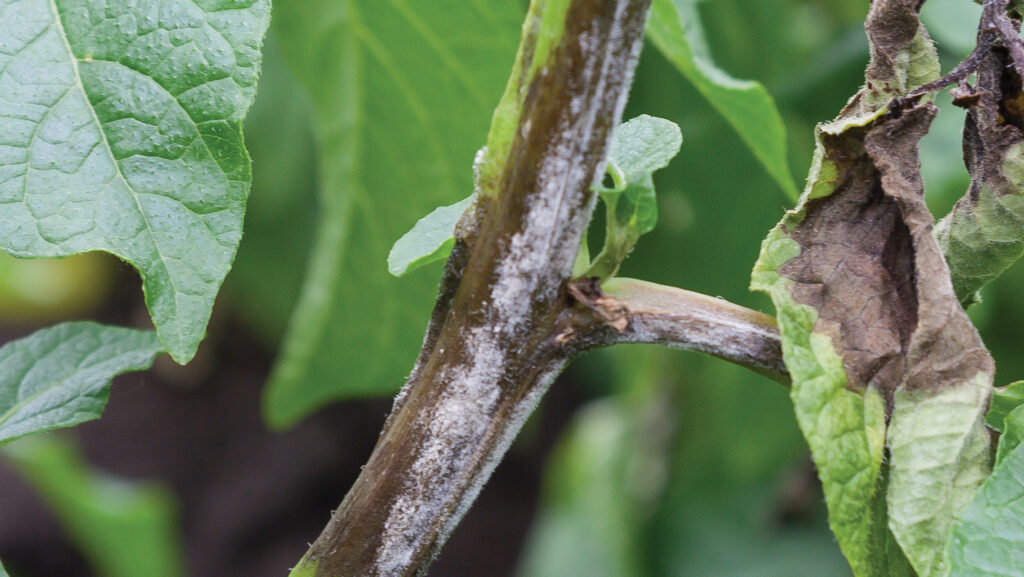
© Blackthorn Arable
Magic trick
“The difficult part is predicting when resistance will break down. Ideally, just before that happens, you go in and spray. That is the magic trick we are trying to pull off,” notes Dan.
The delayed-spray programmes were informed by a decision support system from Dutch firm Farmmaps, which allows users to enter varietal resistance profiles into the model.
The results were striking. At the low-pressure Scottish site at Invergowrie, several resistant varieties required no sprays at all, compared with 13 fungicide passes under the farm standard approach.
Under medium pressure in Poland, resistant varieties needed just one spray, and in very high-pressure conditions in Brittany, fungicide use was roughly halved.
“There was an interesting breakdown in one of the resistance groups. Just because it broke down this season does not mean it will do so next year. It is a useful example of what can happen,” Dan says.
Adding layers
A key question arising from the trials is what additional information could be fed into the decision-making process to strengthen next year’s work and improve the robustness of future recommendations.
Dan is keen to introduce in-season early-warning tools that track the distribution of late blight genotypes and identify where particular R-gene resistances are being overcome.
He notes that BlightTracker, an app developed in Denmark for this purpose, is already live in Europe, and would significantly improve the precision of fungicide timing.
Another potential layer comes from ongoing work at the James Hutton Institute, which aims to develop rapid genotyping capable of detecting resistance-breaking strains far more accurately than current methods.
“The overarching goal is to develop sustainable, genetically informed and real-world-validated IPM strategies that reduce fungicide dependence while maintaining effective control of late blight,” Dan says.
‘Avoid complacency’ after low-pressure year
Late blight pressure remained “phenomenally low” in 2025, but growers are warned not to become complacent as new genotypes continue to shift the disease landscape, says Dr David Cooke, plant pathologist at the James Hutton Institute.
The exceptionally dry spring and early summer kept a lid on primary inoculum levels, with some eastern regions recording just a single Hutton Criteria event before mid-July.
This meant more than half of the year’s confirmed outbreaks occurred after September, once any semblance of moisture returned.
Despite the general picture, the Fight Against Blight monitoring initiative still genotyped some 300 active samples, which revealed that the aggressive EU36 remains the dominant strain across the UK.
A key discovery to note is the increase in EU46, accounting for 23% of samples, although it was detected at only seven sites, mainly in Wales early in the season before jumping into the West Midlands and Derbyshire.
Crucially, EU46 isolates tested in 2025 were resistant to oxathiapiprolin (Zorvec), which underlines the need for growers to maintain strict resistance-management strategies.
David points out that EU41 also re-emerged at low levels, while EU43 – associated with carboxylic acid amide (CAA) resistance in Europe – was not detected in the UK.
He adds that fungicide sensitivity testing at the James Hutton Institute offered positive news, with mandipropamid, amisulbrom, propamocarb and fluopicolide all showing full sensitivity across UK isolates.
Nevertheless, he stresses that reliance on single-site chemistry remains a major risk and urges growers to continue using mixtures and alternation, following Fungicide Resistance Action Group guidance.
With active blight still present on volunteer potatoes into November, he warns growers to maintain vigilance into 2026 and avoid complacency, particularly with regards to hygiene.
“No inoculum means no blight. Volunteers and dumps remain the foundation of good control,” he says.
David also thanked the sponsors and blight scouts for their support of the Fight Against Blight initiative.
The research and commentary in this article were raised during a seminar session at the recent British Potato 2025 event in Harrogate.