Why Cambs grower invested in bicropping separator
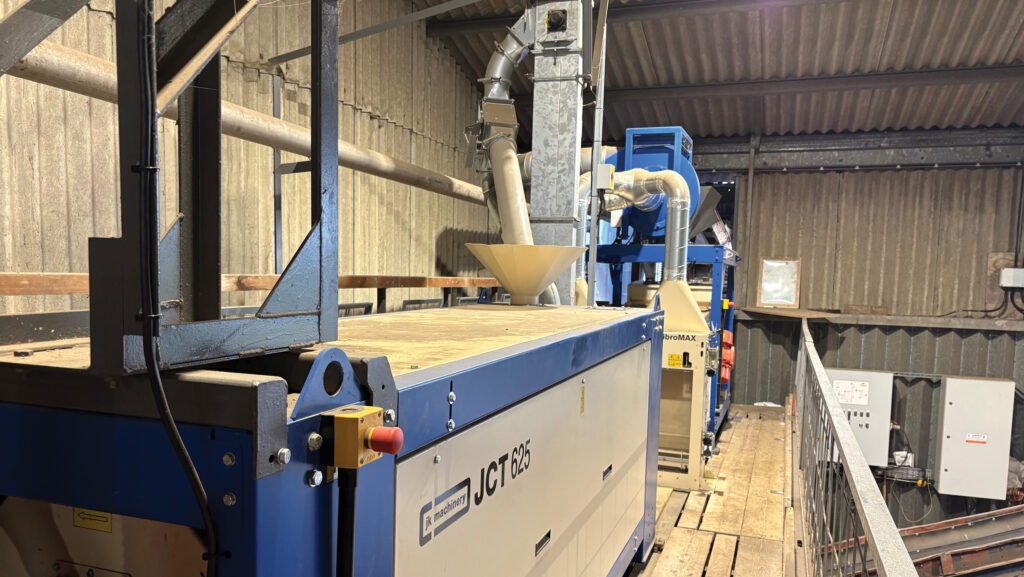 Crop separator © MAG/Lois King
 The installation of a specialist crop separator at the family farm’s bicropping enterprise is enabling farmer Hannah Darby to sell peas, beans and oats into premium markets.
The bicropping system at Roughs Farm in Huntingdon, Cambridgeshire, is delivering more consistent yields, better weed control and also improving the ease of harvesting peas.
However, the practical challenges of separating bicrops after harvest was proving tricky. Hannah knew something had to change.
See also: Sheds or silos? What to consider when upgrading grain storage
“We tried our 1950s Turner seed cleaner, but it just wasn’t up to the job. We also got a mobile seed cleaner in. It was expensive and the process was not always thorough,” she says.
Getting good separation and achieving a clean sample is especially important when aiming for premium human consumption markets.
It was at Cereals event in 2022 when Hannah approached McArthur BDC for a solution.
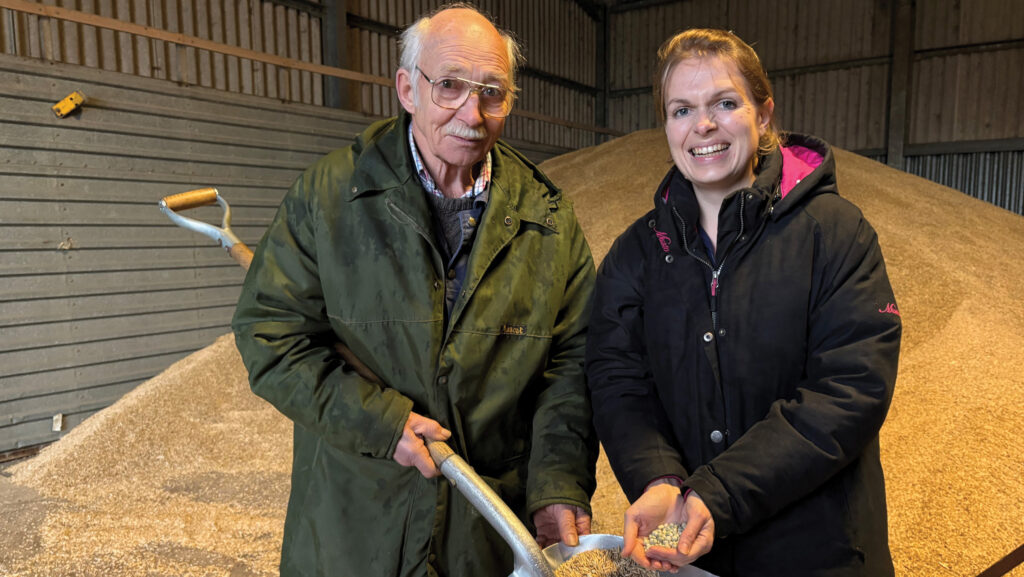
Hannah and Tony Darby © MAG/Lois King
Why bicropping?
Under the business name of TE Darby & Sons, Hannah farms 310ha of arable cropping with her uncle, Tony Darby.
They grow predominately Group 3 wheats and 60-80ha of bicrops on light Fen and heavy clay soils in the north of Cambridgeshire.
Her bicropping includes oats grown with peas, and oats partnered with beans.
There are few reasons for the bicropping. For the peas, the oats act as scaffolding – Hannah recalls combining them several years ago when they were flat on the floor and it was a very slow job.
The second reason is that the very high organic matter content of the Fen soils means herbicides have limited efficacy, and she recalls spending more than £100/ha.
In one trial previously carried out on farm, she compared half a field treated with Basagran (bentazone) with the other half without herbicide, and there was little difference in crop output.
Instead, increased crop competition from the mix helps suppress weeds. “Oats do well on our soils and are really good at scavenging nitrogen, resulting in less being available to the weeds,” she says.
And the third reason is that it has increased yields and reduced inputs. “We are seeing the same pulse yields as we did before, but have gained the oats.”
Yields typically range up to 4t/ha in more favourable years, but 2025 was a challenging year with the drought on the light soils.
Hannah estimates the pea and oat bicrop yielded about 2.6t/ha, although the combine yield meter struggles with mixed crops.
How the system works
McArthur BDC’s Tom Wood explains that the setup comprises two different parts – a vibrating screen cleaner with aspiration and an indented cylinder.
The first stage sorts by size and the second by shape – combining both produces a consistent and accurate output.
First, the mixed crop is loaded into the vibrating screen cleaner via a conveyor, as this reduces the risk of damage to the pulses that can be seen when using an auger.
The vibrating screen cleaner is a JK Machinery VibroMAX JCM08133, which is based on technology widely used in the milling industry to separate bran from flour, explains Tom.
The 80cm wide VibroMAX has three screens, which are selected according to the crops being separated.
Chaff and other large debris are removed by the top screen (largest), while the second removes the larger crop (pulses).
The third screen removes the smaller crop (oats) with small seeds (mainly weeds such as poppies, dust and fine material) falling through all three sieves.
The peas and oats streams are then passed through aspirators, which remove further waste by using airflow rather than sieve size.
From here, the peas are then loaded into the telehandler bucket while the oats move into the JK Machinery JCT indented cylinder for the second stage of separation.
This removes the few broken peas that remain.
The waste product from the indented cylinder is run through the machine again, as it consists largely of half peas which still have a value and the rest is used as pheasant feed.
So how much can it process? Tom says the first stage, separating bicrops based on size, can process up to 6t/hour.
This capacity depends on crop type and condition. The indented cylinder can run at a capacity of 3t/hour for this application.
Working at around 2t/hour, Hannah says the priority is quality rather than speed and she estimates the entire process will take about two to three weeks to process the crop.
This is carried out in the quieter winter months once some of the wheat has been loaded out of the store to make space.
“It utilises staff at what is a quiet time,” she says.
The system is currently configured to produce five output streams, with the option for six if required.
This means that more complex crop mixes, such as peas, oats and phacelia, could be handled in the future should the enterprise expand.
“The system allows us to separate crops more precisely, and it gives growers confidence that the final product is clean, consistent and market ready,” Tom says.
In contrast, Tom points out that traditional seed cleaners are designed to end up with one premium product, not two, and can compromise quality.
Return on investment
The family invested £70,000 in the firm’s vibrating screen cleaner and indented cylinder system and aim for a 10-year payback.
This winter marks the second year the crop separator has been used on farm.
Hannah says the savings in inputs (herbicides/fertiliser) growing the bicrops is covering the cost of the investment, which she says will pay for itself over 10 years.
This season, the separator is producing encouraging results and is currently separating Isobel milling oats and Butterfly blue peas. After that, crop of Lynx beans and Isabel oats will be separated.
The oats are coming out at 3% admix and are hoped to be sold to a local oat mill.
McArthur BDC’s grain separating/sorting product specialist Tom Wood believes, with refinement, this will come down to 2%.
Looking ahead, Roughs Farm plan to expand their bicrop acreage and build on the benefits already seen in soil health and weed management.
With the machinery now in place, and the first full season of output data to draw on, the next step is refinement, she says.
Establishment
The bicrops are established using a Weaving GD disc drill with two hoppers that plants both at the same time.
For the peas, Hannah Darby aims for a plant population of 100 pea plants/sq m and 70 oat plants/sq m.
Drilling usually falls between mid-March and mid-April – last spring it was at the end of March and they established well.
Weed control consists of glyphosate before drilling the cover crop. Later in the winter, they roll the cover crop on a frost, then glyphosate it off.
No in-crop herbicides are used, as there are no products approved for both.
The only other inputs are trace elements and a fungicide approved for use in both crops to tackle downy mildew in peas and crown rust in oats, if required.