East Yorkshire grower joins Hutchinsons’ farm productivity trial
East Yorkshire arable farmer Adam Hayward is the new Hutchinsons Helix Technology Demonstration farm host, who hopes taking part in further trial work will help maximise farm productivity.
Adam runs a 300ha mixed beef and arable farm with his father Paul at Cold Harbour Farm, Bishop Burton.
“We’ve always done on-farm trials, so being part of the Helix network matches closely with what we do,” says Adam.
See also: Why arable farmers should target 5% soil organic matter
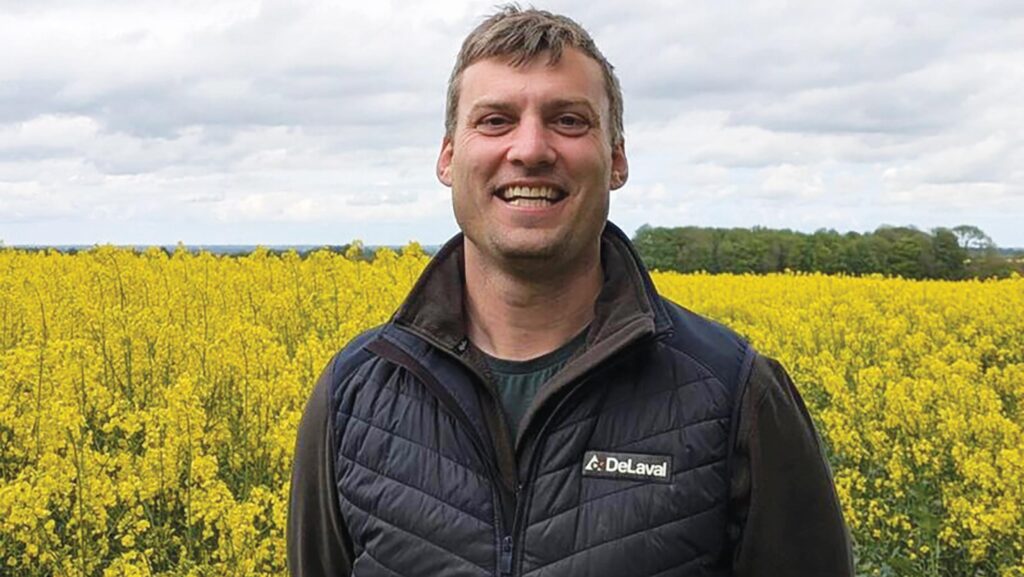
Adam Haywood © Paul Spackman
Adam acknowledges that while there is considerable pressure on margins within agriculture, the focus for their business is on driving yields and quality, not cutting costs.
“We run a high-input, high-output system. We need to maintain yield.
“We monitor everything carefully to make sure we use all inputs, such as nitrogen, in the best way possible.”
Using precision data and conducting on-farm trials is all part of the process to help achieve that.
The team values being able to see if new products and technologies are successful or not.
“If we find something that works, that may well be adopted on a wider commercial scale across the farm.
“For example, a biostimulant we use as mainstream for pulse growing started as a trial a few years ago.”
Trial highlights
- DNA-based soil assessment Investigating whether DNA sequencing and artificial intelligence-driven predictive models can assess the soil microbiome, identifying the “good” and “bad” microbes that influence crop performance. If successful, it could be used as a support tool to aid rotational and nutrition planning.
- Optimising nitrogen inputs Assess the value of the Messium hyperspectral satellite imagery system for optimising nitrogen applications according to crop potential. The Helix team is also looking at soil sensors to measure plant-available nitrates in soil moisture.
- Disease prediction Two systems tested to see if disease prediction and fungicide timing can be improved. The first detects latent disease before symptoms are visible, while the other is a computer-based disease forecasting model.
- Organic amendments Quantifying the crop benefits from organic amendments, with nutrient analysis and regular tissue testing, alongside grain and straw analysis to assess plant uptake. DNA sequencing tools will be used to assess the impact of organic matter on the soil microbiome.
Various other trials looking at phosphate-based fertilisers, variety blends, and the impact of seed rate on disease are also under way.
Find out more about the Helix network.