Farmer Focus: The benefits of drone mapping
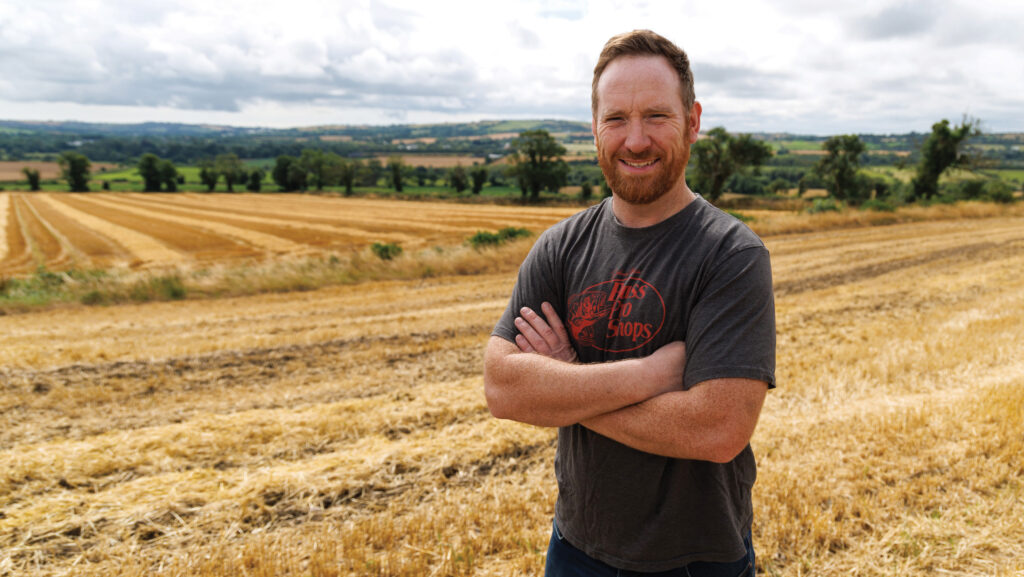 Peadar Whyte © Damien Eagers Photography
 When my non-farming brother first suggested flying a drone over my crops to map them for variable-rate nitrogen, I thought it was pie in the sky stuff.
However, we had just bought a fertiliser spreader capable of variable-rate spreading so we gave it a try.
See also: Poor grain outlook sees farms rethink rotations and machinery
About the author

His first flight, in early spring 2021, covered most of a 200-acre farm with several crops.
The drone’s multispectral camera measured biomass and produced colour-coded maps showing canopy strength.
Straight away, it grabbed my attention.
For example, weak red patches in hybrid barley and yellow areas indicating strong areas of the field. A cover crop with huge biomass stood out among winter crops.
The most useful results were on the oilseed rape. The software grouped the field into four colours, each tied to a biomass score.
Each colour represents a number on the scale from 0 to 1. For example, red, the worst area, was 0.42 and yellow, the strongest area, was 0.83.
I compared these areas using green area index (GAI) readings and found that the drone’s scale could be related to this. Each colour represented a reliable average GAI.
That meant I could finally target nitrogen accurately, giving weaker patches enough to build a full canopy without overfeeding the stronger areas.
In the past, walking fields and averaging GAI always led to applying too much nitrogen overall, because you allowed more to cover the weak areas.
The drone maps gave me the confidence to cut back where fertiliser wasn’t needed, while still supporting the poorer zones – areas which may have been grazed by birds.
I usually fly the fields with the drone in mid-February. I check my GAI’s and apply an early nitrogen application to the weaker zones, with strong zones getting a zero or very low rate.
Then I can spread my main split a few weeks later using the same map.
We have been fine tuning the process over the past few years, and my brother now does this for other local farmers over thousands of acres.
The principle is clear: it reduces nitrogen use, not across the board, but precisely where it isn’t required.
Drone mapping has proven itself on oilseed rape. I’m still learning how best to use it on other crops, but I have had favourable results in winter wheat and barley.