How 6 farmers are managing fertiliser use in tight season
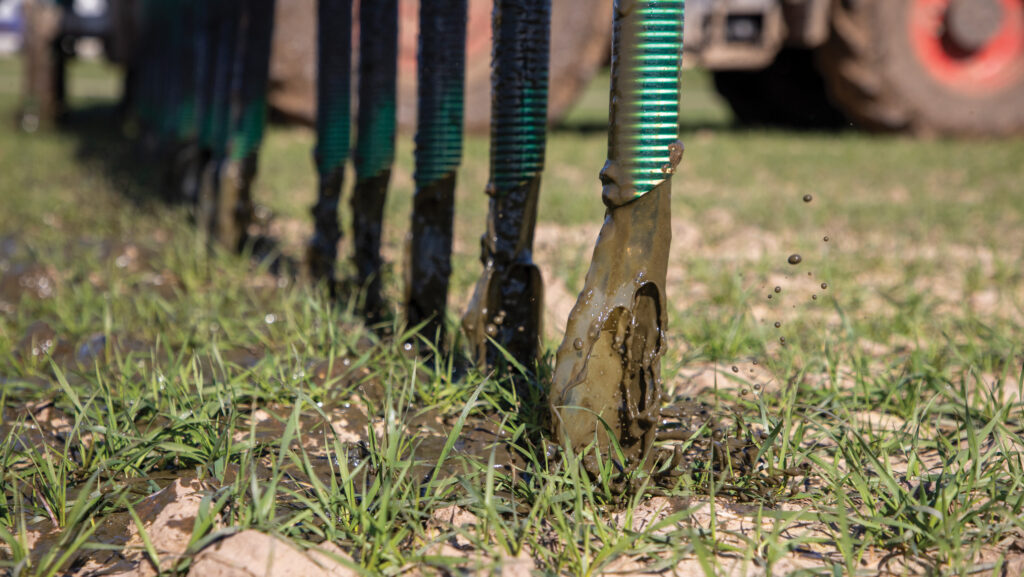 © GNP
© GNP With margins tighter than ever, how is the Arable Insights farmer panel approaching fertiliser use in wheat crops this spring?
Farmers Weekly asks six farmers across the regions for an update.
See also: Meet the new Arable Insights farmer panel for 2025-26
Scotland
David Aglen, Inverarity Farms, Angus
Applying enough early nitrogen to 200ha of winter wheat to mitigate against any prolonged dry spell in spring is a key requirement for Inverarity Farms farm manager David Aglen.
“I’ve tried the theory of the ‘little and often’ approach to applying nitrogen several times in the past and always seemed to get my fingers burned when it dries up and the crop can’t take up nitrogen when it needs it,” he explains.
It is very easy to lose tillers and yield potential in the spring if a crop starts to be hungry for nitrogen because of a long dry spell – which seem to be occurring more frequently, he says.
“So I’m erring on the side of caution and will put a bigger dose of 80kg N/ha as soon as we can travel after the middle of February.”
Having sold a decent proportion of the wheat forward at higher prices than currently available, he is aiming for yields of 10-12t/ha and is budgeting applying on 210-220kg N/ha on his five-variety feed/distilling wheat blend.
Chicken manure applied in the autumn, available as part of the deal for use of the chicken sheds on the farm, supplies the farm’s P and K needs, plus about 20-25kg N/ha of nitrogen.
It is also likely a key reason why grain nutrient analysis has shown no shortage of trace elements compared with typical values, David says, along with sheep recycling some nutrients in winter grazed crops.
A trial of 20ha of a four-way Group 1 milling wheat blend will be trickier to manage, with limited experience of what will be required to make the spec.
But with the alcohol market dwindling steadily, David feels it is worth a look as an alternative.
“It’s going to be a bit more gut feel. We’ll do some soil mineral nitrogen and in-season tissue testing to see whether we need to apply a bit more nitrogen to get to the protein in a lower yielding crop.”
North West
Martin Caunce, Brow Farm, Lancashire
Quality rather than out-and-out yield is the more important consideration for Martin Caunce, whose focus is on producing cereal products for direct sale to consumers.
With customers directly handling grain in products such as home milling and heat packs, or seed to grow wheatgrass for juicing or microgreens, Martin has found physical quality and size are more important than total weight.
Wheat yields of 5t/ha would make him “ecstatic”, he says. “But [at the prices he sells at] if I grow 1ha, my neighbour has to grow 6ha to equal us.”
Linking customers’ wellness to his farm’s growing methods, he has shifted from using conventional granular fertilisers to a system based predominantly on foliar feeding, complementing other approaches that are designed for the soil to naturally support nutrient release through its biology.
Soil biology and nutrient cycling is encouraged through growing cover crops and the use of compost extracts, either on seed or in-furrow at sowing.
Regular sap tests and Brix refractometer checks for plant sugar levels are used to decide what nutrients the crop needs, with applications made every couple of weeks throughout the growing season.
“Some mixes might include eight or nine different nutrients,” he says. “But many are at very low doses. It might be costing more in labour than actual product.”
ChatGPT has become an invaluable tool for helping work out what nutrients the crop needs and when, he says.
“Each field has its own chapter on ChatGPT where I add all the test data and pictures of leaves and roots. It helps me think through options and timings.”
It is helped him tailor his approach, with the nutrient mix changing with plant growth stages, for example from vegetative to reproductive growth stages.
Nitrogen use is low – below 50kg/ha – applied as foliar urea as required by sap testing, typically early in the morning.
“New research suggests that you get better uptake early in the morning as the plant starts to use the sun’s energy and taking nutrients up through the roots, after stopping during the night.”
South
Andy Meecham, St Giles Farm, Dorset
Precision technology is an essential component in how Andy Meecham, farm manager for the 1,400ha St Giles Farm, approaches nutrition management.
Counts of around 900-1,150 tillers/sq m on the farm’s 400ha of all October-sown winter wheat are in line with targets, giving a good base for achieving target yields and quality, he notes.
An application of 15cu m/ha of food waste digestate, usually containing 4% available nitrogen, will kick off spring nutrition programmes on the farm, part of the Shaftesbury Estate in Dorset, once soil temperatures are consistently above 5C in February.
Soil temperature probes installed in a field, as part of a Framework for Improving Nitrogen Efficiency project led by AgAnalyst, help with monitoring, while Andy will also use soil mineral nitrogen tests to help with first nitrogen doses.
After 480mm of rain from 1 October to mid-January, he’s not expecting any more than 15kg N/ha in his chalk soils.
“Typically, we’d be applying 50kg N/ha on most wheats, rising to 60kg N/ha to wheat after oats where tiller numbers are a little lower.”
Milling wheats will be pushed to achieve at least 12.8% protein, after Andy took out contracts with a £30/t premium over October 2026 feed wheat futures back in February 2025. “It will probably take 270-280kg N/ha to get there.”
A range of precision technologies will be used to guide a further three or four applications, including the use of satellite normalised difference vegetation index (NDVI) imagery and chlorophyll handheld devices for variable rate applications.
Initial applications are targeted more at improving struggling areas, while third and fourth splits are flipped, with better areas receiving higher doses, Andy says.
Grain protein prediction tests by Hill Court Farm Research are used to help determine whether a last application of foliar urea is needed at milky ripe.
“I’ve also invested in an Infracont grain meter, which give us real-time protein levels off the field, so we can divert grain into a feed bunker rather than contaminating a milling shed if it’s not in spec.”
East Midlands
Tess Lincoln, Burton Lazars Farm, Leicestershire
Balancing yield potential in crops with affordability of fertiliser is a major concern for Leicestershire farmer Tess Lincoln.
Winter wheat crops are in excellent condition coming out of winter, having been direct drilled in September and established well.
Crops are being mob-grazed with the farm’s flock of 300 ewes during January and February, which will remove diseased leaves, promote tillering and help nutrient cycling, she says.
Towards the end of February or beginning of March, the first dose of 26N+S liquid fertiliser will be applied.
Tess is considering cutting the number of splits this season to two rather than the usual three, partly to reduce labour and operating costs.
“We’re desperately trying to squeeze the margins where we can. It’s a balancing act between yield and preserving profitability – it’s going to be a tight time to get to harvest,” she says.
About two-thirds of the fertiliser has been bought, with Tess also beginning to wish she’s bought a little bit more over winter.
In total, the farm usually applies about 190kg N/ha to wheat.
“We’ve been trying to reduce our reliance on synthetic fertiliser by experimenting with digestate and pig slurry, but we’ve been struggling with both quality and consistency of supply,” Tess says.
“But we’ve just met with a new supplier, so if the artificial fertiliser price doesn’t reduce, we might top up the nitrogen with digestate if I think the product is good.”
East Anglia
James Porter, Porters Farm (Walpole), Suffolk
Wheat crops with a yield potential that currently should reach at least 10t/ha, with the possibility of 12t/ha or even 14t/ha in some fields, means Suffolk farmer James Porter is looking to push for high yields this spring.
“I’m not planning to hold back as much as we have in some previous years, because I think the yield potential is there. But it will depend on what commodity prices are doing when we are applying nitrogen, and how much we have to pay for the remaining fertiliser.”
He bought about 75% of his requirements last summer in the form of a 32% liquid N plus 9.4% sulphur product from Yara.
Product that was delivered onto farm immediately cost £333/1,000 litres, while buying for delayed delivery this spring came at a premium of about £27/1,000 litres.
“In hindsight perhaps I should have bought it all then, as prices are now just over £400/1,000 litres, but then you have to outlay the money in advance.”
James is considering applying a slightly higher dose of nitrogen, of up to 70kg N/ha, as his first of three splits after hearing from Yara experts while visiting the firm’s recently upgraded Chedburgh liquid fertiliser terminal.
“Liquid is taken in by the plant better than solid, but you still need some rain to wash it in, and in hindsight last year, I should have put more on earlier,” he says.
In total, he’s aiming to apply up to 240kg N/ha for his feed wheat compared with 200kg N/ha last season, where the dry spring led to a decision to not push for yield as hard.
He will be applying nitrogen variably for the first time this season across the farm, after opting for the £27/ha PRF1 variable rate nutrient application in his SFI agreement.
The farm is already a big believer in variable-rate seeding, with James calling it “our biggest step forward” on land that is quite hilly with clay caps.
“It’s made our fields a lot more even,” he says.
That potentially lessens the impact of variable rate nitrogen, but after seeing how closely yield maps at harvest replicate NDVI maps from as early as January in the same season, he’s keen to test whether he can use that information effectively.
“It will be a bit of trial and error. The first time I think we will put more on the poorer areas, and then after that push the better bits harder. After seeing those maps, I’m wondering whether the poorer areas if you push them will ever get better.”
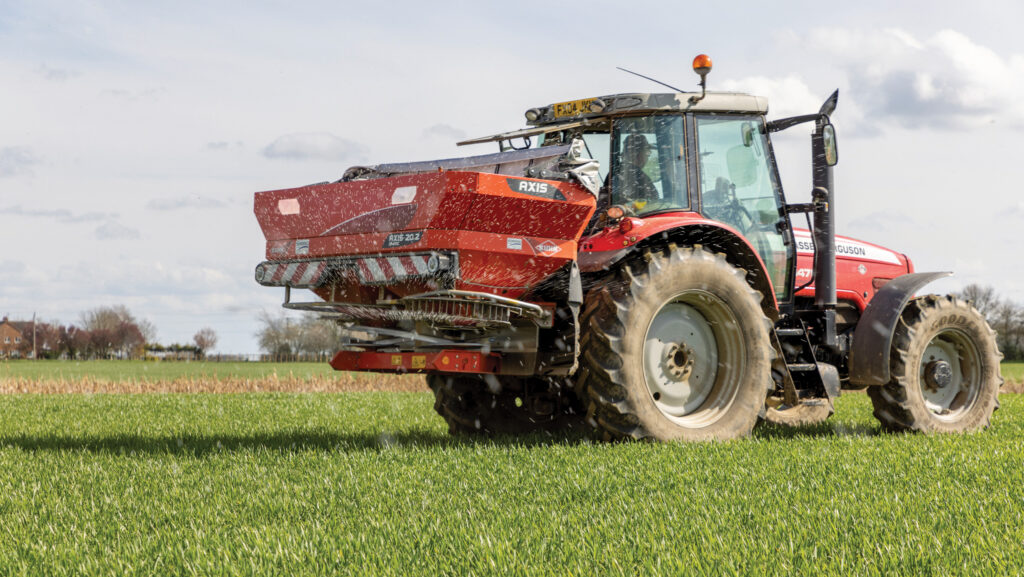
© GNP
North
Richard Bramley, Manor Farm, Yorkshire
A “little and often” approach guided by the use of Yara’s N Sensor and handheld N tester tools, forms the basis of Richard Bramley’s strategy for nitrogen management in wheat.
Growing milling wheat with good premiums available on a contract for Warburtons, which doesn’t allow the use of foliar urea at the grain milky ripe stage, he says a key requirement is judging how much nitrogen to apply to reach target grain protein specs, without overspending.
“Leaf testing with the N tester will be critical once the flag leaf emerges,” he notes.
Product of choice early on for cereals and oilseed rape is a solid urea plus sulphur compound. “It’s ideal for the earlier colder weather, activating as the crop wakes up.
“The key is not to start too late,” he adds. “I’ve been caught out too many times with dry weather early on, and you then spend the rest of the season never quite regaining what you’ve lost.”
A rolling programme of using farmyard manure on the sandy loam soil type that accounts for about two-thirds of the farm, usually in conjunction with cover and/or catch crops, helps minimise synthetic fertiliser requirements.
“We also use a foliar-applied controlled-release nitrogen product in May, and are considering having another look at R-leaf, which claims to capture and convert atmospheric nitrogen oxides into nitrogen fertiliser.”
Richard is also a believer in the use of various biostimulants, foliar feeds and trace elements after he trialled their use in potato crops in the dry year of 2018.
“The response was very promising on unirrigated crops,” he says.
“Gradually this approach, to a greater or lesser extent, has been rolled out in all crops. Molasses, humic and fulvic acids, amino acids and a wide range of trace elements have been used to keep the plant as ‘happy’ as possible, particularly in stressful situations.”

Staying sharp shouldn't be a chore