Triple-use maize variety on offer to support rising interest
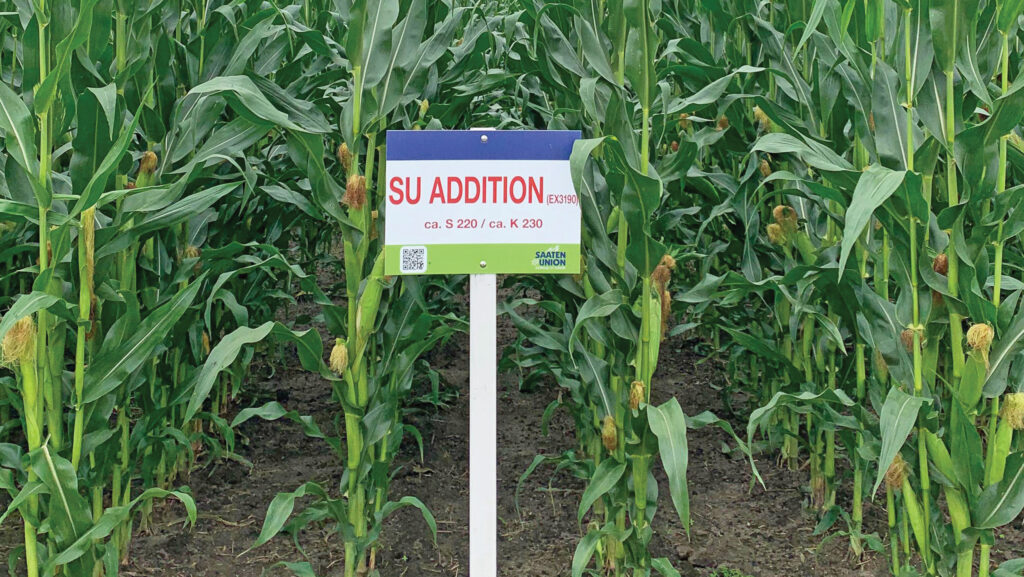 Addition maize variety © SU
 The demand for UK maize rise is rising, and so too is the demand for multi-use varieties which offer flexible market opportunities.
Maize continues to be the first-choice feedstock for anaerobic digestion (AD) plants and remains a popular energy feed for livestock rations, alongside growing interest in grain maize.
The total UK maize crop reached 240,000ha in 2025, supporting these three distinct markets.
See also: Why variety and drill date are key to yield and disease
Jon Myhill, technical lead at the Maize Growers Association (MGA) explains why he believes there has been an uplift in the area grown.
“The biogas and renewable energy sector has been the fastest-growing market over the past 15 years, with multiple anaerobic digestion plants coming online and absorbing increased production,” he says.
Meanwhile, grain maize – though still the smallest sector at about 7,000ha – is expanding rapidly.
“Production is mainly concentrated in the south-east and east of England, and the Midlands, where warmer conditions favour the longer growing season required for maturity,” says Jon.
New variety

Agronomist Millie Kilham © Millie Kilham
Millie Kilham, feedstock manager at AD firm Future Biogas, advises maize growers to prioritise reliability, drought resilience and multi-use cultivars, which a new maize variety is offering.
New triple-use variety Addition was first added to the British Society of Plant Breeder’s (BSPB) Descriptive List (DL) last year, and has revealed promising results in a 30ha trial carried out by the firm.
“Drilled on 26 April, the variety displayed impressive early vigor.
“Despite this year’s near-drought conditions, it stayed green late into the summer, achieving an average plant height 30cm taller than our other maize varieties,” says Millie.
Addition provided an impressive final fresh weight yield, being the highest yielding new variety out of 10 other cultivars, by just over 1t/ha.
“What impressed us was its resilience – including impressive drought tolerance. While we will be firmly focusing on its biogas yields for AD, it also offers silage and grain end market options,” she says.
“It is definitely a variety that maize growers should be looking at for next season.”
Beyond the two well-established markets for maize, there is a growing case for producing more UK-grown grain maize, rather than importing huge amounts each year.
Although, drying costs and later harvest dates can be a major drawback.
“The key for growers is careful variety choice, particularly for those growing larger areas of maize, to trial new varieties that tick those resilience, reliability and multiple end-use boxes,” says Millie.
Acting as an effective spring break crop, there is plenty of opportunity for growers to collaborate with nearby livestock units or AD plants to bring maize into the rotation.
Ian Granfield, farm director
Green Gem Agriculture, Cheshire
Ian Granfield, who runs Cheshire-based Green Gem Agriculture, grew just over 200ha of Addition last season.
He was impressed with its consistent yield and drought tolerance. “For such a dry year it was remarkable just how long it retained its green colour,” he says.
This year, the team drilled 202ha of the variety in the last week of April, split between 26 farm customers across Cheshire, Shropshire and North Wales.
“It yielded consistently well, achieving fresh weight yields of up to 63t/ha on the best sites with an average dry matter (DM) of 34%,” says Ian.
“By 12 August, it still looked green and was quite immature. However, three weeks later, it had hardened and some of the green colour disappeared. It clearly offers rapid development in its final growth stages.”
With a Food and Agriculture Organisation (FAO) rating of 190, Addition may not be the right variety for every site, says Ian.
But after beng impressed with its result, he’ll be stepping up the area for 2026 and says he is “genuinely excited to see how it fares”.
Ed King, farm manager
Blankney Estates, Lincolnshire
Ed King annually supplies 800ha of wholecrop maize for AD on contract to Future Biogas.
He selected Addition for Blankney Estates, near Navenby, Lincolnshire, last year for three key reasons:
- Improved yields
- An FAO maturity date of 190
- Its potential to reduce the risk of fusarium in a following winter wheat crop.
Ed was pleased with the variety’s performance and plans to increase his 2026 area by 50-100ha.
“We farm predominantly on heathland with shallow soils which brings its own unique agronomic challenges – particularly with the very dry conditions experienced in 2025,” he says.
The team look at a spread of varieties with FAO maturity dates ranging from 160-200.
“If soil temperatures are right, this enables us to start drilling from mid-April, spreading our harvest window during what can often become a protracted maize season,” says Ed.
Maize Growers Association trials and conference
The Maize Growers Association (MGA) is continually carrying out new research on practices such as drilling methods and agronomy to enhance maize production.
Jon Myhill, technical lead at the organisation, explains how recent trials have delved into foliar nitrogen, bird repellent use, and pesticide requirements.
“At the moment, with our foliar nitrogen research, we’re seeing some huge environmental and economical improvements in maize growing – with big reductions in the nitrogen required and consequently a reduction in leaching,” he says.
“Whatever your market, the economics stack up, and these new independent trial results that show we can cut artificial fertiliser use by 30kg/ha, while maintaining yields are game changing.
“The reduction in carbon footprint will help to future proof the crop.”
For the latest maize results, the MGA conference is being held on 4-5 February 2026 at Hinckley, Leicestershire.
Thoughts from industry trials
Stephen Goward, general manager of Saaten Union UK, says the anaerobic digestion sector is opening several new production plants over the next few years.
He sees new opportunities ahead for maize growers, supplying more forage maize in regions facing forage shortfalls.
Saaten Union has been trialling Addition, along with 22-25 other varieties each year, in replicated trials across our three main sites in Gloucestershire, Cheshire and Norfolk.
Addition yielded 104% of controls in 2022, 106% of controls in 2023 and 111% of controls last year, highlighting an upward trajectiory over the past three years.
Toby Reich, head of agriculture at UK seed supplier Elsoms Seeds, says the variety has consistently demonstrated excellent stem strength, with no lodging or green snap, and displays a reliable stay-green trait in near drought conditions over three years of trials.
Good seed availability
“On the new BSPB Forage Maize Descriptive List, it was the second highest yielding variety on the favourable sites list at 19.5t dry matter/ha – only 0.1t/ha behind the top yielder, and there’s good seed availability for 2026,” he says.
“With an FAO of 190, the variety sits in both the safe and optimum range for forage maize, balancing yield potential in line with the shorter UK growing season.”