Why Africa is first to benefit from potato seed technology
 © HZPC
 Kenya, at least to Western eyes, might seem an unlikely place to debut what could be industry-changing breeding technology that could eventually appear in European potato fields.
But with a climate that rivals Ireland for creating intense late blight pressure, and needing better quality potato seed, the East African country has become the ideal proving ground for growing potatoes from hybrid true potato seeds rather than via cloned tubers.
See also: The role of cover crops in nitrogen management for potatoes
As the climate changes, Kenya is looking to reduce its reliance on crops that require a lot of water, explains Charles Miller of Solynta, one of the companies developing and commercialising hybrid true potato seeds.
Potatoes can produce more calories than maize, the most consumed crop in the country, using 40% less water, so increasing potato production would potentially improve nutritional security, he says.
“At the same time, the younger population, which is the predominant demographic, are demanding more and more potato type alternatives, including french fries and crisps.
© HZPC
“But there isn’t enough local production to meet that growing demand and it’s quite expensive to import those potatoes or products.”
That led the Kenyan government to incentivise the creation of a local market, designing a regulatory environment that makes it easier for companies like Solynta to bring in innovative technology such as hybrid true potato seeds.
Lack of disease-free tubers
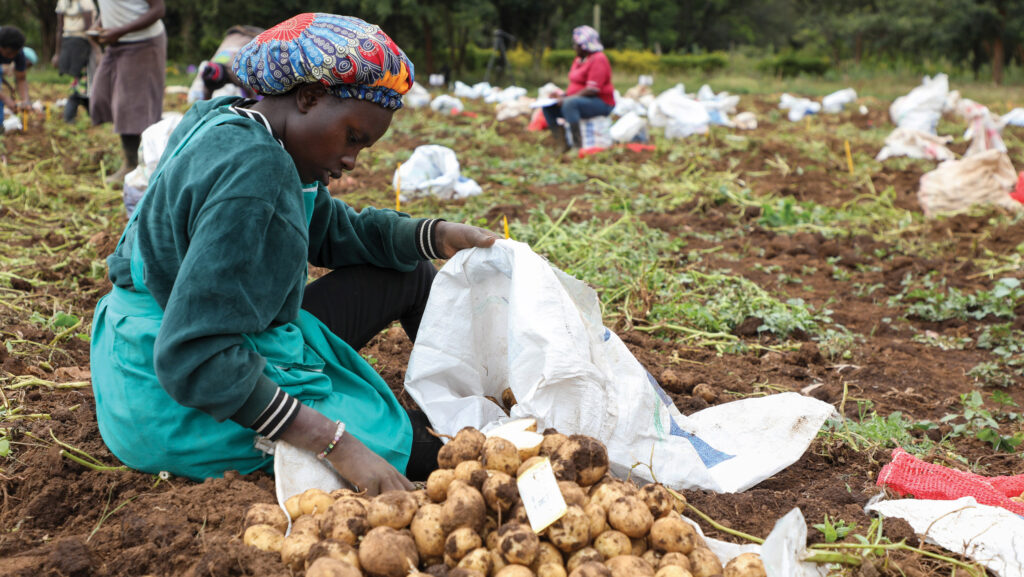
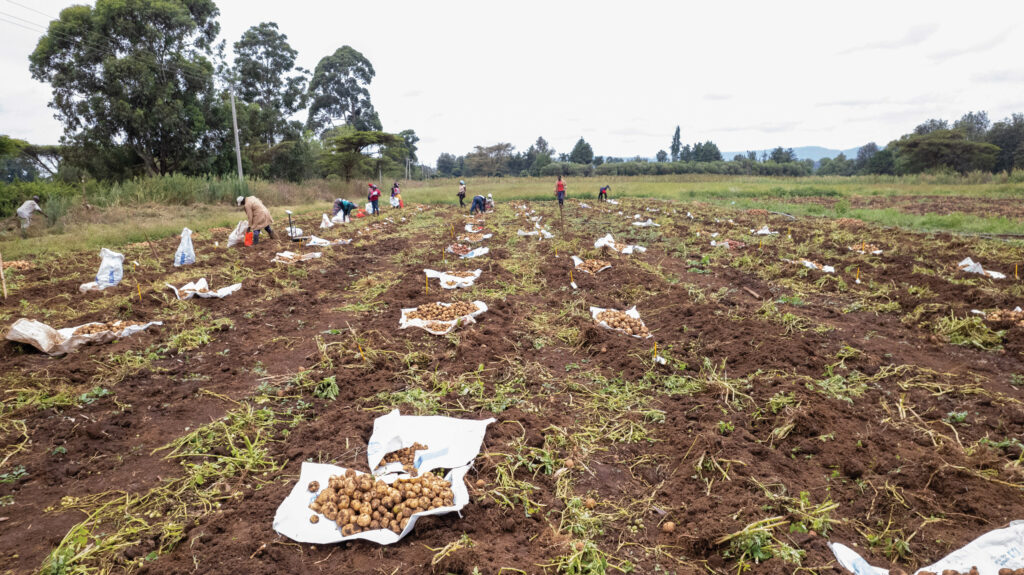
Technically, one of the main challenges is that only 10% of the country’s 800,000 small-scale potato growers have access to certified, disease-free seed tubers.
As a result, most growers reuse part of each harvest as seed for the following crop, resulting in higher disease and pest pressure and lower yields.
Solving the problem is not as simple as importing European varieties, as these are not well-suited for Kenyan production, as they lack both the necessary disease and pest resistances and the low dormancy favoured by Kenyan growers.
Gert Jan Feddes at HZPC, another firm developing true hybrid potato seed for the Kenyan market, explains: “Longer dormancy means growers would need to store the seed tubers and skip one growing season to replant them, and storage facilities are not commonly available.”
Hybrid breeding
Hybrid breeding is helping address the twin challenges of low dormancy and high disease resistance much faster than in conventionally bred potatoes, Charles says.
“With climate change and regulatory pressures on pesticide use, we have to move more quickly,” he points out.
It can take 10-15 years to produce a new variety using conventional techniques, with much of that time spent sorting through genetic variation caused by the potato genome having four sets of each gene and the resulting time required to fix traits through repeated selection.
In contrast, hybrid breeding can at least halve that time, partly through the introduction of diploid parent lines with only two copies of each gene helping to simplify the genetics. “It’s easier to identify traits of interest,” Charles says.
By mapping the diploid genome, breeders can use molecular breeding and bioinformatics to accurately predict the performance of new hybrids using a computer, he adds.
“That brings time and cost efficiencies, allowing us to move faster and more directly to new varieties and hybrids and reducing our environmental footprint in the greenhouse and in the field.”
Late blight resistance
This precision has enabled Solynta to identify up to eight genes for late blight resistance and produce resistant hybrids in as little as 18 months, he says, three of which are registered in Kenya.
Blight resistance is also a key initial target for HZPC. The Kenyan Highlands are “blight heaven”, according to HZPC agronomist Harmen den Braber, who manages the field trials in Kenya.
“Farmers have a crop in the field all year without much rotation, and the weather favours blight, so the pressure is really high.
“When we started trials with varieties without blight resistance the crop failed, even when spraying up to twice a week.”
In contrast, HZPC’s new multiple-gene, blight resistant hybrid variety was able to remain clean without any sprays, Harmen claims.
After discovering, in HZPC’s case, at least 12 new genes responsible for conferring late blight resistance, part of the strategy of both companies is to use different combinations of resistant genes in different hybrids.
“If we see a specific strain of blight is becoming more prominent, we can drive the introduction or removal of a certain variety from the market,” HZPC’s hybrid potato breeding program leader Ad Vrolijk says. “That’s something that’s impossible to do with traditional breeding because large amounts of money have been invested in producing the seed potatoes.”
Bringing hybrids to market
One key difference between Solynta and HZPC is how they intend, at least initially, to bring the new hybrids to market.
HZPC, no doubt aware of the impact on existing customers in the seed multiplication chain, is intending to still use that chain to multiply seeds into tubers before selling on tubers for planting to growers. It will launch its first variety in about a year’s time.
“It would be great if we could just sell the seeds for farmers to sow in the open field,” says Gert Jan. “But as per today, we don’t believe that’s possible because the seeds are quite small, very fragile and you need perfect conditions for the seed to become a plant.
“And those conditions in Kenya, most of the time are not present.”
For example, weed pressure is generally high, leading to competition challenges for the emerging potato seedling, while heavy rain can wash seeds away.
A possible solution is to germinate in a controlled environment and plant out the resulting plantlets. “But there are still some disadvantages, including it will take longer,” says Gert Jan. “Farmers want a crop in 90 days so they can sell potatoes, and then replant as fast as possible. It’s not going to be preferable to extend the growing season by a couple of weeks.
“You will also need good conditions in the field for the plantlets, for instance enough water, and irrigation is not always possible.”
© HZPC
For HZPC the most obvious way to introduce the new varieties is through the existing channels, with growers used to planting seed tubers.
“We will start small-scale and focus on a few multiplications from a true potato seed into a seed potato tuber, working with a few selected partners to bring it into the market.”
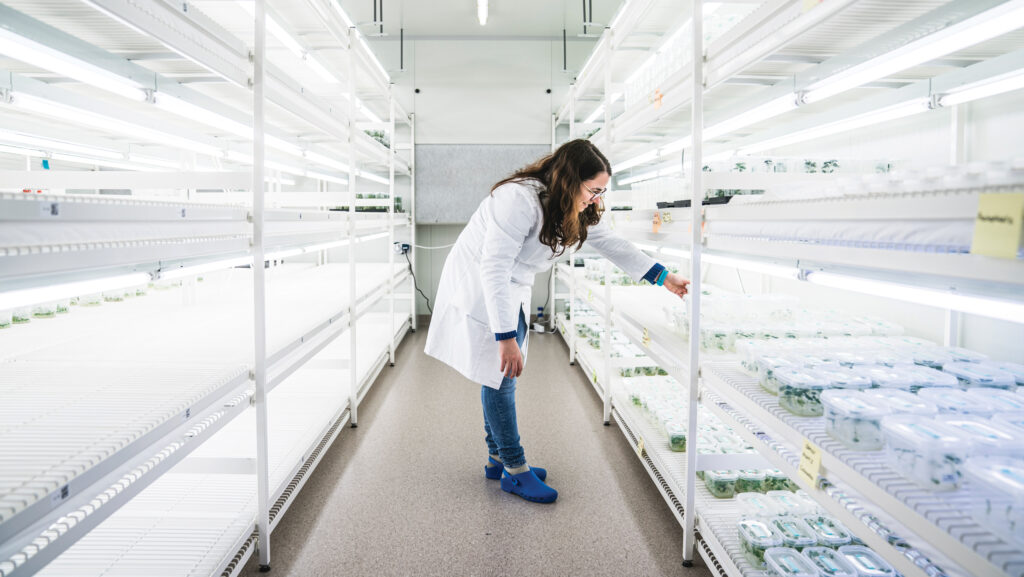
That will still allow for time and cost savings, with the initial labour-intensive, expensive plantlet and mini-tuber production cycle in a lab avoided by starting from a true potato seed.
“We think we will be able to have fewer multiplications than used today,” Gert Jan says.
The most immediate logistical benefit would be a dramatic reduction in transport volumes, with HZPC’s Ad Vrolijk noting that the industry as a whole hauls about 1m tonnes of bulky seed potatoes around the globe every year.
“We could reduce that by producing seed tubers closer to the customer,” he says.
“In Kenya it’s proven difficult to propagate tubers year on year without attracting a lot of disease into the seed tubers, but shortening the cycle to produce seed tubers from true seed will be a big benefit.”
That could be through the use of decentralised multiplication farms in the areas where the potato crop will be grown, Harmen suggests.
“We think it will be possible to sow the seeds and transport the seedlings across the country to partners that will do the multiplication, producing the seed tubers.”
Reducing the number of generations during the multiplication phase will reduce the risk of rejections because of disease, while ensuring the material that reaches the farmer is cleaner, he adds.
Bypassing tubers
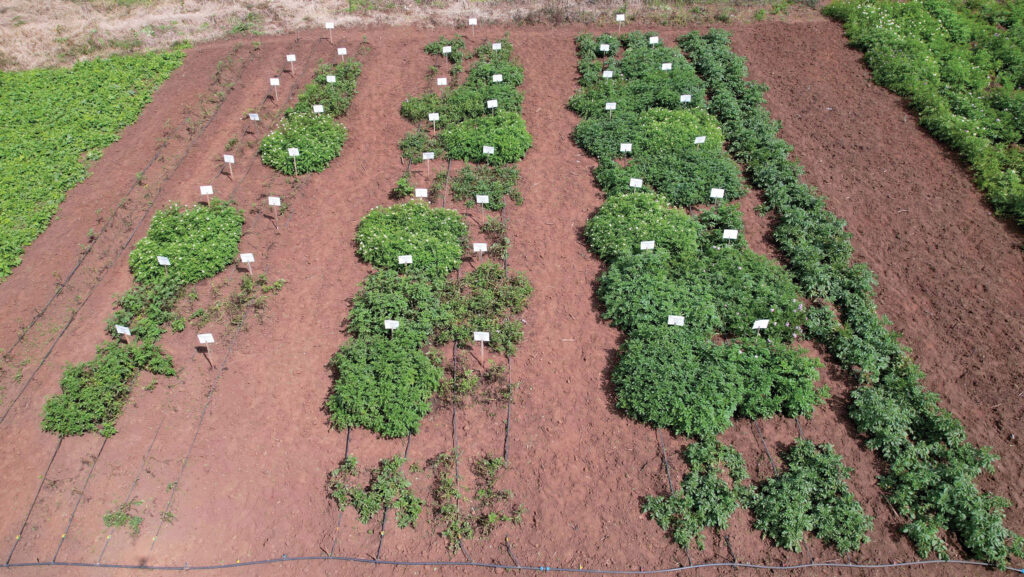
Solynta, as a start-up with no previous history as a potato breeder, is pushing a more disruptive model, which bypasses seed tubers entirely in favour of direct planting of true potato seeds.
The resulting environmental benefits include lower pesticide use, reduced soil compaction, and a lower carbon footprint from not growing up to five multiplication generations before the first ware crop.
“It will require a system change,” Charles stresses. “But we firmly believe in the long-term grower will purchase these tiny seeds, plant them and produce a crop they sell to a processor, end user or distributor.”
To make it easier for the farmer, the seeds are pelletised in a similar way to sugar beet, enabling machinery use for planting.
“If you are a grower who would like to use transplants, you can put them through a mechanised nursery planter into trays,” Charles says.
“If you are a farmer that wants to direct sow, you could put it through a vacuum planter. We’re trying to align the delivery system to currently available technology in the field.”
While that technology might be different to what’s used for potatoes, it is likely that other crops would be planted with a true seed, he notes. “Growers will know how this system works.”
© HZPC
Direct sowing seed would require some more changes. For a start, direct sowing would be on flat ground. “You then wait until the plants have four to six leaves before putting up a partial hill,” he says.
“That will also help with non-chemical weed control. After more growth you create the final ridge. It’s not dissimilar to re-ridging.”
There is potentially more risk to the grower from such a system, he acknowledges, although he stresses Kenyan growers are skilled in growing other crops from seed.
In addition, Solynta is building knowledge through training sessions and also providing an alternative system where growers use transplants rather than seeds.
“The seed industry in East Africa has facilitated the development of nurseries to grow young plants that can be sent across the country, which eliminates many of the risks to growers,” he says.
“A growing percentage of vegetable crops are being grown this way now.”
Even so, while interest in hybrid potatoes is high in Kenya, it’s still relatively small scale commercially, Charles admits.
“We see incremental growth opportunities, but we need to start slowly to change the system.”
Will hybrid true potato seeds reach the UK?
The commercialisation of hybrid true potato seeds in Kenya should help meet a desperate need for clean material to plant.
However, the threshold for introduction is far higher in the UK and Europe, where to be commercially viable a variety must possess the perfect combination of yield, end-market quality and storage stability.
Currently, hybrid potato yields in HZPC’s hybrid potato breeding programme for Europe are up to 20% lower, says Ad Vrolijk.
“I’m confident we could have all the resistance genes in place within a year, but it will take at least another 10 years before we are able to reach the current yield levels in the market.
“And we’ve seen in the past when developing resistant varieties, they are only successful if all the other quality traits are acceptable.”
Solynta is further ahead, at least in commercialisation, with its first variety expected to be registered in the Netherlands in 2026.
The picture for the UK is less clear, with Charles Miller suggesting there is not scope within existing UK regulations to certify or regulate potatoes grown from true seeds rather than tubers.
In the shorter term, the hybrid breeding programme can be used to improve the genetics in conventional potato varieties, Ad says.
“It’s a rather simple procedure to transfer diploid genetics into a tetraploid variety for use in a clonal crop,” he says.
“The downside is the time it takes to get sufficient volumes to bring to the market.
“But we think we can use that as a bridge between the full introduction of a hybrid in Europe and the phasing out of tetraploid varieties.”
What are hybrid true potato seeds?
© Solynta
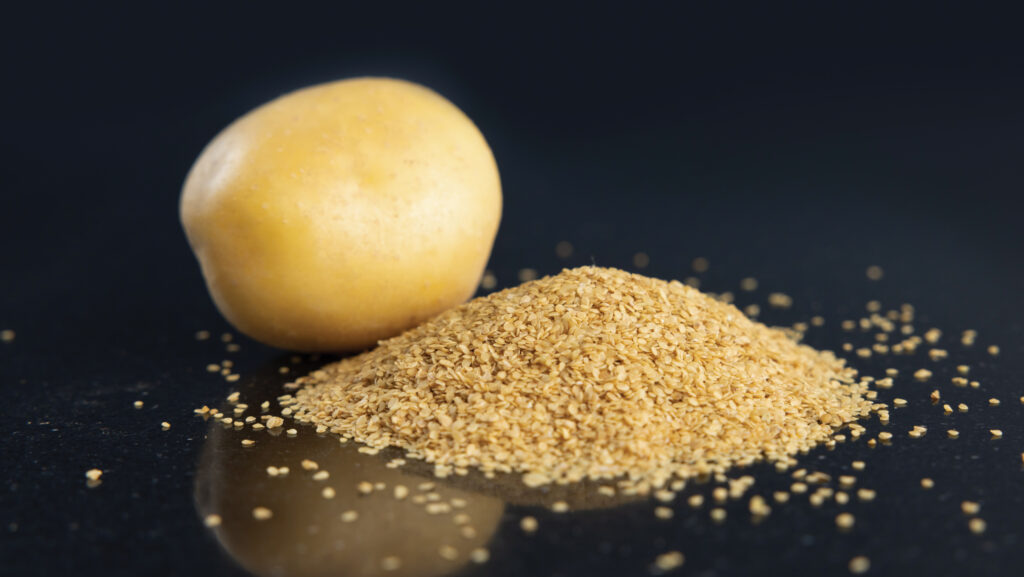
While growers usually plant tubers, true potato seeds are essential for breeding. In conventional breeding, two parent plants are crossed, the small aerial berry that forms is harvested, and thousands of botanical true potato seeds are collected.
Each seed grows into a genetically unique plant from which breeders select the best individuals, with the winners eventually cloned by planting their tubers, in a process that typically takes 10 to 15 years.
Two major scientific breakthroughs were needed to make hybrid true potato seeds, the first being a switch to diploid genetics. Traditional potatoes have four sets of genes, which makes traits unpredictable and slows breeding.
Scientists tackled that by finding wild relatives of the potato that naturally have only two sets of chromosomes. Through crossing and improving these diploid lines, the foundation of hybrid systems was built.
But it needed one other crucial breakthrough – the ability to self-pollinate, which isn’t possible in commercial potato varieties.
Without self-pollination, breeders couldn’t make uniform inbred lines which, when crossed, produce seeds that are genetically similar.
In the 1990s plant geneticists found that a single gene, now known as Sli, was responsible for breaking self-incompatibility, although they didn’t know which one. Scientists at Wageningen University and Solynta have taken that research further, identifying the exact gene sequence and making it easier to use within breeding.