

Advertiser content
Prime wheat for stress with one addition to your T0 tank mix
By the time stress is visible in a wheat crop, it can be too late to intervene.
Trials from a dry 2025 season show that the biostimulant Scyon offers a cost-effective way to prime wheat plants to cope with abiotic stress, helping maximise yields even when conditions turn challenging.
Scyon is applied at growth stage 30 at 1 l/ha. The product works by upregulating the plant’s natural stress defence mechanisms, essentially preparing the crop to withstand heat, drought, waterlogging, or other abiotic stresses before they occur.
A single application is required, making it a straightforward addition to standard crop management.
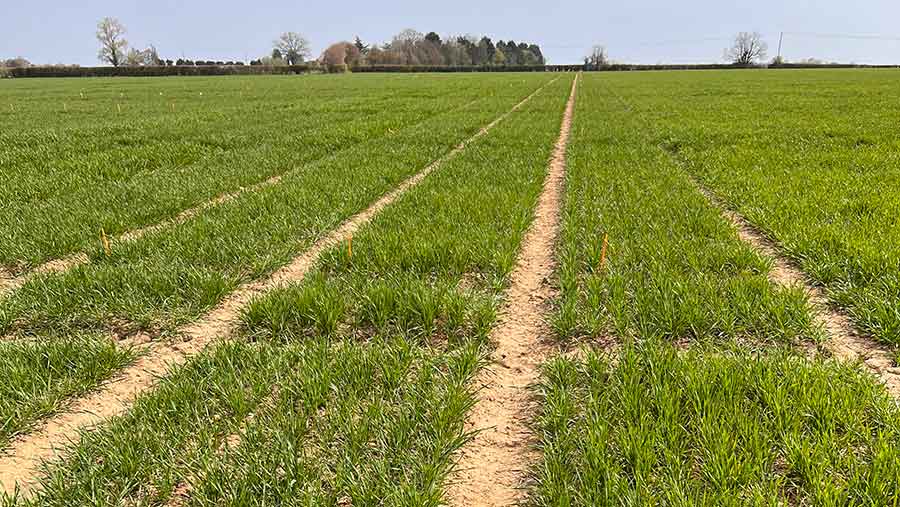
Independent small-plot replicated trials, conducted by Prime Crop Research across Norfolk and Lincolnshire, tested four wheat varieties on high-grade land during dry summer conditions.
Yields across the trial sites ranged from 10-13 t/ha.
© Unium Bioscience
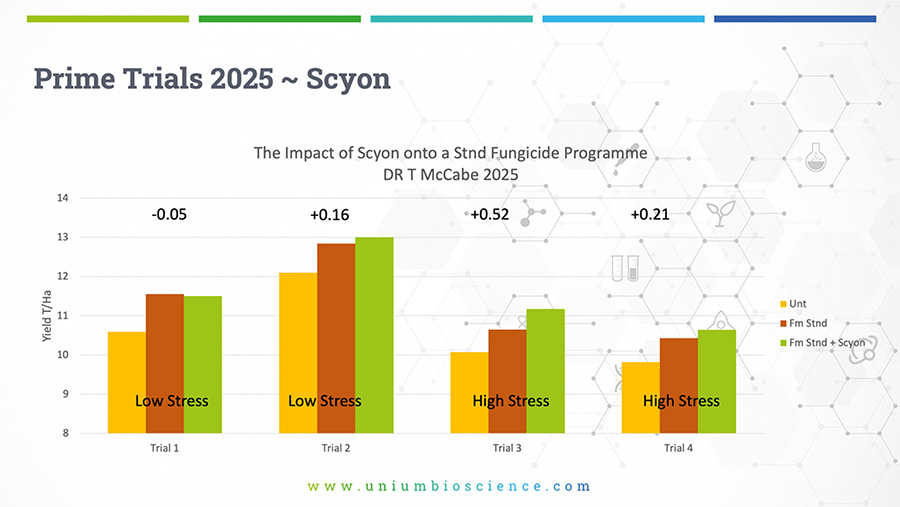
The trials were designed to group plots by stress level, and showed that as stress increased, the relative performance of Scyon-treated wheat improved compared with untreated or standard farm treatments.
Trials showed that under lower stress conditions, standard farm treatments plus Scyon delivered a clear uplift over untreated crops and overall, performed ahead of standard farm treatments, demonstrating a consistent benefit to plant health without compromising baseline performance.
Trial results
As stress levels increased, the advantage of Scyon became more pronounced. In high-stress plots, where drought and abiotic stress were greater, Scyon produced a stronger yield uplift above both untreated and standard farm treatments, indicating that the product’s stress-defence mechanism became more valuable as conditions became more challenging.
Yield uplift:
- Scyon vs untreated: +0.93 t/ha (+8.8%)
- Scyon vs treated: +0.21 t/ha (+1.8%)
Overall, results showed an average yield uplift of around 9% compared with untreated crops, alongside a 2% gain over standard farm programmes.
The strongest improvements were observed where crop stress levels were highest, suggesting early application may help prime crops to better withstand later-season stress.
The trials reinforced the importance of applying Scyon early at growth stage 30, before visible stress appears, allowing plants to activate natural defence mechanisms ahead of difficult weather or growing conditions later in the season.
“Scyon is a true biostimulant designed to biologically prime the plant, improving nutrient efficiency and creating stronger, healthier crops that are better prepared to withstand stress.
“By supporting nutrient uptake and plant metabolism, it helps optimise plant health, support fungicide programmes and maximise yield potential,” explains Andrew Cromie at Unium Bioscience.
These results demonstrate the value of early decision-making. Applying Scyon at GS30, before crops show signs of stress, allows the plant to ‘arm itself’ for the dry, wet or challenging conditions that often arrive later in the season.
As stress increases, so too does the benefit of the treatment, supporting stronger plant health and higher yields.
For farmers looking to protect wheat against unpredictable conditions, Scyon offers a simple, single-application solution to prime crops and secure performance, even under drought or heat stress.To learn more, visit the Unium Biosciences website.
|
Treatment |
Average yield |
|
Untreated |
10.64 t/ha |
|
Farm standard treated |
11.36 t/ha |
|
Farm standard + Scyon |
11.57 t/ha |
Provided by
Unium Bioscience is a science lead innovator in the biologicals, bio stimulants, specialty fertiliser and alternative crop protection industry, located in Howden, UK.